Showing posts with label Sparrowhawk. Show all posts

Tuesday, 8 January 2013

Happy New Year


It's been a long time since a blogpost, but I've been busy trying to contract diabetes over the past 6 weeks, so had nothing to post about.

Today was the first class of 2013. We started at a large local park. The first surprise arrived in the initial 5 minutes when I heard a Jay. On investigation it appeared that a pair had been present since November, and had even been since recently nest-building, but we don't see to for ourselves. One class member was quick enough to spot a scruffy urban fox, but the rest of us weren't so lucky. There were Long-tailed & Blue Tits near the car park. We then had a long walk punctuated only by Starlings & House Sparrows. For beginners the differences between Common & Black-headed were pointed, and later juvenile and adult Herring Gulls were added to the mix.

All pics (c) 2013 Chris Cox
Goosander (Drake)
 Goosander (female)
 Ditto
 Ditto
 Pochard (drake)
 Tufted Duck (female)
On the water Mallard including many 'mongrels' were differentiated, and in the afternoon we discovered 2 apparent Pintail hybrids. More straightforwardly the lake had Tufted Ducks, Pochard, Greylag & Canada Geese, an immature Cormorant and in the afternoon a very brief glimpse was obtained of a Great Crested Grebe. However, the true stars of the water were approximately 30 Goosanders spread throughout the park. Occasionally, these gave very good views, but the light wasn't brilliant for taking photographs. 
The Kingfisher, Heron and Little Grebe didn't survive the previous 3 winters, and don't appear to have returned, and there wasn't even any sign of last years parakeets.
On the return journey the morning highlight was provided by a pair of Goldcrests, whilst in the afternoon we couldn't relocate them, but we did find a pair of Siskins instead. Here's hoping for better light next time.
In the morning every participant wished everyone else a Happy New Year, but in the afternoon as far as I could tell no one bothered.  Is that another difference between mornings and afternoons?

Thursday, 18 October 2012

A Tale of Two Site-ies

Today started off very badly just as forecast with heavy driving rain. The participants arrived in good time, and remained ensconced in their cars as the rain lashed down. From the look on everyone's faces they didn't expect it to clear up before the class was about to start. However, just as the class was due to begin the rain suddenly stopped and we were able to go ahead as planned. The weather continued to improve and after only 30 mins a large patch of blue appeared. Several 'students' had to pay the extortionate parking fees before we shared cars to a reserve hidden behind a housing estate. 
On arrival we repaired to the large 'L-shaped' hide. The best bird was a Black-tailed Godwit, but after half an hour an Avocet flew in. It's the latest I ever remember seeing one in Yorkshire. In the afternoon a Curlew was also seen from this hide. Other birds included several Teal, which had emerged from their eclipse plumage, but after checking thoroughly we couldn't find a single Snipe, which is normally common on this reserve at this time of the year.

Oystercatchers
 Ditto
 Turnstone
 Avocet (c) 2012 Aileen Urquhart
 Black-tailed Godwit (c) 2012 Aileen Urquhart
A visit to the smaller hide resulted in a few Wigeon, and a pair of Gadwall, and a few Tree Sparrows at the feeding station. However, the finest performance was put on by a female Sparrowhawk being mobbed by several Crows and Magpies.

In the morning we went on to the cliff tops where we added Guillemots, Gannets, Shags and Cormorants, and several exhausted Redwings arrived from the sea running the gauntlet of a hunting Peregrine. In the afternoon we walked on the beach where we enjoyed close views of Oystercatchers, Turnstones and Redshank. There were no other waders, which was rather surprising and the lack of Red-throated Divers, Eiders and Grey Seals was another disappointment.
Carrion Crow (too much white bread)(c) 2012 Aileen Urquhart
 Sparrowhawk being mobbed (c) 2012 Aileen Urquhart

On Tuesday we were able to visit our planned location: Tophill Low, but we did so in the teeth of a ferocious wind. A hurricane hadn't been forecast for our visit, just as it hadn't 25 years before a previous non-existent hurricane, but the winds were certainly very strong. This can be seen in the water flying out of 'O' reservoir. Highlights included 2 female Sparrowhawks sparring over D reservoir for 5 minutes in the morning & 2 Chiffchaffs in the afternoon. The site exhibited strong apartheid tendencies with only Gadwall on North Lagoon, only Teal on South Marsh East, and only Tufted Ducks on 'O' Reservoir. However, there was plenty of racial integration at Watton Borrow Pits, which held several more species including Great Crested Grebe, Wigeon, Curlew, Cormorants and a few others.  One morning participant remained behind and was able to photograph a Willow Tit on the feeders 
 Great Crested Grebe 
 Great Crested Grebe
 Common Frog
 Drinking Water Blowing Away
 Record Shot of Grey Wagtail 
2 Female Sparrowhawks Sparring (c) 2012 Maggie Bruce
 Willow Tit (c) 2012 Maggie Bruce

Saturday, 6 October 2012

The Past Week

The past week wasn't the greatest for photo opportunities.  Tuesday should have featured a visit to the South Bank, but strong winds curtailed this trip, and North Cave Wetlands was lousy for taking pictures - none survive from that trip.  It was windy again at Tophill Low, so there weren't that many chances of taking photos of the best birds 300+ House Martins and 3 Chiffchaffs.  The wind was blowing straight into North Marsh, so there was very little chance that the Kingfisher would be on its perch, and we had a fruitless vigil.  As the morning session was about to end attention was drawn to a small feisty raptor attacking & being mobbed by Crows.  At first it seemed to be a young Hobby, but the wings weren't swept back enough and on one occasion its role was taken over by a male Sparrowhawk which was noticeably larger and broader-winged.  Then when the first bird passed behind some dark vegetation and flipped over, so we could see from its front that it was a female Merlin.  She then flew higher right through the large flock of House Martins a couple of times before she singled one out.  Needless to say the House Martin easily managed to evade her attentions.

On Thursday and Friday we travelled to Fairburn Ings.  The Lin Dike area was supposedly flooded, so we walked from the Visitor Centre to Bob Dickens Hide.  The Thurs pm & Friday am groups were the only 2 which were rewarded with the immature male Kingfisher, although a Thurs am 'student' remained behind if only to prove that Kingfishers aren't in the same category as leprechauns, fairies and pure moonshine - his life ambition achieved, I wonder what his next bogey bird will be?  The immature Green Woodpecker on Thursday am was a nice compensation.  

There were plenty of Redpolls and Siskins and a few Jays at Fairburn - all birds which are a little thin on the ground in East Yorkshire.  However, late September and early October, doesn't seem to be the best time to visit Fairburn, I wonder what is?
Immature Male Kingfisher - Fairburn
 Blackcap - in the garden
 Woodpigeon Squab - on the Fairburn Boardwalk
 Green Woodpecker - Fairburn (c) 2012 Phil Todd
 Lapwings (c) 2012 Phil Todd
Lesser Redpoll
 Record shot of Goldcrest - Tophill Low
 Comma - Tophill Low
 Common Darters - Fairburn
 Darter - Fairburn

Thursday, 13 September 2012

Slim Pickings

On Thursday we returned to a venue we hadn't visited for 2 years, as they were insulting to us last time & demanded a months' notice before our next visit. Since our last visit someone seems to have physically removed all the birds. It could be the time of year, but there were very few birds of interest.


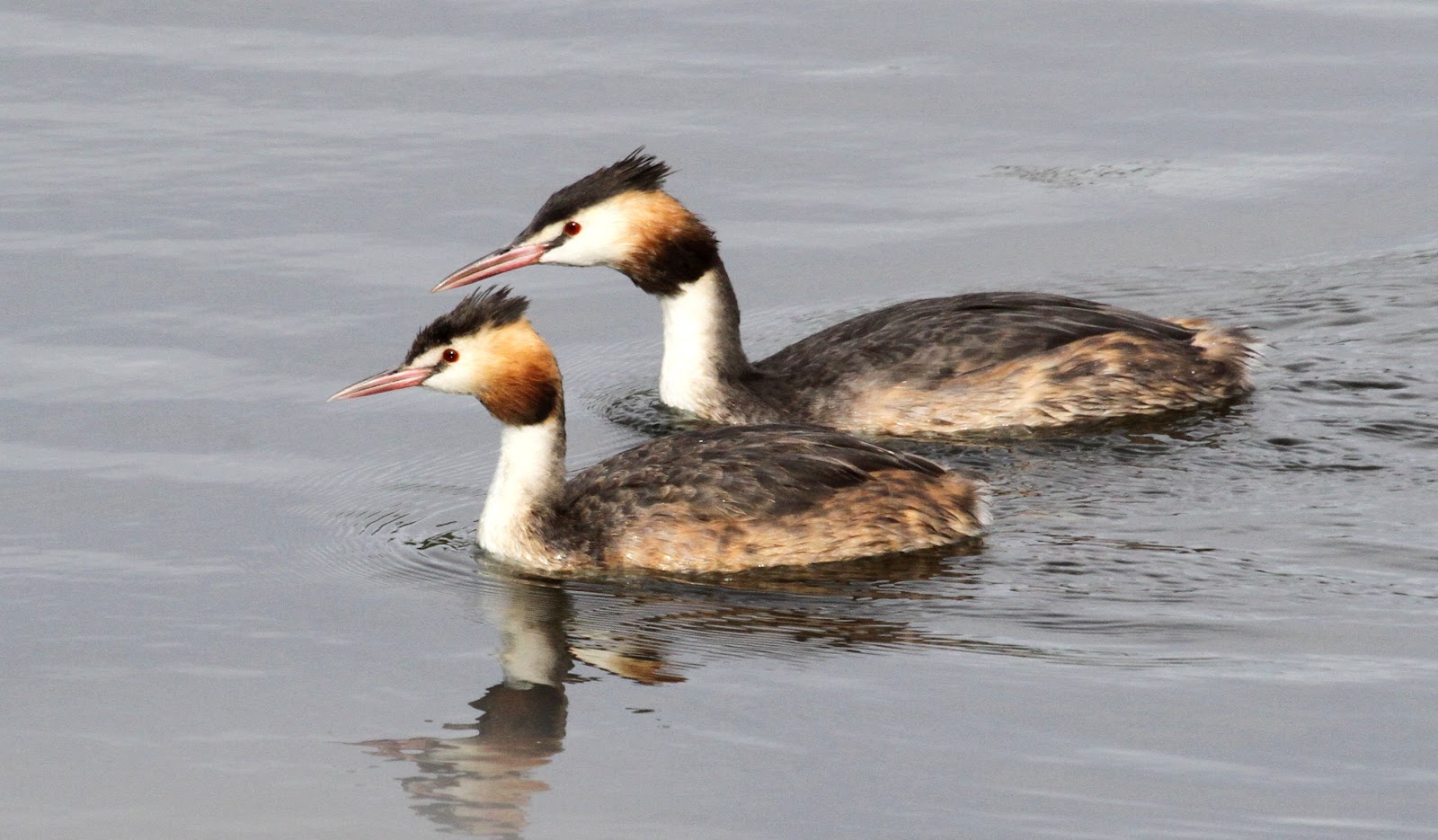
From the 1st hide we were told we had just missed a Bittern, but there were plenty of Coots and a very distant Little Grebe. A Gadwall flew in, but there wasn't much else to see until a pair of Great Crested Grebes made their stately way from the back of a reedbed and swam directly under the hide.


Great Crested Grebes (c) 2012 Richard Whateley

 Great Crested Grebe (c) 2012 Richard Whateley
 Great Crested Grebes
 House Sparrow (c) 2012 Richard Whateley


We left the hide and walked along the green tunnel, but this was also devoid of birds. We eventually heard some tits but even these remained out of sight. We bumped into a volunteer cutting back greenery, and he informed us that this path would be closed next week due to heavy machinery moving in to create a new scrape & install a new hide. As he was talking some migrating Pink-footed Geese could be heard, but they were hidden by the thick hedgerow. We climbed up the river bank and immediately located a pair of Redshank feeding on the mud. A closer inspection led us to find 4 Black-tailed Godwit probing the hinterland between river and mud. They are a lot larger an Redshank, but they had lost their breeding colours so blended into the background much better.

Black-tailed Godwit
 Black-tailed Godwit & Redshank (c) 2012 Richard Whateley
 Sparrowhawk (c) 2012 Richard Whateley
 We carried on to the next hide. Again it was very quiet from here, but Richard spotted a Sparrowhawk flying low over the water before it landed in a tree opposite to us. It stayed in the area for 20 minutes from where we were able to see its bright pinkish undersides. While we were observing the male Sparrowhawk another tiny raptor raptor swept over the area. On closer inspection it turned out to be a juvenile Hobby. Unfortunately, only a brief glimpse was permitted before it flew over the receded & then over the hedgerow which obscured it from our sight.


A walk round the perimeter of the site brought the contact calls of Willow Warblers to our ears, but the most constant sounds were the melancholy songs of several Robins. At the final hide there was very little to see beyond a Migrant Hawker, some concealed Moorhens and some fighting Coots. 

There were even fewer birds to see in the afternoon, but we did see one of our earliest juvenile Goldeneyes ever, and a soaring Buzzard over the Lincolnshire Wolds. I'll have to see if this venue improves during the next few weeks, as otherwise it may be worth dropping this venue completely from the itinerary. 
Common Blue Damselfly
 Record shot of Cormorant (c) 2012 Richard Whateley
 Record shot of Juvenile Goldeneye
 Ruddy Darter
 Migrant Hawker eating a fly


Friday, 7 September 2012

Great White Cape?

 Today we were at a coastal site, but migrants were kept down by strong westerly winds just the direction you don't want on the east coast at this time of year.


There were plenty of Fulmars about the cliffs, and one particularly sheer cliff was covered with Shags. There were a couple of female Grey Seals in a little cove, and some Herring Gulls, but little else. A walk along the hedgerow got us out of the wind, but apart from the call of a Robin and the sound of a Linnets in the thistle field there was very little sign of bird life. One exception was the chattering House Martins, but then Andy spotted a Swift heading south.

Roe Deer
Roe Deer Doe [left] & Fawn
Speckled Wood
Great, White Cape?

The walk along the cliff edge was very windy again. We were accompanied by House Martins with the odd Swallow virtually all the way. In the ploughed field I located a Wheatear, and Caroline later saw another. A couple of Lesser Black Backed Gulls flew past at one point, whilst further out to sea I heard a Sandwich Tern, which was heading south. A pair of Red-legged Partridge were hunkered down on the edge of a field, and from their indistinct plumage they appeared to be moulting.
As we travelled to the woodland a flock of Goldfinches were observed flying over the hedge - they seemed to be trying to evade a Magpie. At the copse we looked back and saw a Kestrel effortlessly hovering in the strong winds. In the trees we eventually saw a juvenile Willow Warbler, and there was a brief call of something unusual, but we couldn't see anything apart from a Great Tit.
As we skirted the trees we flushed a doe Roe Deer and her fawn, which took off across the fields, but they did pose long enough for everyone to get a good enough view. Back on the path I noticed a pair of ears sticking up from the shade of a small bale of hay. It was a Hare. It lowered its ears, but remained hidden in the shade and all participants were able to observe it from the path before it zoomed off along a field margin. Just after this we saw a family of 6 distant Red-legged Partridge, but we only got a rear view as they carried on walking away from us.
The remainder of the walk was pretty uneventful - just a few Starlings on the wires. Not the most exciting start for Linda's first session, but she did enjoy the sight of the deer and the long look at the Hare.
In the afternoon we went through some woodland down to the beach, but the heat had brought out some day trippers and dog walkers, so there weren't many waders to see. There were a few Oystercatchers, and Turnstones ; plenty of Cormorants were flying back and forth across the surface of the sea, and at least 3 Sandwich Terns fished as they headed south. One of them caught an enormous fish, which it carried off with ease. It was lucky to get away with it because also heading south a few minutes earlier was our first ever Great Skua (Bonxie). This was a bird that some on the course had never heard of, and those who had didn't expect to see one on our shores - they had been up to Orkney specially to see them!
Hare
After the beach we climbed the steps to the top of the cliffs. From this vantage point we could see Redshanks and a Ringed Plover in the rock pools and a Curlew also flew in. A pair of Kestrels flew over the golf course, and continued to make a lot of noise for the next 10 minutes. The hoped-for Wheatears failed to materialise, so we retraced our steps to the woodland. In here we heard a few alarm calls of bramble-eating Blackcaps, a Treecreeper, and the plaintive cries of an immature Sparrowhawk, but there were precious few other birds to be seen or heard. However, it was a very pleasant walk in a fern-covered, verdant pleasure garden. Hopefully, there will be more birds for the newcomer from Bingley, as it's a long way to travel for only a few birds!

Sunday, 15 July 2012

A 'Butterfly' Walk at Noddle Hill

Yesterday the Yorkshire Wildlife Trust organised a Butterfly Walk at the Noddle Hill Nature Reserve, and they even arranged for it not to rain!  Approximately 12 members of the public turned up  including a young media star, who recently found some Speckled Bush Crickets near the Humber Bridge.  Helen had plenty of ID sheets for anything other than butterflies we might see, and the children each took a net and some jars and magnifiers to observe any insects in detail.
Small Skipper
We set off down Red Admiral Alley, but my expectations weren't terribly high after the recent unsettled weather.   However, this alley is quite sheltered and quite soon we saw a few Ringlets, a high-flying Comma, a migrant Silver-Y-moth, and a smaller brown moth.  A pair of Blue-tailed Damselfies flew off before their picture could be taken.  There was no sign of the Speckled Wood butterflies, which had been in this area the other week.  However, we could be between their 3 or 4 broods.
Ringlet
 Silver-Y Moth

We emerged from the alley into a more open area, and pretty soon there was a fast moving skipper butterfly, and another dark brown moth, which may have been a carpet moth species.   There were plenty of wild flowers including Red and White clovers, Mellilot, and other members of the pea family.  An insignificant white-mauve flower was spotted by Helen and after investigation seemed to be the Smooth Tare.
Shaded Broad-Bar (thanks to Barry Warrington for ID)
 Caterpillar
  Caterpillar
 
Not long after this Maggie caught the first Meadow Brown of the day.  It seems hard to believe that this is the most numerous butterfly in the UK.  Only a little further one was a Soldier beetle, and we were going to see a lot more of them before the session ended.  We then came across a flooded area, which isn't really surprising considering the recent rain we've had.  It was along here that a Sedge Warbler could be heard singing from a bramble patch.  
Meadow Brown
 Smooth Tare
 Small Skipper
Soldier Beetle
Narrow-Bordered 5-Spot Burnet-Moth
 In an area with a lot of clover we saw a Narrow-Bordered 5-Spot Burnet-Moth flying around, which we were unable to catch in a net, but there were several more in the area.  The children wandered off the path to a fenced-off area where there may have been an old tip.  Near here we heard the strange scratchy sound of a Grey Partridge, which was great as numbers of this gamebird have plummeted in recent years.   Ten minutes later we flushed another in a different area, so hopefully there is at least 1 pair in the area.  Gail, Jacob's mum, moved a stone & disturbed a large moth.  This seemed to be injured and was very difficult to photograph as its wings were fluttering even more rapidly than the Silver-Y.  It didn't appear to be pumping up its wings after it emerges as a moth from the chrysalis for the first time, but there was a very active ants' nest near to where it was found, so they may have been attempting to devour it until it was disturbed.
Oak Eggar

 The children were hungry, so when we reached a bench they had a few sandwiches, and it was at this point that one young searcher and his parents headed back to the car.  As they ate their lunch a Grasshopper Warbler started to 'reel', and its strange insect-like song rose and fell for the next quarter-of-an-hour.  The second half of the walk wasn't as fruitful as the first, as it had clouded over, so there weren't as many insects on the wing.  A Yellowhammer could be heard singing faintly over Foredyke Drain, while Reed Buntings stuttered their simple ditties closer at hand.  

One of the highlights on the return journey was a noisy female Sparrowhawk which soared for a while before plunging into thick vegetation, and then finally setting off in a northerly direction.  We reached the ponds where we found a female Blue-tailed damselfly resting on a reed.  It stayed long enough for everyone to study it.  
Sparrowhawk 
 ditto
 Blue-tailed Damselfly
My initial fears proved groundless, because although there weren't exactly hundreds of butterflies, and there weren't as many bird species to see as there had been in May, there was still plenty to see and observe, and hopefully everyone went home impressed with Noddle Hill and the wildlife they had studied there.