Showing posts with label Buzzard. Show all posts

Monday, 17 September 2012

Wolds Walking Festival

This weekend was the Wolds Walking Festival, and I was involved in at least one event on Saturday, Sunday and Monday.  On Saturday 5 individuals turned up in beautiful warm and sunny weather: one couple from Helmsley, another from Beverley, and one local inhabitant of Thixendale.  We walked down the hill from Robert Fuller's Gallery, but were unable to find the Tawny Owls, which usually inhabit these sycamores.  In fact any sort of birdlife was noticeable by its absence.  I had to fill in by talking about our local Swallow behaviour, plus the latest news of what was happening on the birdfront at Spurn, Blacktoft and other East Yorkshire sites. Needless to say there was no sign of the local Little Owls either.  The only birds seen at this stage were Woodpigeons flying over.  However, flying closer to us was a Migrant Hawker Dragonfly, which did give good views as it hunted for insects along the hedgerow, and almost seemed as large as a Goldcrest!  We were a long way from any appreciable water, but these can be long distance fliers.  
Barnacle Goose
 Red Kite being mobbed
 At the bottom of the hill we took a right turn on to the Wolds Way.  A tilled field was covered with Red-legged Partridges - possibly as many as 10.  The Yellowhammers, and Meadow Pipits which had been so vociferous in the Spring and Summer had all gone quiet, and it wasn't until we went through the second gate that things picked up.    We were watching a hovering Kestrel as it hunted for voles in the long grass in the steep slopes of the dale.  It plunged into the verdure several times, but when it rose again, there was nothing in its talons.  As we observed this young bird, I could hear the high-pitched telltale sounds of a Treecreeper in the mature Ash trees behind us.  We swung round and everyone was able to spot the bird as it inched its way up the main trunk of the tree, before it spiralled round to the back of the trees, and it was lost to sight.  
Cream-Crown Marsh Harrier
 Migrant Hawker
 Bracket Fungus
 Stoat
 Stoat
We hadn't gone much further when there was a strange sound above us.  At first the only birds I could see were a couple of gulls flying north, but then I spotted a bird of prey.  A Buzzard seemed to be the most likely candidate in this habitat, but through the binoculars it was uniformly dark brown despite the tattiness of many of its feathers.  It was a Marsh Harrier.  Later, we heard that the gulls and the Harrier had been in a brief skirmish, which was the origin of the unusual sound.  We carried on to the sight of a baffling turf sculpture, which apparently looks much better and explicable from the top of the hills.  While the turf sculpture was being explained to us by the local inhabitant a bright orange Comma butterfly flew south.  Fairly soon after this a genuine Buzzard came into view - its mixture of dark wing edges and central white patches were in marked contrast to the earlier bird.  On the return journey we could hear Swallows twittering and House Martins "farting", but our best birds had definitely been on the  Wolds Way.  We passed BBC Look North's Simon Clark and  friend making the most of the nice weather by walking part of the Wolds Way.  The Cirrus clouds looked fine against the blue sky, but they didn't bode well for the weather on Sunday...

5 individuals again turned up for the Sunday Wolds Red Kite Roost event.  Unfortunately my sat nav led the attendees from Robert Fuller's Gallery on a circuitous, but picturesque route seemingly all over the wolds.  However, we did eventually arrive at the viewpoint.  At first it seemed very few birds were present apart from some very noisy female Mallards opposite our site.  However, a Heron flew through, which was a sign of better things to come.  Unfortunately, it was spitting with rain, so I didn't expect too many birds of prey.  It wasn't too long before our first Red Kite appeared to the right of the site, spotted by a Pocklington couple.  It flew over the woodland and disappeared to the left and below a very distinctive tree.  We then enjoyed sightings of several lone birds, sometimes they appeared distantly over the brow of the wooded hillside.  On other occasions they began to emerge in the far distance in the north, but always making for the same general area.  At least 2 birds showed interest in a green field, which may have hosted some carrion, but the roost site seemed to be the favoured area with all the other birds.  

Another Heron made its distinctive slowly flapping flight over the  woodland - seemingly with a wingspan only marginally greater than some of the Red Kites we had been watching.   Unfortunately, the lowering clouds began to look ever more threatening.  At one time 4 birds could be discerned in the northern distance through what looked like mist, but this was the first sign of a more significant shower of rain moving in.  We decided to call it a day, but we had seen over 10 Red Kites flying into the woodland.

On Monday we revisited Friday's location in worse light, so there were fewer photo opportunities.  North Cave Wetlands seems to be a fairly well-known site locally, so it was an unusual experience to introduce the venue for 5 people (100% of the attendees) who were trying it out as part of the Wolds Walking Festival.  The birds and dragonflies we saw today were very similar to those last week.    A mammal highlight were 2 Stoats - one running towards us, and another running away.  The Barnacle Goose showed really well, but seemed a very isolated individual, and was virtually the last bird we saw, so brought the session to a fitting end.  Please see Friday's photos here: Friday

Thursday, 13 September 2012

Slim Pickings

On Thursday we returned to a venue we hadn't visited for 2 years, as they were insulting to us last time & demanded a months' notice before our next visit. Since our last visit someone seems to have physically removed all the birds. It could be the time of year, but there were very few birds of interest.


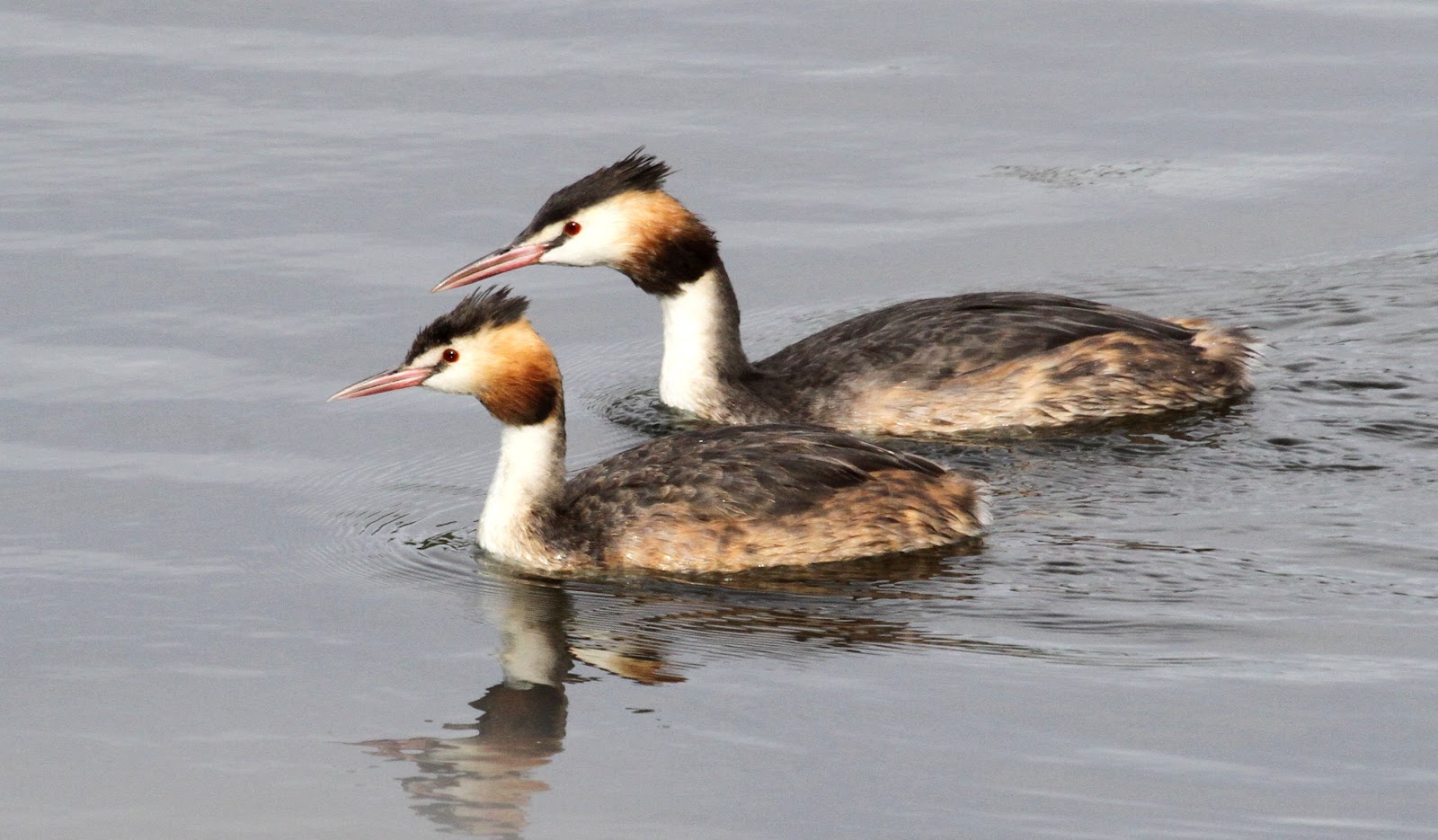
From the 1st hide we were told we had just missed a Bittern, but there were plenty of Coots and a very distant Little Grebe. A Gadwall flew in, but there wasn't much else to see until a pair of Great Crested Grebes made their stately way from the back of a reedbed and swam directly under the hide.


Great Crested Grebes (c) 2012 Richard Whateley

 Great Crested Grebe (c) 2012 Richard Whateley
 Great Crested Grebes
 House Sparrow (c) 2012 Richard Whateley


We left the hide and walked along the green tunnel, but this was also devoid of birds. We eventually heard some tits but even these remained out of sight. We bumped into a volunteer cutting back greenery, and he informed us that this path would be closed next week due to heavy machinery moving in to create a new scrape & install a new hide. As he was talking some migrating Pink-footed Geese could be heard, but they were hidden by the thick hedgerow. We climbed up the river bank and immediately located a pair of Redshank feeding on the mud. A closer inspection led us to find 4 Black-tailed Godwit probing the hinterland between river and mud. They are a lot larger an Redshank, but they had lost their breeding colours so blended into the background much better.

Black-tailed Godwit
 Black-tailed Godwit & Redshank (c) 2012 Richard Whateley
 Sparrowhawk (c) 2012 Richard Whateley
 We carried on to the next hide. Again it was very quiet from here, but Richard spotted a Sparrowhawk flying low over the water before it landed in a tree opposite to us. It stayed in the area for 20 minutes from where we were able to see its bright pinkish undersides. While we were observing the male Sparrowhawk another tiny raptor raptor swept over the area. On closer inspection it turned out to be a juvenile Hobby. Unfortunately, only a brief glimpse was permitted before it flew over the receded & then over the hedgerow which obscured it from our sight.


A walk round the perimeter of the site brought the contact calls of Willow Warblers to our ears, but the most constant sounds were the melancholy songs of several Robins. At the final hide there was very little to see beyond a Migrant Hawker, some concealed Moorhens and some fighting Coots. 

There were even fewer birds to see in the afternoon, but we did see one of our earliest juvenile Goldeneyes ever, and a soaring Buzzard over the Lincolnshire Wolds. I'll have to see if this venue improves during the next few weeks, as otherwise it may be worth dropping this venue completely from the itinerary. 
Common Blue Damselfly
 Record shot of Cormorant (c) 2012 Richard Whateley
 Record shot of Juvenile Goldeneye
 Ruddy Darter
 Migrant Hawker eating a fly


Wednesday, 5 September 2012

Juvenilia


The first Wednesday session of the Autumn term saw us venturing into Lincolnshire. We shared cars over the Humber Bridge at the recently discounted rate. The tide was still coming in when we were due to start, so I was hoping for some close views of waders, but the site has been silting up. 

 Yellow Wagtail
 Immature Swallow
 Immature Willow Warbler
 
 Black-tailed Godwits [mainly]
 Black-tailed Godwits [foreground]
 Little Egret
 Long-tailed Tit (c) 2012 Aileen Urquhart
 Long-tailed Tits
 Small Tortoiseshell
 Common Blue
Common Blue [female]
Record shot of Immature Water Rail
Ruddy Darter


From the car park I heard Whimbrel and Bullfinch, but couldn't actually see either of them there. Meadow Pipits were heard calling and a pair of Stock Doves flew over. Before we arrived at the 1st hide the class marvelled at a flock of Black-tailed Godwits as they circled the pool several times before coming in to land. There were a couple of Dunlin among the Black-headed Gulls. At the hide itself there were plenty of distant Teal, Shoveler, and a few Shelduck. An unusual call turned out to be a Spotted Redshanks, which landed for a few minutes before heading off with a bog-standard Redshank heading West. A Ringed Plover called several times before being lost to sight. The whole day was punctuated by the calls of Greenshank, but they weren't as easy to see as yesterday.
Along the high bank path we saw at least 10 Yellow Wagtails and a Reed Warbler. As we watched these about 50 Swallows were catching insects above our heads, and these had 2 House Martins in tow. A family of Long-tailed Tits were seen in some bushes along the path, and while we were observing these 3 very bright young Willow Wagtails were seen.
In the final hide Miles spotted something in the reeds, which seemed to be half a mile away. It turned out to be an immature Water Rail, and another passed through the reeds nearby.  The juvenile Water Rail was still there in the afternoon.
After lunch some very strange sounds seemed to emanate from a pair of Little Egrets - I've never heard them make a sound before.  the large flocks of Swallows had been replaced by 4 soaring Buzzards - one with very tatty wings.  

Sunday, 17 June 2012

Some You Win...

On Friday the am group got to partake in a more negative side of twitching.  We met at Hornsea Mere half an hour later than normal to avoid the wet start to the day.  This turned out to be a good move as both sessions avoided the downpours – the afternoon session by only a couple of minutes.
Unfortunately, in the aftermath of heavy overnight rain and strong winds, there was no sign of the Roller.  It had been replaced by noisy jets - not really an adequate substitute.  While we scanned the area there were no hirundines over the crop this time, and although I could hear Yellow wagtails from time to time, there was only one quick glimpse. The Skylarks put on a better show, and the Whitethroat still seemed very vocal in the car park.  On the return trip David noticed a Barn Owl perched on a road sign – one of the best sightings of the morning.  Back at the Mere there was no sign of the Red-Crested Pochards, and very few other birds of interest.  There seemed an absolute plague of Canada Geese, which appear to be taking over the site.  Even their goslings had already lost that air of cuteness, which they exude in their first few weeks of life.  

Linnet [male]
 Bristling with Missiles
 Treecreeper
At the woodland site the Treecreeper was the star performer with excellent views of 2 birds, but especially of one confiding individual.  Someone (Peter?) spotted a Buzzard soaring over the hall, and we also heard a noisy Great Spotted Woodpecker, which then flew off erratically.  A pair of Red-legged Partridge rocketed up, and flew away from us & hurdled a hedge into the distance.  We reached a gate, which represented the furthest extent of our walk.  On Wednesday we could just hear a Cuckoo at this point, but today we couldn’t hear anything interesting, and it all seemed rather disappointing, until Jeanette turned spotted a Fox carrying a dead Rabbit.  We spun round but at the same time the very bright Fox saw us, and he quickly bolted back the way he had come and disappeared into the woodland.
 Treecreeper
 Pair of Linnets
 ditto
 A less red dry perched Linnet
In the afternoon we couldn’t find anything of interest at the mere, so we checked out a reserve we’ve never visited before.  Even before we left the car park we came across a pair of bright Linnets and a Tree Sparrow having a bath in a puddle.  We negotiated our way along the rather confusing start and blind turns among the rather recently-planted native tree species.  A Swallow twittered away on an old farm building, but it wasn’t possible to snatch a picture, while a Blue Tit scolded us from a hedge.  In a marshy area on adjacent land, Jim spotted a Lapwing sat on a nest.  As we neared the sea the air was full of birdsong.  This was made up of Skylarks, Meadow Pipits, Linnets and Reed Buntings, while large numbers of Sand Martins flitted & twittered over the long wet grass, and hung round a WWII pill-box.  All but the Skylarks also sat prominently on either posts or the barbed wire.  The best sight of the afternoon was seen on the return journey came when Sue W identified a Yellow Wagtail on the barbed wire.   Thunder rumbled all around us with lightning flashes appearing to hit the Driffield area.  One Linnet was the reddest Linnet I’d ever seen, and I even had to double-check it wasn’t a Rosefinch – it wasn’t!  There was a whole family of young meadow Pipits – seemingly at least 6 juveniles – sharing their time between the wires and the mowed path, but they were flighty & it wasn’t possible to get pictures of any of them.  A Willow warbler gave even briefer views as it took refuge in one of the small trees, and a Chaffinch and a flock of Starlings were the final birds we encountered.  We didn’t hang around too long as eventually the ominous sky looked as though it was actually going to engulf us after all.  We were just changing out of our boots and back into our shoes when the heavens opened.
 Meadow Pipit
 ditto
 An apparently intact fossilised Tree (elm?) on the cliff edge & now open to the sea with several feet of boulder clay above it

Wednesday, 13 June 2012

Shock! Horror! We Went on a Dirty Twitch!

Today’s planned venue seemed to have quietened down recently, so we did something we have really never done before in 8 years of these classes – we went on a twitch!


The morning group met at Hornsea Mere, and while there we saw a Black Swan chasing a Mute Swan just off shore.  Keeping up the ‘plastic’ theme, through the telescope we could just make out a single drake Red-Crested Pochard with 2 females in the far distance.  There were quite a number of bog standard Pochards, and Tufted Ducks and seemingly hundreds of Coots.  Anthony spotted a single Common Tern on a buoy, which stayed long enough for everyone to get a decent view.
We shared cars to Aldbrough and parked at the designated car park – we seemed to be the only ones present.  A Whitethroat was singing as soon as we opened the car doors, and House Martins were ‘farting’ around the farm buildings.  We emerged from the farm drive and looking across the road there was no sign of the Roller on its accustomed post.  Then we spotted some chaps at the top of the hill on the bend, who waved us towards them.  We carefully negotiated the grassy verge punctuated with muddy & wet drainage slots.  On the brow of the hill about 5 birders were lined up on the Roller which was perched in a small bare tree in the trees which surrounded the farmhouse.  The bird had its back to us, so at that distance appeared mainly brown (although technically it has been described as cinnamon pink).  However, it was preening itself and when it turned its head the remarkable blue colour could be glimpsed.  There was a singing Skylark in the distance and then Brian spotted a Yellow Wagtail flying over the wheat.  Sure enough there was a pair and another single male.  Shortly afterwards Eileen saw a male Yellowhammers, while Swallows chased insects over the crop.  Later, they were joined by a couple of Sand Martins.  Once everyone had observed the Roller through the telescopes, as well as their own binoculars, and because the bird looked quite settled we shared cars to some woodland.  
The Roller photographed a few days ago when it favoured the bare field (c) 2012 Vince Cowell
 ditto
 Red-Crested Pochard (c) 2012 Tony Robinson [photographed elsewhere]


At the woodland those who didn’t have a coffee break were rewarded by saw a pair of Buzzards soaring over the woodland, and a Sparrowhawk moved far more purposefully just over the canopy.  In a ring of bushes we could hear a family of Long-tailed Tits, while a Reed Bunting perched briefly on the top.  Then there was a distinctive ‘chupping’ sound as 11 Crossbills flew north.  Only a few mintues later another was spotted at the top of a pine being bothered by a Pied Wagtail.  15 minutes later another pair were seen briefly feeding on the edge of a pine branch, but they soon flew towards the Mere.  There was no sign of any of these Crossbills in the afternoon, but we did hear a distant Cuckoo while we were standing in the same place.  The afternoon groups also had good views of a male Great Spotted Woodpecker feeding a much less colourful youngster.  A distant Chiffchaff could be heard, as could the ‘raunchy’ cooing of a Stock Dove.  Anthony glimpsed an Egyptian Goose back at the Mere at lunchtime, but it had hidden itself away before I’d had chance to set up the scope.
In the afternoon we went straight to Albrough.  This time about 5 birders were scutinizing the tilled field, so it looked as though the Roller was much closer to the road.  When we walked to the end of the drive we discovered we were mistaken and that the Roller hadn’t been seen for over an hour even by the 3 RSPB employees.  Rather than stare at an empty field I crossed the road & walked partly up the hill & checked out the trees around the farm.  The Roller wasn’t where it had been in the morning, but I could make out something blue in another tree.  This time the bird was facing the watchers, so its stunning colour was more obvious.  Everyone else came across, but despite my directions initially no one else was able to get on to the bird.  As well as setting up my telescope I was then asked to lock on to the bird through the RSPB’s scope.  Then everyone tried to see the bird through the telescope, and once they had done so, they also attempted to find it through their own binoculars, which proved rather tricky for some.  Before everyone had had their turn looking through the scope a twitcher who had travelled some distance, insisted he should have a look, as he’d left his telescope in the car & was petrified that the bird may have flown away before he had retrieved it, and he may actually miss out on seeing the bird.  My ‘student’ was too polite to tell him where to go, and he saw it through the scope before they did!  We  were watching the bird from the safety of the grass verge, but we were still photographed by a mad local person going past in a speeding car.  Once everyone was satisfied with the views they had obtained we shared cars back to the Mere.  The behaviour of the Roller seems to have altered.  It doesn’t seem to be spending anywhere near as long feeding in the tilled field.  I wonder if it’ll be leaving soon?
House Martin

 Sand Martin [left] & House Martin [right]
 Sand Martin
 ditto
 Swift
Unfortunately, the Red-Crested Pochard & Egyptian Goose were no longer in view, but there were several Great Crested Grebes present and a single Gadwall.  The clouds had darkened and looked more threatening than in the morning & there was a resultant huge increase in the number of hirundines over the water.  Numbers of House Martins & Sand Martins heavily outnumbered the swallows, and several unrelated Swifts flew just over our head, and one of them actually displayed its white chin.  
The visit to the woodland was less eventful in the afternoon, an apart from the woodpecker already mentioned the best find was probably a Treecreeper, which was fairly confiding.  We dipped our toes into the murky water of twitching, and everyone was happy to see the Roller, but I don’t think we’ll be making a habit of it!  There was a bitty quality to the day, which was quite alien to the happily-established norm of an in-depth 2-hour session.
PS I’m not really sure if today’s events really qualifies as a dirty twitch – whatever one of those is!

 Buzzard