Showing posts with label Goldeneye. Show all posts

Friday, 11 January 2013

180 Degree Neck Turn

Short-eared Owl
 Ditto
 Waxwing
 ditto
Record shot of Drinking Waxwings 
 Record Shot of Weasel
 Record Shot of Goldeneye
 Goldeneye


Wednesday, 9 January 2013

Ho-Hum

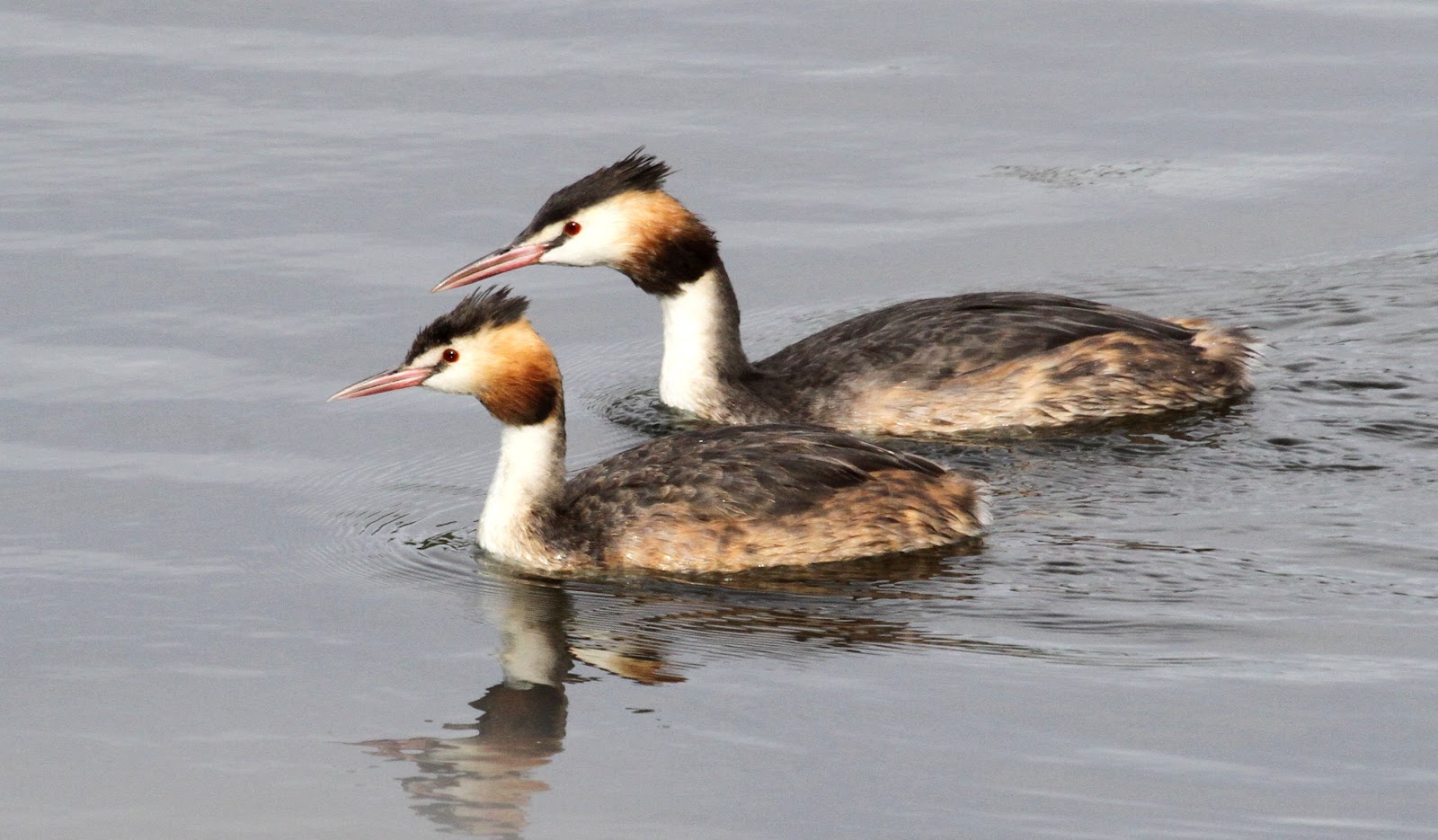
As we drove towards today's location many of the fields were under water. This would later come to haunt us. The morning started well with a Mistle Thrush and a Treecreeper singing outside the visitor centre. As we moved off we saw a pair of Siskins feeding on the alders, and a female Great Spotted Woodpecker in a nearby Poplar tree. Then came a long period of virtually no bird song and empty lakes and marshes. This dearth was remedied when we reached the hide overlooking the apparently almost empty reservoir. Here were several Great Crested Grebes and in the afternoon 5 drake Goldeneye displaying to 3 females. There were also plenty of Wigeon, and Tufted Duck, plus a few Pochard. 
Record Shot of Great Grey Shrike (c) 2013 Tony Robinson
 Lesser Redpoll (c) 2013 Aileen Urquhart
We walked through woodland and then scrub to another hide. This is normally the most productive hide at this time of year, but at first it seemed there were only plenty of Greylag Geese. A closer inspection revealed the odd Goldeneye, Gadwall, Teal, Pochard and wigeon, but the numbers were definitely down. The reason for this is the birds are normally concentrated on the lakes and reservoirs in the area, but now that they have so much flood water to chose from then they have become scattered throughout the surrounding water logged fields.
On the return journey we stopped off at South Lagoon and were rewarded with several views of a Kingfisher flying past the hide. A few minutes later we had close views of 4 rather drab Lesser Redpolls. In the end 5 birds flew off, but whether the 5th bird was also a redpoll remains a moot point. The visit to the larger reservoir revealed another depleted water resource, which sees very ironic when the surrounding fields were dripping with water. 
Lesser Redpoll (c) 2013 Tony Robinson

Meanwhile 3 morning students went off to look for roosting Kites.  It was while they were watching those they heard about a more interesting bird, and tracked down a Great Grey Shrike.  That is the only reason this bird appears at the head of the post.

Wednesday, 14 November 2012

And Now for the Good Smews

Today's reserve failed to live up to the quantity and variety of species compared with more than 2 years ago and further back in time.  However, there were Pochard, Shoveler, Teal, Gadwall, Tufted Ducks, a Great Crested Grebe and an obscene number of Coots from the first hide.  
Smew (drake) [2nd winter?]
The walk down the green tunnel yielded very few birds, although plenty of shy Redwings could be seen leaving the tree-tops as we made our way over the yellow leaves.   There was nothing at all to see at the new hide, but when we reached the embankment we could see some Wigeon as we looked West.   

 From the rickety hide we saw the same species as the first hide, but we did get a much better view of a female Goldeneye.  Meanwhile Aileen manage to photograph a Goldcrest directly outside the hide, which was in the company of some Long-tailed Tits
All remaining pics (c) 2012 Aileen Urquhart
Goldcrest
 Cutting across the meadow I heard and then we all glimpsed a Willow Tit.  There were calls of a Bullfinch and some of the afternoon session managed to get their binoculars on a stunning male, but he quickly flew off again.
Willow Tit
When made our way to the deeper pools and on here were at least 3 drake Goldeneyes, and some Tufted Ducks.  A flock of Goldeneye could just by made out through the hawthorn hedge as they flew past, and with them was a drake Smew.  Unfortunately, it spotted us, and flew away again.  However, luckily for us it alighted directly in front of the final hide.   
Mute Swan
Some of us were able to sneak up to the hide and carefully lift up the flaps to get a better look.  It was an extremely nervous bird and almost immediately swam towards the channel leading out of this pool.  It must have later flown away from the main water while no one was looking, as it later turned up on a lake a quarter of a mile away.  
Drake Smew [White Nun] (c) 2012 Tony Robinson
The Smew was replaced by a pair of Great Grested Grebes, which came and fished for both groups.  Both sessions also had very good views of a female Kingfisher from this hide, especially the afternoon gang, as it perched within about 6 feet from the hide.  It was an excellent way to bring the Wednesday Autumn sessions to a conclusion.

Friday, 9 November 2012

A World Without Love

This morning we tried the southern section of Tophill, mainly because a Bittern had been seen going in to roost yesterday evening, but we didn't have any luck. There were mainly Tufted Ducks with a few Goldeneye on 'O' reservoir, although a female Sparrowhawk flying just over the surface enlivened things. Watton Borrow Pits was the best for variety of species with: Curlew, Wigeon, Teal, Cormorant, Gadwall, and Jackdaw. Then 40 Curlew had just settled themselves on the green peninsula when the female Sparrowhawk appeared again & they all took off. They later landed among the safety of the Cormorants on the muddy strip.
All photos (c) 2012 Richard Whateley
Cormorant
 Curlew
 Shoveler
 Wigeon
 Gadwall (& Tufted Duck left)
 Teal
Things perked up again from D Reservoir where there were plenty of Shoveler and Wigeon, and suddenly Richard spotted 15 Swans & although they went out of sight without us gaining decent views, when we checked his photos they did appear to be Whoopers. They flew along the river Hull, so were soon lost to sight.
In the lunch hour I got out my spade and flattened a muddy area in the hope that either tonight or tomorrow night an Otter will leave some nice clear tracks to show for Sunday's Otter Walk!!

 Record shot of Whooper Swans
 Goldcrest
Coal Tit


It was the poorest turnout on Thurs pm we have ever had before with only 3 participants arriving. What a difference from the morning group, which is currently the largest of any of the groups, and ensure all the hardest are full. Nearly everyone had already sent their apologies ahead of the session, but the 60's pop duo who had their best hit with 'A World Without Love' hadn't let me know they wouldn't be coming, so let's hope they will still be performing together in the future. In the afternoon we took the risk of heading north through D woods. This was a risky strategy because apart from a flock of more than 20 Siskins we didn't see much of interest. We then surveyed D Reservoir & saw mainly the same birds as the am, but we did manage a count of 10 female Goldeneyes.

Tuesday, 6 November 2012

Kingfisher Comes to the Rescue

There were a lot more ducks around at this venue than there were 3 weeks ago.  A female Goldeneye was the highlight with very smart Shovelers, plus Gadwall, and a couple of Pochard and a single drake Teal and 2 females.

At the brand new hide there was a single Redshank, but the site has been beautifully landscaped, so has great potential for the future.

On the river there were a few more Redshank, and in the afternoon through John's scope we saw five Black-tailed Godwits, a couple of Dunlin, some Wigeon & more Redshank.

There were Long-tailed Tits, Goldcrests, Bullfinches and Redwings among the Hawthorn bushes, and a couple of drake Goldeneyes near the hotel.  However, the highlight for both the morning and the afternoon was a male Kingfisher near the hotel hide.  However, Maggie went back at lunch time & managed to photograph a very close female Kingfisher.  A pair of Great Crested Grebe were also pretty confiding from the Hotel Hide.

All photos (c) 2012 Maggie Bruce
Female Kingfisher
 Ditto
 Ditto
 Ditto

Thursday, 13 September 2012

Slim Pickings

On Thursday we returned to a venue we hadn't visited for 2 years, as they were insulting to us last time & demanded a months' notice before our next visit. Since our last visit someone seems to have physically removed all the birds. It could be the time of year, but there were very few birds of interest.


From the 1st hide we were told we had just missed a Bittern, but there were plenty of Coots and a very distant Little Grebe. A Gadwall flew in, but there wasn't much else to see until a pair of Great Crested Grebes made their stately way from the back of a reedbed and swam directly under the hide.


Great Crested Grebes (c) 2012 Richard Whateley

 Great Crested Grebe (c) 2012 Richard Whateley
 Great Crested Grebes
 House Sparrow (c) 2012 Richard Whateley


We left the hide and walked along the green tunnel, but this was also devoid of birds. We eventually heard some tits but even these remained out of sight. We bumped into a volunteer cutting back greenery, and he informed us that this path would be closed next week due to heavy machinery moving in to create a new scrape & install a new hide. As he was talking some migrating Pink-footed Geese could be heard, but they were hidden by the thick hedgerow. We climbed up the river bank and immediately located a pair of Redshank feeding on the mud. A closer inspection led us to find 4 Black-tailed Godwit probing the hinterland between river and mud. They are a lot larger an Redshank, but they had lost their breeding colours so blended into the background much better.

Black-tailed Godwit
 Black-tailed Godwit & Redshank (c) 2012 Richard Whateley
 Sparrowhawk (c) 2012 Richard Whateley
 We carried on to the next hide. Again it was very quiet from here, but Richard spotted a Sparrowhawk flying low over the water before it landed in a tree opposite to us. It stayed in the area for 20 minutes from where we were able to see its bright pinkish undersides. While we were observing the male Sparrowhawk another tiny raptor raptor swept over the area. On closer inspection it turned out to be a juvenile Hobby. Unfortunately, only a brief glimpse was permitted before it flew over the receded & then over the hedgerow which obscured it from our sight.


A walk round the perimeter of the site brought the contact calls of Willow Warblers to our ears, but the most constant sounds were the melancholy songs of several Robins. At the final hide there was very little to see beyond a Migrant Hawker, some concealed Moorhens and some fighting Coots. 

There were even fewer birds to see in the afternoon, but we did see one of our earliest juvenile Goldeneyes ever, and a soaring Buzzard over the Lincolnshire Wolds. I'll have to see if this venue improves during the next few weeks, as otherwise it may be worth dropping this venue completely from the itinerary. 
Common Blue Damselfly
 Record shot of Cormorant (c) 2012 Richard Whateley
 Record shot of Juvenile Goldeneye
 Ruddy Darter
 Migrant Hawker eating a fly