Showing posts with label Little Grebe. Show all posts

Tuesday, 8 January 2013

Happy New Year


It's been a long time since a blogpost, but I've been busy trying to contract diabetes over the past 6 weeks, so had nothing to post about.

Today was the first class of 2013. We started at a large local park. The first surprise arrived in the initial 5 minutes when I heard a Jay. On investigation it appeared that a pair had been present since November, and had even been since recently nest-building, but we don't see to for ourselves. One class member was quick enough to spot a scruffy urban fox, but the rest of us weren't so lucky. There were Long-tailed & Blue Tits near the car park. We then had a long walk punctuated only by Starlings & House Sparrows. For beginners the differences between Common & Black-headed were pointed, and later juvenile and adult Herring Gulls were added to the mix.

All pics (c) 2013 Chris Cox
Goosander (Drake)
 Goosander (female)
 Ditto
 Ditto
 Pochard (drake)
 Tufted Duck (female)
On the water Mallard including many 'mongrels' were differentiated, and in the afternoon we discovered 2 apparent Pintail hybrids. More straightforwardly the lake had Tufted Ducks, Pochard, Greylag & Canada Geese, an immature Cormorant and in the afternoon a very brief glimpse was obtained of a Great Crested Grebe. However, the true stars of the water were approximately 30 Goosanders spread throughout the park. Occasionally, these gave very good views, but the light wasn't brilliant for taking photographs. 
The Kingfisher, Heron and Little Grebe didn't survive the previous 3 winters, and don't appear to have returned, and there wasn't even any sign of last years parakeets.
On the return journey the morning highlight was provided by a pair of Goldcrests, whilst in the afternoon we couldn't relocate them, but we did find a pair of Siskins instead. Here's hoping for better light next time.
In the morning every participant wished everyone else a Happy New Year, but in the afternoon as far as I could tell no one bothered.  Is that another difference between mornings and afternoons?

Wednesday, 19 September 2012

Kingfisher saves the Afternoon

Wednesday was a rerun of last Tuesday with the long slog to Castleford. We were leaving our cars at the Lin Dike car park when a Jay flew over - little did we know that would be one of the best sightings of the whole morning! There were no sign of the Little Grebes from the hide this time, so we had to put up with some nearby Lapwings instead. We could also see Teal, Cormorant, Herons, Mute Swans, Great Crested Grebe, Shoveler and Gadwall. We carried on to another pool we didn't visit last week. There were better views of all the same birds here, with the addition of Little Grebes. A cream crown Marsh Harrier flew fairly close to the hide and we saw at least 3 Buzzards all in the sky at the same time.
Record shot of Kingfisher
 ditto
 Lapwing
 Marsh Harrier
We headed back to the visitor centre and passed a parked car on the road with the distinctive figure of a bird forum member standing next to it. He was staring into the sunshine through his scope and was about to fix on to an eclipse Garganey. It seemed a rather dangerous place to leave 3 more vehicles, so we carried on to the visitor centre. When we get there we had a look at the kingfisher screen with no result, and had a scan from Pick-up hide, but there was little of excitement to see there either.
 Siskin
As last week the Lin Dike area was much less productive in the afternoon, and it was so poor this morning I thought I'd better not go there again after lunch. The afternoon group had a look from Pick-up Hide where there wasn't a great deal to see, but Les did very well to locate a distant Snipe, but his young Moorhen wasn't anything to write home about. A possible Little Owl wasn't definitely confirmed. We went to the Kingfisher screen, and sure enough after only a few minutes we saw a very active immature male Kingfisher. Eventually, it flew very close to the hide, perching only a few feet away from us. Some people had only seen them whizzing past, so this was their best ever sighting, and I think it's the best example I've seen this year.
 Record shot of Willow Warbler
 Shoveler in Eclipse
 Comma
 Unusual Bee Species


We carried on the long hike to Bob Dickens hide. This was almost completely bereft of birds, though we did encounter a Long-tailed Tit flock which were accompanied by a single bright yellow juvenile Willow Warbler. When we got to the hide there was an enormous flotilla of Coots, plus many of the same water birds we'd seen in the morning. There was an eclipse Shoveler, which displayed some extraordinary colours because of a large number of missing feathers. Eileen and Sally both shouted out at the same time when they spotted another Kingfisher flying low over the water on the far side of the lake.

Friday, 14 September 2012

Getting Windy

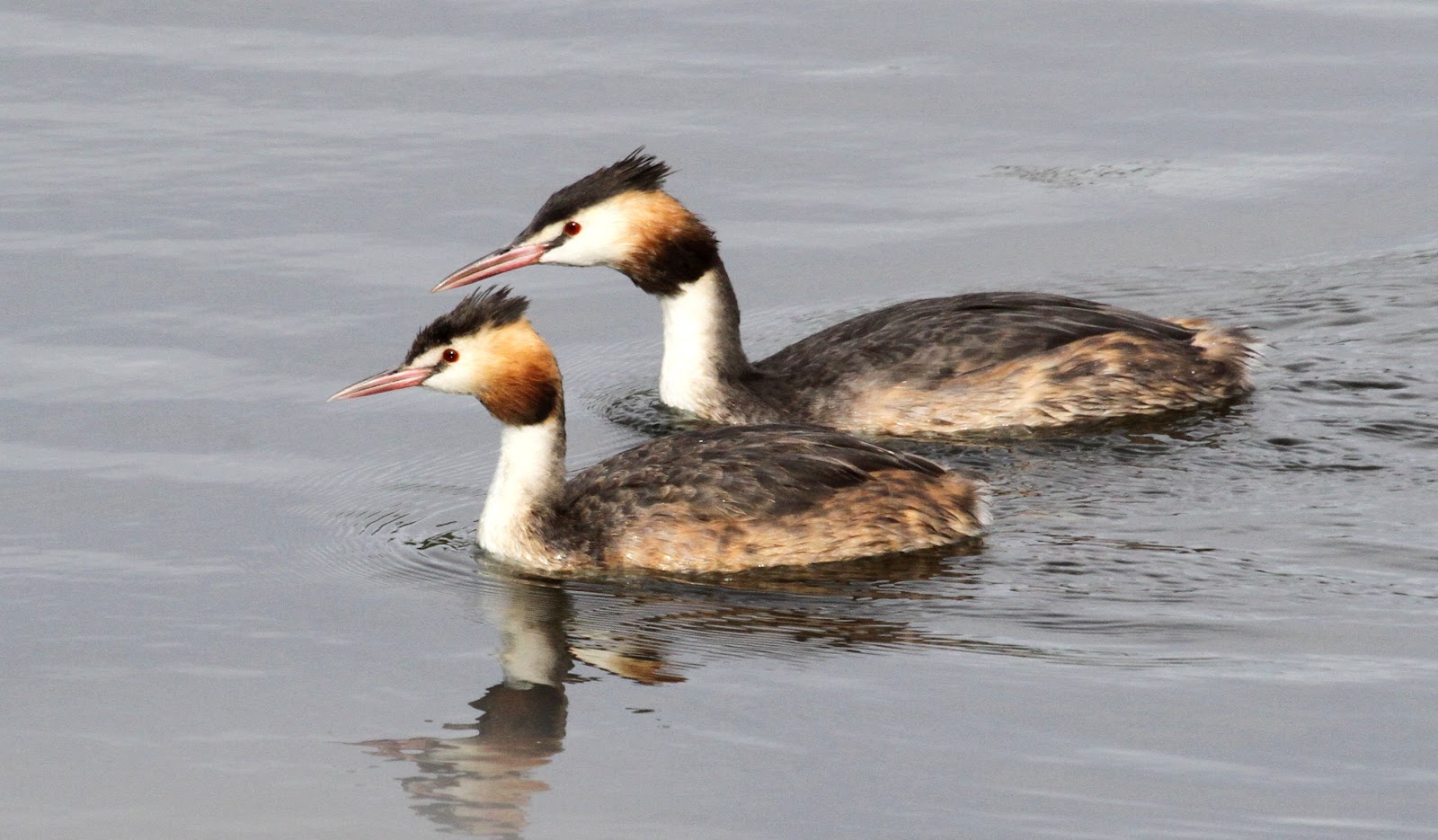
 The strong winds forecast for Friday put a kibosh on the planned location, so we went to the trusty standby instead. On the walk down the lane we kept our heads down into the wind, but Caroline spotted a Yellow Wagtail. The first hide added a pair of Great Crested Grebe, and a couple of antagonistic Little Grebe. The Great Crested Grebe gave a flypast, which is not something we encounter very often.  Other birds included: some Pochard, Tufted duck and a single Common Sandpiper. A flock of 5 Wigeon flew in, and other dropped in or flew past as single individuals.
Great Crested Grebe
 ditto
 ditto
 Little Grebe
 Little Grebe Chick
On the circuit round the edge of the reserve Elizabeth found a Migrant Hawker resting on some vegetation out of the strong winds. We went on to locate several more - all identical apart from one greener individual - a female? There were also a selection of Common and Ruddy Darters and 2 Damselflies. There were very few birds in the hedgerow, but plenty of Coots, Mute Swans and a small family of Little Grebes.
 Migrant Hawker
 Migrant Hawker
 Migrant Hawkers
 Migrant Hawker [female]
  Migrant Hawker [female]
 Brown Hawker
 Darter
 Darter
The next pool had plenty of Gadwall and several of the usual suspects. The long hedgerow was almost devoid of birds but we did find a Goldfinch flock, plus one other bird seen briefly. There has been a Redstart in the area which is a possibility, but in size a Willow Warbler would seem to be a better fit.  3 rather out of place birds were seen on a 'T' bar.
 3 Brown Jobs on a 'T' bar
 Weird, they are Snipe!

Common Blue


The final hide seemed less interesting at first, although by this time the light was a lot better. 3 Geese flew past and one of them turned out to be a Barnacle Goose. It landed near some Greylags where it commenced to have a good preen. Everyone got onto it eventually - the first we have seen for quite some time, although I'm sure it's wild credentials are suspect, to say the least.  We couldn't find the Barnacle in the afternoon. However, there were lots of dragonflies in the sheltered section. The Migrant Hawkers were quite impressive, and then a Brown Hawker appeared - a massive dragonfly & very unusual during our classes.  Luckily, it eventually posed long enough for everyone to get decent views.  

Thursday, 13 September 2012

Slim Pickings

On Thursday we returned to a venue we hadn't visited for 2 years, as they were insulting to us last time & demanded a months' notice before our next visit. Since our last visit someone seems to have physically removed all the birds. It could be the time of year, but there were very few birds of interest.


From the 1st hide we were told we had just missed a Bittern, but there were plenty of Coots and a very distant Little Grebe. A Gadwall flew in, but there wasn't much else to see until a pair of Great Crested Grebes made their stately way from the back of a reedbed and swam directly under the hide.


Great Crested Grebes (c) 2012 Richard Whateley

 Great Crested Grebe (c) 2012 Richard Whateley
 Great Crested Grebes
 House Sparrow (c) 2012 Richard Whateley


We left the hide and walked along the green tunnel, but this was also devoid of birds. We eventually heard some tits but even these remained out of sight. We bumped into a volunteer cutting back greenery, and he informed us that this path would be closed next week due to heavy machinery moving in to create a new scrape & install a new hide. As he was talking some migrating Pink-footed Geese could be heard, but they were hidden by the thick hedgerow. We climbed up the river bank and immediately located a pair of Redshank feeding on the mud. A closer inspection led us to find 4 Black-tailed Godwit probing the hinterland between river and mud. They are a lot larger an Redshank, but they had lost their breeding colours so blended into the background much better.

Black-tailed Godwit
 Black-tailed Godwit & Redshank (c) 2012 Richard Whateley
 Sparrowhawk (c) 2012 Richard Whateley
 We carried on to the next hide. Again it was very quiet from here, but Richard spotted a Sparrowhawk flying low over the water before it landed in a tree opposite to us. It stayed in the area for 20 minutes from where we were able to see its bright pinkish undersides. While we were observing the male Sparrowhawk another tiny raptor raptor swept over the area. On closer inspection it turned out to be a juvenile Hobby. Unfortunately, only a brief glimpse was permitted before it flew over the receded & then over the hedgerow which obscured it from our sight.


A walk round the perimeter of the site brought the contact calls of Willow Warblers to our ears, but the most constant sounds were the melancholy songs of several Robins. At the final hide there was very little to see beyond a Migrant Hawker, some concealed Moorhens and some fighting Coots. 

There were even fewer birds to see in the afternoon, but we did see one of our earliest juvenile Goldeneyes ever, and a soaring Buzzard over the Lincolnshire Wolds. I'll have to see if this venue improves during the next few weeks, as otherwise it may be worth dropping this venue completely from the itinerary. 
Common Blue Damselfly
 Record shot of Cormorant (c) 2012 Richard Whateley
 Record shot of Juvenile Goldeneye
 Ruddy Darter
 Migrant Hawker eating a fly


Tuesday, 11 September 2012

A Beached Grebe

Today we ventured into North Yorkshire to a site we've only visited as a one off special in the dim & distant past. There was the call of a Bullfinch near the car park, but it remained hidden. Everyone arrived on time & we shared cars to the ultimate destination about a mile or so further up the road. After lunch the 3 at the front had a brief glimpse of a Kingfisher, as it took off on sight of us and headed away along the stream. This was quite well screened from the strong winds, so we could hear juv Willow Warblers & the alarm calls of Blackcaps, Robins & Wrens, and a Great Spotted Woodpecker called as it flew behind the hedge. Even the frog-like croak of a Gadwall carried against the wind to where we were standing. In the afternoon there was a massive flock of Long-tailed Tits with a few Willow Warblers, Blue Tits and Great Tits also part of the gang.

Little Grebes
 Willow Tit
 Commas
 Comma
 Looking through the gaps in the hedge we could see Mute Swans, Greylag Geese, with plenty of Lapwings accompanied by a few Starlings. Ducks included: Mallard, Teal, Shoveler and Gadwall. There were large numbers of House Martins flying high after insects with just a few Swallows in tow. 

From the hide we had great views of a family of four Little Grebes, plus Herons, Cormorants, Lapwings & a single Redshank. John or Steve spotted a flock of Canada Geese coming in to land across the road onto some far pools. Then John spotted a very distant Great Crested Grebe, which remained long enough for everyone to find it. The only bird of prey was a distant hovering Kestrel. 

Migrant Hawker
 Migrant Hawkers
 Ditto
 Red Admiral
 Ruddy Darter
 Common Darter? [female]
 Common Darter [male]
We carried along the path until the railway bridge, at which point we saw at least 3 Willow Tits, plus a few skulking Blackcaps and Whitethroats. On the way back a female Bullfinch was spotted, but she disappeared into the hedge pushed on by the strong winds. On the pool behind the path I spotted a tiny distant bird struggling against the wind - this was a Kingfisher. Luckily, it first landed on a stout, short post then flew high into a Hawthorn bush where it sat long enough for everyone to see it. This was a new location for Len & he was especially pleased as it was his first Kingfisher for 20 years.
Speckled Wood
 Green-Veined White
 Meadow Brown
 Chickory
 Amphibious Bistort
 A return to the Visitor Centre saw plenty of Tree Sparrows on the feeders, plus Greenfinches & Goldfinches, but the visit to a screen was less productive with nothing new to add apart from a pair of scruffy moulting old Pheasants. A Marsh Harrier drifted west of the car park at lunch time, but not everyone managed to get on to it before it disappeared. The day went quite well, and would have been even better without the awful wind!

In the afternoon we had a look at the Kingfisher Screen, but there wasn't a single bird of any description. However, it was a bit better for butterflies and dragonflies. We found a pair of Migrant Hawkers resting on a bare twig, and back at the dog muck walk we saw a pair of Commas. These didn't interact at all, so it was impossible to say if they were 2 males, 2 females, or one of each!