Showing posts with label Lapwing. Show all posts

Wednesday, 19 September 2012

Kingfisher saves the Afternoon

Wednesday was a rerun of last Tuesday with the long slog to Castleford. We were leaving our cars at the Lin Dike car park when a Jay flew over - little did we know that would be one of the best sightings of the whole morning! There were no sign of the Little Grebes from the hide this time, so we had to put up with some nearby Lapwings instead. We could also see Teal, Cormorant, Herons, Mute Swans, Great Crested Grebe, Shoveler and Gadwall. We carried on to another pool we didn't visit last week. There were better views of all the same birds here, with the addition of Little Grebes. A cream crown Marsh Harrier flew fairly close to the hide and we saw at least 3 Buzzards all in the sky at the same time.
Record shot of Kingfisher
 ditto
 Lapwing
 Marsh Harrier
We headed back to the visitor centre and passed a parked car on the road with the distinctive figure of a bird forum member standing next to it. He was staring into the sunshine through his scope and was about to fix on to an eclipse Garganey. It seemed a rather dangerous place to leave 3 more vehicles, so we carried on to the visitor centre. When we get there we had a look at the kingfisher screen with no result, and had a scan from Pick-up hide, but there was little of excitement to see there either.
 Siskin
As last week the Lin Dike area was much less productive in the afternoon, and it was so poor this morning I thought I'd better not go there again after lunch. The afternoon group had a look from Pick-up Hide where there wasn't a great deal to see, but Les did very well to locate a distant Snipe, but his young Moorhen wasn't anything to write home about. A possible Little Owl wasn't definitely confirmed. We went to the Kingfisher screen, and sure enough after only a few minutes we saw a very active immature male Kingfisher. Eventually, it flew very close to the hide, perching only a few feet away from us. Some people had only seen them whizzing past, so this was their best ever sighting, and I think it's the best example I've seen this year.
 Record shot of Willow Warbler
 Shoveler in Eclipse
 Comma
 Unusual Bee Species


We carried on the long hike to Bob Dickens hide. This was almost completely bereft of birds, though we did encounter a Long-tailed Tit flock which were accompanied by a single bright yellow juvenile Willow Warbler. When we got to the hide there was an enormous flotilla of Coots, plus many of the same water birds we'd seen in the morning. There was an eclipse Shoveler, which displayed some extraordinary colours because of a large number of missing feathers. Eileen and Sally both shouted out at the same time when they spotted another Kingfisher flying low over the water on the far side of the lake.

Friday, 14 September 2012

Getting Windy

 The strong winds forecast for Friday put a kibosh on the planned location, so we went to the trusty standby instead. On the walk down the lane we kept our heads down into the wind, but Caroline spotted a Yellow Wagtail. The first hide added a pair of Great Crested Grebe, and a couple of antagonistic Little Grebe. The Great Crested Grebe gave a flypast, which is not something we encounter very often.  Other birds included: some Pochard, Tufted duck and a single Common Sandpiper. A flock of 5 Wigeon flew in, and other dropped in or flew past as single individuals.
Great Crested Grebe
 ditto
 ditto
 Little Grebe
 Little Grebe Chick
On the circuit round the edge of the reserve Elizabeth found a Migrant Hawker resting on some vegetation out of the strong winds. We went on to locate several more - all identical apart from one greener individual - a female? There were also a selection of Common and Ruddy Darters and 2 Damselflies. There were very few birds in the hedgerow, but plenty of Coots, Mute Swans and a small family of Little Grebes.
 Migrant Hawker
 Migrant Hawker
 Migrant Hawkers
 Migrant Hawker [female]
  Migrant Hawker [female]
 Brown Hawker
 Darter
 Darter
The next pool had plenty of Gadwall and several of the usual suspects. The long hedgerow was almost devoid of birds but we did find a Goldfinch flock, plus one other bird seen briefly. There has been a Redstart in the area which is a possibility, but in size a Willow Warbler would seem to be a better fit.  3 rather out of place birds were seen on a 'T' bar.
 3 Brown Jobs on a 'T' bar
 Weird, they are Snipe!

Common Blue


The final hide seemed less interesting at first, although by this time the light was a lot better. 3 Geese flew past and one of them turned out to be a Barnacle Goose. It landed near some Greylags where it commenced to have a good preen. Everyone got onto it eventually - the first we have seen for quite some time, although I'm sure it's wild credentials are suspect, to say the least.  We couldn't find the Barnacle in the afternoon. However, there were lots of dragonflies in the sheltered section. The Migrant Hawkers were quite impressive, and then a Brown Hawker appeared - a massive dragonfly & very unusual during our classes.  Luckily, it eventually posed long enough for everyone to get decent views.  

Thursday, 13 September 2012

Visit to the Dentist Required

Wednesday saw us return to last Tuesday's venue. However this week it was low tide, so the birds weren't as close to the hides as last week. We sheltered from the heavy rain in the Visitor Centre where we saw several Ruff and 5 Dunlin towards the left, and Teal, Shoveler and a single Wigeon on the right. Tony saw what he thought was a Marsh Harrier flying east, which the young Scottish RSPB officer was too polite to correct. On investigation it proved to be a Bittern, which was much more exciting for everyone. We had already seen a bona fide Marsh Harrier too, so we had the best of both sightings. A Long-tailed Tit flock passed by and some of the group saw a small, sharp-billed bird in tow, which was probably a Willow Warbler.

Konik Pony
 Long-tailed Tit
 When the rain stopped we set off to last week's premier hide. There was plenty to see here again, but nearly everything was much further away. The nearest bird was a juvenile Redshank & a couple of Snipe flew in. Spotted Redshank and Ruff were already in situ, but a couple of Greenshank flew right into the back of the site and shortly before we left 3 Black-tailed Godwit arrived - one of which still had plenty of breeding colour.  One surprise was an adult Avocet with 3 youngsters in tow, which were seen from 2 hides before setting off west.  Perhaps they were breeders from further north on their way south - but records this late in September are rather unusual at this reserve.  In the afternoon a distant Great Crested Grebe was sighted from the most easterly hide.
Juvenile Redshank
 Snipe
 Black-tailed Godwits (far left & far right)
The far hide was less profitable with mainly the odd duck species, a distant Marsh Harrier and a family of Little Grebes. We retraced our steps, but the hide near the visitor centre was very poor. The photocopying hide was a little better, but didn't add any new species. The main entertainment was provided by the fierce marshland ponies. 
 Spotted Redshanks & Lapwing
 Marsh Harrier
We then tried the one hide on a different alignment to the others. Here were 15 or so roosting Spotted Redshanks, which were later joined by a very white-headed male Ruff and a couple of others, plus plenty of Lapwings. A total of 6 then 9 and later 15 & eventually as people got their eyes in 18 Snipe were asleep at first, but then set about stitching for food. In the heavy rain the afternoon group saw 6 Ringed Plovers, a fairly unusual bird at this site - they had obviously dropped in to refuel in the bad weather.

Sunday, 24 June 2012

FLAMING June!

The weather forecast for Thurs morning was appalling, so that session was cancelled.  However, the afternoon seemed as though it would be brighter, and as a Thurs pm session had already been cancelled earlier in the term the afternoon went ahead at a location with hides - North Cave Wetlands.  Friday also looked very unsettled, so those sessions were also transferred to the same location.
Wasp-Beetle


We normally walk round this reserve in a clockwise direction to make the most of having the light behind us, so we were able to risk this on the Thurs pm, but with the even more unsettled weather on Friday we decided to go anti-clockwise and move between the hides.  The lowering clouds had forced the Swifts and the hirundines down after their prey, so there were plenty of these to see right from the beginning.  2 Reed Warblers could be heard singing briefly from the edge of Carp Lake, but they couldn’t be seen.  
On Thursday before the rain came down I found an interesting beetle resting on some Bramble leaves.  This has obviously evolved to resemble a wasp, and to deter possible predators with its warning colouration.  Unfortunately, the bright start to the afternoon was a chimera, and we were some engulfed in a heavy downpour.  
Wasp-Beetle (c) 2012 Margaret Richardson


Little Grebe with chick
 Shelduck with Well-grown Young


We eventually reached Turret Hide, where we could dry off for a time, but still watch some of the wildlife from indoors.    The most interesting sightings here were a family of Reed warblers being fed against an electric fence, whilst beyond these a pair of Little Grebe chicks were begging for food.  A group of 20 Gadwall were gathered in another bay, slowing going into eclipse plumage together.   There were some fairly small Shelduck chicks directly under the hide on the northern side, but also a much older family was on one of the islands.  
Reed Warbler

 Lapwing

All groups saw the largest gathering of Common Terns we’ve encountered this year from South Hide.  One pair had at least 2 chicks, but the other birds seemed to be on eggs.  They’ve probably arrived after most of the Black-headed gulls have already raised their chicks & vacated the raft.  
Common Terns (& Black-headed Gull)
 Mallard Duckling
 ditto
 Female Mallard's Speculum

On Friday morning we risked the long walk round & we marvelled at Reedbed Lake when a Peregrine Falcon attacked the Feral Pigeons.  It stooped out of the sky and effortlessly caught a very dark pigeon, which it proceeded to cart away.  Most of the birds on the lake took to the sky and the clamour was fantastic, and after a minute or so the Peregrine relinquished its prey, which may have been largely unharmed.  The Peregrine flew off north & was lost to sight.  Shortly afterwards a heavy shower set in, but everyone agreed that the soaking was worth it, to get such a close view of a Peregrine in action.  
Most groups saw the confiding family of 13 ducklings and their mother back at the Wild Bird food wagon.

Wednesday, 2 May 2012

Bad Weather Alternative

Yesterday we should have been walking along a slow, gentle canal, but the previous day a flood warning was given out for the area by the Environment Agency & more rain was forecast for today, so we switched to North Cave Wetlands.  
Those who didn’t arrive really early were kept waiting as cement was added to the foundations of the new gates, which are to be SE & SW corners of the reserve.  The place is blighted on a night by lowlifes who do hand- rake turns, write graffiti in the hides & have even caused damage in them in the past.  A traffic jam started on the approach road, but the early birds were able to watch the many low-flying hirundines & a Bar-tailed Godwit which flew over the road at about 9.30.  One of the few birds seen was a Red-legged Partridge, which ran away from the approaching group.
In South Hide the northerly wind was blowing straight in & there weren’t that many wildfowl on the water apart from Tufted Ducks, a single Pochard, and a snoozing Great Crested Grebe. We were buffeted by the strong winds, but a few Willow Warblers and Blackcaps were still gamely singing.  The crop of Groundsel was wondered at & admired.  A couple of Lapwings were seen in a field & some participants believe they spotted some young Lapwing chicks.  A flock of 6 Shelducks flew fairly low over our heads on an unknown mission, whilst a few Skylarks flew up briefly before disappearing in the grass.
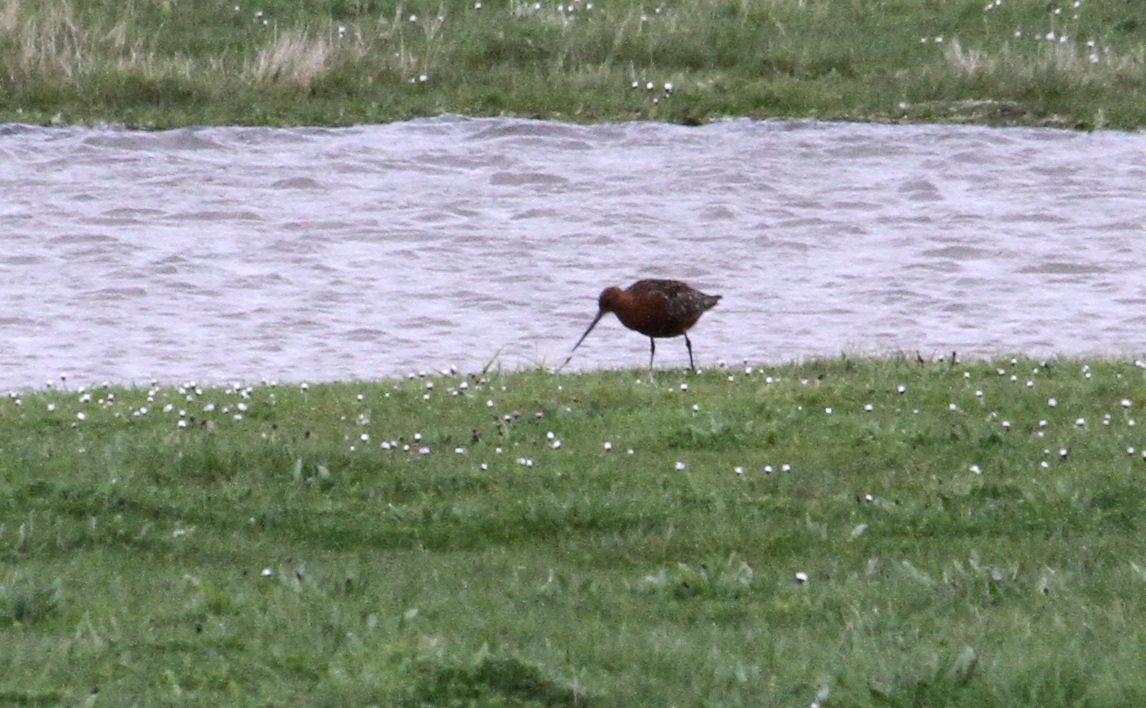
From Turret Hide the best birds were the Bar-tailed Godwit which had taken up residence on Top Scrape, and a singing Reed Warbler which was visible perched halfway up a reed.  There were Avocets of course, but they seemed rather overwhelmed by the many Black-headed Gulls.  A pair of Great Crested Grebes were espied building a nest, and a pair of Little Grebes were heard chittering, but most of the other birds seemed to be struggling against the wind.  Passerine birds were relatively few in number because they were almost certainly sheltering in hedges.
In the afternoon the weather took a turn for the worse, so instead of making a complete circuit of the reserve we went hide hopping instead.  We saw most of the birds that the am crowd did, but one addition was a very smart male Ruff, and better views of the Bar-tailed Godwit through a state-of-the-art-telescope.

Bar-tailed Godwit [an ideal view from Spurn]
 Bar-tailed Godwit [as we saw it yesterday]
 Great Crested Grebe
 Avocet
 Lapwing
 Swallow
 Swallow
 House Martin
 Sand Martin
 Sand Martin
 Black-headed Gull