Showing posts with label Ruff. Show all posts

Saturday, 27 October 2012

Signs of Summer Still Lingering

On Friday everyone shared cars from the Humber Bridge to the same N. Lincs estuarine location we visited on Tuesday. We looked for the Grey Wagtail first but we were disappointed. Instead there were what may have been Otter tracks. When we reached the hide we flushed a Kingfisher, but it perched just a little further on allowing everyone great views. However, before I could snatch a photo a careless dog-walker with her 2 unruly dogs ensured it was frightened off to an area where none of us could see it.


Kestrel [male]
 ditto
 ditto


From the hide there were at least 60 Avocets (amazingly late for this far north), and over 200 Black-tailed Godwits. There was one adult male Ruff with white head feathers and some black feathers on its crown. Meanwhile 2 females or juveniles were on the flooded field opposite the hide. There were fewer than 20 Dunlin, and a possible Snipe, and Caroline pointed out a pair of Shoveler. A few Golden Plover flew through from time to time, but didn't settle on the mud. An immature and an adult Heron were useful for comparison purposes, and a few Curlew stalked on the mud near the Black-tailed Godwits to illustrate just how much larger they are!

The walk round the gravel path resulted in a pair of Bearded Tits, which were later joined by another pair. There were also a few Redwings a little further on. We didn't see much from the east hide apart from Curlews and young Moorhens, although a juvenile Ruff dropped in for the pm crowd. On the way back there were 2 Kestrels hunting and 3 Lesser Redpolls flew near the female, whilst the male settled down and perched in an Elder bush quite close to the group, and stayed there for several minutes. In fact in the end we carried on & left the relaxed Kestrel to preen in peace. It also allowed the pm group to approach fairly close. Some of the group glimpsed a flying Bearded Tit on the way back.  
Avocet
 Avocet
 Avocet (underside)
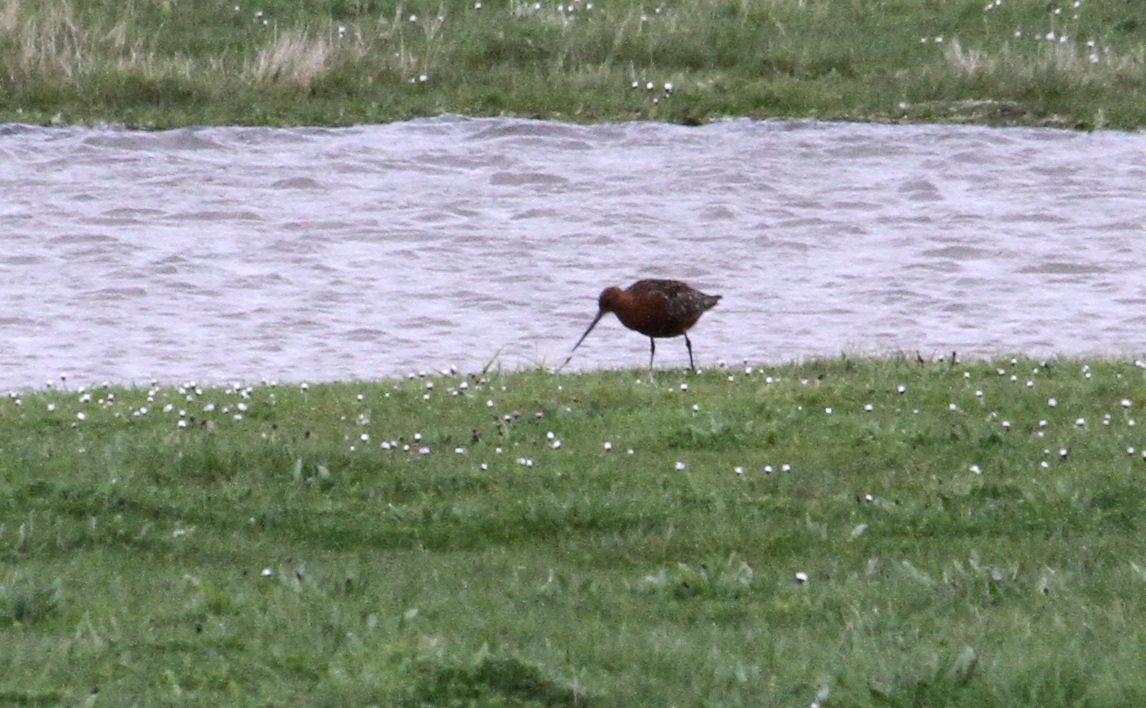
 Black-tailed Godwit
 Otter Footprints?
 Otter Footprints?
At least one member of the pm group viewed Kingfishers as mythical birds like a Roc or a Phoenix, but yesterday she did gain a glimpse of it flying away from the hide area where it was seen in the morning.  

Wednesday, 24 October 2012

Twirling Moustachios

As we crossed the Humber Bridge the fog was so thick, I'm sure most people wondered if we were going to see anything.

One of the first birds we could discern was a very confiding Grey Wagtail, which was catching insects alongside the tiny creek leading to the hide.  Throughout the whole walk the air was punctuated by the croaks of flying Snipe.  Suddenly all the dabbling Teal took to the air and a long winged raptor could just be made out through the mist.  The wings looked too thin & narrow for a Marsh Harrier, so a Hen Harrier was the most probable answer.  There were plenty of Reed Buntings and Tree Sparrows in the bushes, whilst on the mud there were over a thousand Golden Plovers, plus Shelduck, a few Ruff, Curlew, Redshank, Black-tailed Godwit, Dunlin, Herons, a single Spotted Redshank, and a Little Egret.

When we took the walk along the gravel path to the other hide it wasn't long before we heard some pinging and a pair of Bearded Tits showed very well, and these were lifers for about half the group.  On the return journey we came across 2 pairs together, and eventually Maggie was able to get a picture of a pair side-by-side.  Unfortunately, although they could be heard in the distance in the afternoon they refused to reappear.  The light was a lot better in the afternoon, and even though the Grey Wagtail was relocated the loss of the Bearded Tit was a large hole, which couldn't be filled.

Bearded Tits [male left] (c) 2012 Maggie Bruce
 Grey Wagtail
 Golden Plovers
 How Blots are Smuggled into the Landscape

Thursday, 13 September 2012

Visit to the Dentist Required

Wednesday saw us return to last Tuesday's venue. However this week it was low tide, so the birds weren't as close to the hides as last week. We sheltered from the heavy rain in the Visitor Centre where we saw several Ruff and 5 Dunlin towards the left, and Teal, Shoveler and a single Wigeon on the right. Tony saw what he thought was a Marsh Harrier flying east, which the young Scottish RSPB officer was too polite to correct. On investigation it proved to be a Bittern, which was much more exciting for everyone. We had already seen a bona fide Marsh Harrier too, so we had the best of both sightings. A Long-tailed Tit flock passed by and some of the group saw a small, sharp-billed bird in tow, which was probably a Willow Warbler.

Konik Pony
 Long-tailed Tit
 When the rain stopped we set off to last week's premier hide. There was plenty to see here again, but nearly everything was much further away. The nearest bird was a juvenile Redshank & a couple of Snipe flew in. Spotted Redshank and Ruff were already in situ, but a couple of Greenshank flew right into the back of the site and shortly before we left 3 Black-tailed Godwit arrived - one of which still had plenty of breeding colour.  One surprise was an adult Avocet with 3 youngsters in tow, which were seen from 2 hides before setting off west.  Perhaps they were breeders from further north on their way south - but records this late in September are rather unusual at this reserve.  In the afternoon a distant Great Crested Grebe was sighted from the most easterly hide.
Juvenile Redshank
 Snipe
 Black-tailed Godwits (far left & far right)
The far hide was less profitable with mainly the odd duck species, a distant Marsh Harrier and a family of Little Grebes. We retraced our steps, but the hide near the visitor centre was very poor. The photocopying hide was a little better, but didn't add any new species. The main entertainment was provided by the fierce marshland ponies. 
 Spotted Redshanks & Lapwing
 Marsh Harrier
We then tried the one hide on a different alignment to the others. Here were 15 or so roosting Spotted Redshanks, which were later joined by a very white-headed male Ruff and a couple of others, plus plenty of Lapwings. A total of 6 then 9 and later 15 & eventually as people got their eyes in 18 Snipe were asleep at first, but then set about stitching for food. In the heavy rain the afternoon group saw 6 Ringed Plovers, a fairly unusual bird at this site - they had obviously dropped in to refuel in the bad weather.

Wednesday, 5 September 2012

Back with a Bang (& a Bittern!)


The 1st session after the long summer break saw us concentrating mainly on wading birds. We were going somewhere with plenty of hides, so it was safe to ignore the rather damp early morning forecast - which rather surprisingly was wrong anyway! The first hide may have been a little confusing for first timer Maggie, as it was absolutely packed with waders. The Lapwings were the most obvious, but there was also a very noticeable white-headed male Ruff. There were also juvenile male ruffs and a buffish female Ruff - or Reeve, much smaller than the other juveniles.

In addition there were some of the closest views we've ever enjoyed of Greenshanks, and in good numbers too. There was a single Green Sandpiper and a couple of moulting Dunlin, but nothing really out of the ordinary. A single Spotted Redshank busy feeding in the deepest water was a very nice sighting. It wasn't particularly close so most people had a better view through the telescope. 
Ruff
 Ruff with Snipe [left]
 Greenshank
 Greenshanks
 Greenshank & Redshank [right]
 Record shot of Bittern
 Record shot of Bittern
 In the next hide we were quickly put on to a Bittern which was perched at the top of the reeds, looking rather windswept. We were told to try & photograph this distant bird as best as we could, because they were trying to discover if this was an old juvenile, as there are still some young birds being fed on the reserve. The ducks were mainly in eclipse, but we could ID Shoveler and Gadwall, and a juvenile Shelduck. A young Cormorant flew in and immediately hung its wings out to dry.
Ditto
 Blackcap
 Cormorant
 Moorhen
 Wigeon
 Heron
 Magpie
 Speckled Wood
 Konik Ponies
 Record shot of Little Grebe

When we went to another hide there was a pair of young Little Grebes with 3 very young chicks. This has put back some of the conservation work back several weeks. There are also young Tufted Ducks and I think Shovelers on the reserve.  There were a few calls of Bearded Tits from this hide, but they resolutely remained completely out of sight, though we did see a Reed Bunting, young Sedge Warblers, and a charm of Goldfinches.
The remaining hides just produced more of the same, but one hide had a great numbers of winter-plumages Spotted Redshanks on display, with one bird with slightly more spangly plumage. There was another Green Sandpiper here, which we'd a little bit better than the earlier bird.  A Blackcap eating elderberries was the passerine highlight of the afternoon session.
The final hide brought more distant views of Snipe, Greenshank, Redshank and 5 more Spotted Redshank. We did see a few Marsh Harriers in flight from time-to- time, but we were told that these had dispersed much earlier than normal, which seems to be the opposite of most of the other birds, which are breeding much later in the season than is usual, but this is almost certainly because of the disastrous early start they had!

Saturday, 5 May 2012

Splashes of Colour Amid the Gloom

Yesterday was another day struggling with this unappealing spring weather.  We walked along a flood-bank in strong northerly winds, and in the afternoon some horrible mizzle.  Despite the conditions we saw some quite good stuff.  Before we started there were plenty of Swallows flying around our heads, plus a few House Martins, and at least 2 inseparable Sand Martins.  Along the river bank we saw some stonking Yellow Wagtails, a Sedge Warbler, and on a pile of dung in the afternoon a Wheatear. Also in the afternoon there was a Common Sandpiper along the river bank, not far from insect-eating Yellow Wagtails & seed-chomping Linnets.  
There was no sign of the Kingfishers, which used to frequent the site before these last 3 chilly winters.  On the return journey you get a bit closer to waders & we saw 7+ Whimbrel, a gorgeous white Ruff, Lapwings, Redshank and in the afternoon despite the drizzle a single Snipe indulged in his impressive display flight.  At times the sickle-shaped wings of the Swifts sawed through the air very close to the group and at one moment came between a married couple!  We heard songbirds as this side too, with Yellowhammers, Lesser Whitethroats and common resident birds.
We’ve seen cows at this location in the past, but this time there were dozens of ponies, some of which had just given birth to foals...


We were about to wrap up for the day when Jim spotted a pair of Pintail - a great end to the afternoon!
Just hoping that next time the weather will be a lot kinder to us...

Wheatear on Dung (like yesterday pm)
 Yellow Wagtail on Reeds (a bit whacky)
 Ruff [male]
 Mute Swan
 Some Whimbrel here
 Swallows
 Foal
 Rounding them Up

Wednesday, 2 May 2012

Bad Weather Alternative

Yesterday we should have been walking along a slow, gentle canal, but the previous day a flood warning was given out for the area by the Environment Agency & more rain was forecast for today, so we switched to North Cave Wetlands.  
Those who didn’t arrive really early were kept waiting as cement was added to the foundations of the new gates, which are to be SE & SW corners of the reserve.  The place is blighted on a night by lowlifes who do hand- rake turns, write graffiti in the hides & have even caused damage in them in the past.  A traffic jam started on the approach road, but the early birds were able to watch the many low-flying hirundines & a Bar-tailed Godwit which flew over the road at about 9.30.  One of the few birds seen was a Red-legged Partridge, which ran away from the approaching group.
In South Hide the northerly wind was blowing straight in & there weren’t that many wildfowl on the water apart from Tufted Ducks, a single Pochard, and a snoozing Great Crested Grebe. We were buffeted by the strong winds, but a few Willow Warblers and Blackcaps were still gamely singing.  The crop of Groundsel was wondered at & admired.  A couple of Lapwings were seen in a field & some participants believe they spotted some young Lapwing chicks.  A flock of 6 Shelducks flew fairly low over our heads on an unknown mission, whilst a few Skylarks flew up briefly before disappearing in the grass.
From Turret Hide the best birds were the Bar-tailed Godwit which had taken up residence on Top Scrape, and a singing Reed Warbler which was visible perched halfway up a reed.  There were Avocets of course, but they seemed rather overwhelmed by the many Black-headed Gulls.  A pair of Great Crested Grebes were espied building a nest, and a pair of Little Grebes were heard chittering, but most of the other birds seemed to be struggling against the wind.  Passerine birds were relatively few in number because they were almost certainly sheltering in hedges.
In the afternoon the weather took a turn for the worse, so instead of making a complete circuit of the reserve we went hide hopping instead.  We saw most of the birds that the am crowd did, but one addition was a very smart male Ruff, and better views of the Bar-tailed Godwit through a state-of-the-art-telescope.

Bar-tailed Godwit [an ideal view from Spurn]
 Bar-tailed Godwit [as we saw it yesterday]
 Great Crested Grebe
 Avocet
 Lapwing
 Swallow
 Swallow
 House Martin
 Sand Martin
 Sand Martin
 Black-headed Gull