Showing posts with label Hobby. Show all posts

Friday, 21 September 2012

Disappearing Waders

It was very drizzly on Thursday morning when we returned to last Wednesday's location. We went to Townend Hide first where there were plenty of waders to see. The largest island was covered in Snipe with 2 Spotted Redshank nearby and a Dunlin on the other side of the island. There was a scattering of bog standard Redshank all over the water with a large Heron stalking at the back of the reeds. Some Teal were dabbling and and a Shoveler and a small flock of Gadwall flew West. A flock of Ringed Plover flew west, which was more surprising. We stayed a long time and eventually a Marsh Harrier flew past. 4 Greenshank flew in and the Spotted Redshank left around the same time. Some large fat Plovers flew over, which may have been Grey Plovers, but we're more likely to have been Golden Plovers. Towards the end of our stay about 12 Black-tailed Godwits flew in and started feeding.

All photos on this post (c) 2012 Richard Whateley
Black-tailed Godwits
Snipe
Redshank
Greenshank
Black-headed Gull & Dunlin
Meadow Pipits

It was very drizzly on Thursday morning when we returned to last Wednesday's location. We went to Townend Hide first where there were plenty of waders to see. The largest island was covered in Snipe with 2 Spotted Redshank nearby and a Dunlin on the other side of the island. There was a scattering of bog standard Redshank all over the water with a large Heron stalking at the back of the reeds. Some Teal were dabbling and and a Shoveler and a small flock of Gadwall flew West. A flock of Ringed Plover flew west, which was more surprising. We stayed a long time and eventually a Marsh Harrier flew past. 4 Greenshank flew in and the Spotted Redshank left around the same time. Some fat Plovers flew over, which may have been Grey Plovers, but were more likely to have been Golden. Towards the end of our stay about 12 Black-tailed Godwits flew in and started feeding.

On to Singleton where there were fewer waders, but a lot more ducks. A young Cormorant was on the island, but took off when the Black-headed Gulls moved in. There were plenty of Shoveler and Gadwall, and a couple of Little Grebes.
We missed out First Hide because there was only a Coot and we headed to Marshland. The birds were mainly roosting here with Spotted Redshank, Snipe and a couple of Greenshank being the best of it. Every member of the hirundine family went over with Swallows in the majority, with a few House Martins and even less Sand Martins. Richard spotted a Kestrel hovering in the distance. 
Near Xerox I heard a Willow Warbler and then suddenly a flock of mainly Long-tailed Tits appeared with a few Great and Blue Tits in tow.
In the afternoon it became hunt the wader with very few waders to be seen. A pristine Hobby flew right along Singleton, but only Eric and myself (as well as some strangers) saw it. In contrast most people saw great number of Lapwing fly up in the far distance and then at the back of the group the fast wing-beats of a hunting Peregrine could be discerned. It made its way all along Alkborough Flats, and apart from a brief detour to chase a small bird, it carried on heading south east until it was lost to sight. A Marsh Harrier came a lot closer and was particular enjoyed by Gordon. We saw plenty of waders drop into Townend, but when we got there there was nothing.  Eventually a Black-tailed Godwit dropped in, at least it was a new bird for the pm session. Eric also later picked up some Bearded Tits, but the rest of us had already left Townend by then. Marshland was much more disappointing than the pm with only a Pied Wagtail, some Snipe and Teal putting on much of a show. Brian spotted some small birds at the back of Marshland - the first were Reed Buntings, but the final birds he noticed were a couple of juvenile Reed Warblers.  There wasn't a sign of the best birds last week - all the Ruff seemed to have continued on their migration south.  I'm not sure if the poor afternoon was a result of the outgoing tide, or the fact that a lot of places are less interesting after lunch.

Thursday, 13 September 2012

Slim Pickings

On Thursday we returned to a venue we hadn't visited for 2 years, as they were insulting to us last time & demanded a months' notice before our next visit. Since our last visit someone seems to have physically removed all the birds. It could be the time of year, but there were very few birds of interest.


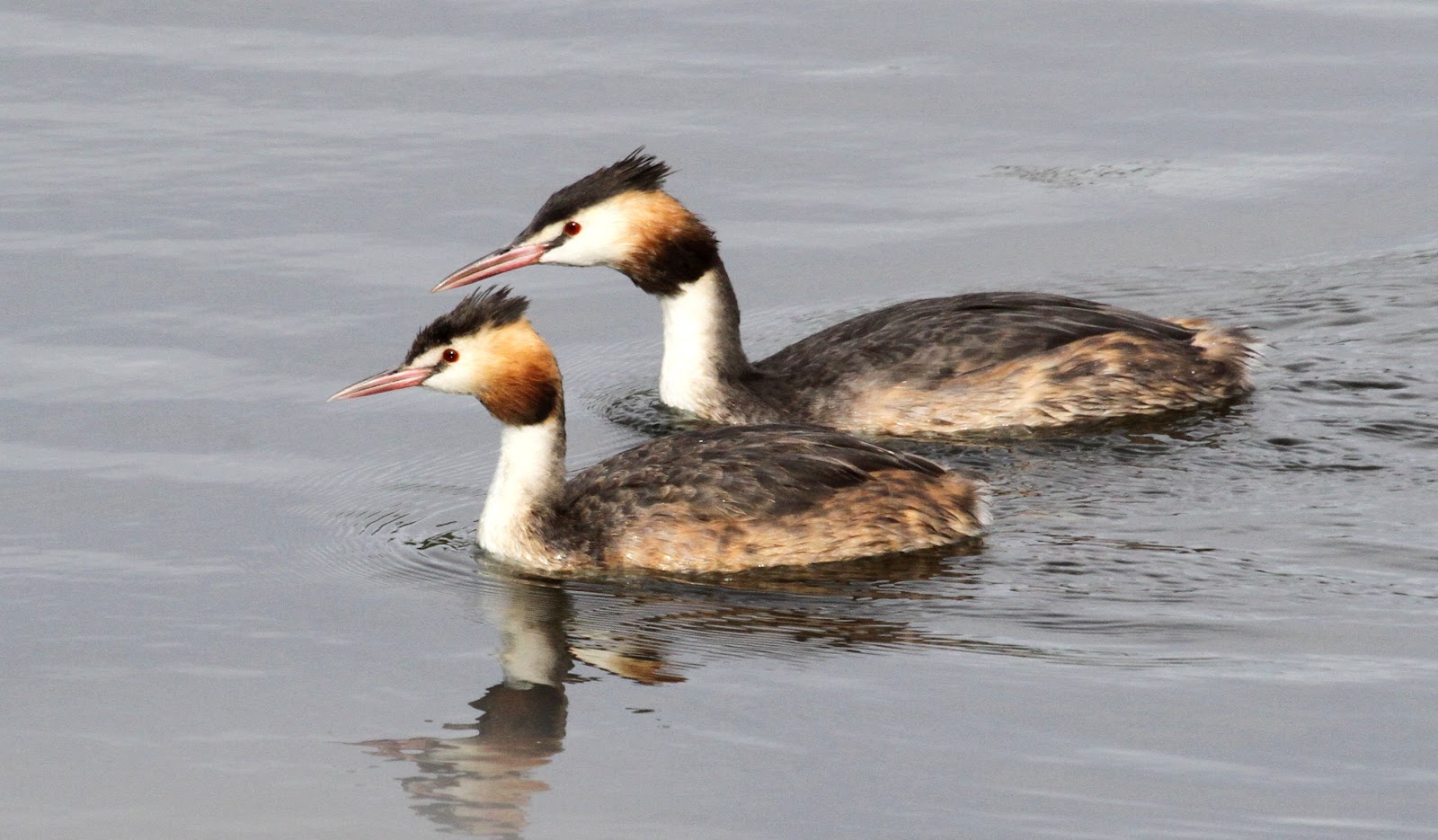
From the 1st hide we were told we had just missed a Bittern, but there were plenty of Coots and a very distant Little Grebe. A Gadwall flew in, but there wasn't much else to see until a pair of Great Crested Grebes made their stately way from the back of a reedbed and swam directly under the hide.


Great Crested Grebes (c) 2012 Richard Whateley

 Great Crested Grebe (c) 2012 Richard Whateley
 Great Crested Grebes
 House Sparrow (c) 2012 Richard Whateley


We left the hide and walked along the green tunnel, but this was also devoid of birds. We eventually heard some tits but even these remained out of sight. We bumped into a volunteer cutting back greenery, and he informed us that this path would be closed next week due to heavy machinery moving in to create a new scrape & install a new hide. As he was talking some migrating Pink-footed Geese could be heard, but they were hidden by the thick hedgerow. We climbed up the river bank and immediately located a pair of Redshank feeding on the mud. A closer inspection led us to find 4 Black-tailed Godwit probing the hinterland between river and mud. They are a lot larger an Redshank, but they had lost their breeding colours so blended into the background much better.

Black-tailed Godwit
 Black-tailed Godwit & Redshank (c) 2012 Richard Whateley
 Sparrowhawk (c) 2012 Richard Whateley
 We carried on to the next hide. Again it was very quiet from here, but Richard spotted a Sparrowhawk flying low over the water before it landed in a tree opposite to us. It stayed in the area for 20 minutes from where we were able to see its bright pinkish undersides. While we were observing the male Sparrowhawk another tiny raptor raptor swept over the area. On closer inspection it turned out to be a juvenile Hobby. Unfortunately, only a brief glimpse was permitted before it flew over the receded & then over the hedgerow which obscured it from our sight.


A walk round the perimeter of the site brought the contact calls of Willow Warblers to our ears, but the most constant sounds were the melancholy songs of several Robins. At the final hide there was very little to see beyond a Migrant Hawker, some concealed Moorhens and some fighting Coots. 

There were even fewer birds to see in the afternoon, but we did see one of our earliest juvenile Goldeneyes ever, and a soaring Buzzard over the Lincolnshire Wolds. I'll have to see if this venue improves during the next few weeks, as otherwise it may be worth dropping this venue completely from the itinerary. 
Common Blue Damselfly
 Record shot of Cormorant (c) 2012 Richard Whateley
 Record shot of Juvenile Goldeneye
 Ruddy Darter
 Migrant Hawker eating a fly


Wednesday, 22 August 2012

Countdown to Autumn Classes

There's less than 2 weeks to go before my East Yorkshire Wildlife classes resume, so there's not a lot of time left to book, if you intend to do so.  The Thursday classes are full, but there are still a couple of vacancies on a few of the other sessions on Tuesday am, Tuesday pm, Wednesday pm & Friday pm.  

We will be looking for birds on migration, so we will be hoping to catch up on migrants on the coast - with visits to Spurn Point & Flamborough.  We will also be visiting some estuary sites at high tide, so we can see waders at close quarters.  Many beginners experience difficulties with distinguishing waders, but hopefully I will be able to assist at identifying these tricky birds.  

The Autumn can also be the best time of year to see such stunning little birds as Bearded Tits, so we will be visiting at least 2 locations where we have a good chance of seeing these absolute crackers.  

Bearded Tit

In the last decade our chances of watching Hobbies has improved immeasurably, so we will also be going to a couple of venues where we have a good chance of watching these dashing little falcons catching & eating dragonflies in mid-air.

Hobby with Dragonfly  Photo (c) 2012 Mike Day
The Kingfisher is a popular bird with almost everyone (apart from some twitchers).  It has suffered badly in the past 3 winters, but I will try & ensure every participant has the best possible views of this stunning bird, which seems too colourful to be British!

Kingfisher
Barn Owls were also badly hit in recent winters, but seem to be doing well along the coast and estuary, so we'll also be catching up with this charismatic giant moth of a bird.  We'll be going on a special Barn Owl Safari in exactly the same spot where this individual was perched, as well as observing them hunt along drainage ditches in the wilds of Holderness.
 Barn Owl
 As the end of the term approaches, we'll also be travelling to an area which has roosting Red Kites, so you can marvel at these masters of aerial manoeuvrability!  
Red Kite near its Roost

Other birds we should catch up with are featured on this blogpost , but we will probably identify over 100 species in the whole 10 weeks.  We will also identify any mammals, butterflies, and dragonflies we encounter, and make a stab at fungi and moths.  You'll find your session an all-round wildlife encounter in both beautiful or bleak locations - certainly places with plenty of character.  The course is extremely competitively priced, so you will find that you have spent a minimum of cash for a very worthwhile experience, and some scenes will be seared on your memory for years to come.  To book a place, just contact me on the email address listed on the top right of this blog.  

Wednesday, 30 May 2012

Diamond Tail Jubilee

Turtle Dove Spreading its 'Diamond' Tail
Wednesday was a rerun of May 15th, but the weather was a lot milder today: http://www.eybirdwatching.blogspot.co.uk/2012/05/crouching-hares-hidden-turtles.html
The strong winds were gone, but if anything it was actually too hot, even first thing in the morning.  Before we set off we saw Whitethroat, Yellowhammer and Blue Tit.  Not long out of the car park and we had a Willow Warbler and a Tree Sparrow.  We had 4 Long-tailed Tits and another Willow Warbler just before the stud farm, and then under the trees which always used to hold a Garden Warbler I was surprised to first hear & then see a single Yellow Wagtail flew over.  Later, at lunch time the 2 Davids & Barbara had 3 Yellow Wagtails in the car park.  These are fairly unusual sightings as there is no water anywhere in the vicinity, although there is an oilseed rape field fairly nearby.  A Song Thrush, and a Chiffchaff were singing in the general area, but there wasn’t a single whimper from the Turtle Doves.  

 Long-tailed Tits
 Long-tailed Tits
When we set off again there was a different family of Long-tailed Tits and among a group of young Rabbits was a melanistic, (black) one!  At the edge of the reserve a Linnet & a Pied Wagtail flew over, and a Marsh Tit flew into the reserve.  Butterflies seen on the journey include: Speckled Wood, plenty of Orange-Tips, and a single Comma.  There were a pair of Linnets on the escarpment, and Miles found a Froghopper, which disappeared before its picture could be taken.  We were a bit luckier with Maxine’s ‘soldier beetle’.  A male Pheasant was spooked from under our feet, which then went on to spook a pair of Red-legged Partridges.
A pair of Treecreepers in the reserve were calling vociferously, but they were very difficult to spot hiding in Hawthorn bushes.  There were quite a few butterflies in the reserve including: Common Blues, Dingy Skippers, an alleged Brown Argus, and a Small Heath.  Not long after we left the reserve a Hobby flew West right through the valley.  We didn’t see a great deal on the return journey, but a pair of Blackcaps under the brick viaduct were a late highlight.  A clucking Red-legged Partridge was another new bird for this particular area. 
Speckled Wood
 Comma
Soldier Beetle sp Cantharis rustica (Thanks to Barry Warrington)
 Common Blue
 Common Blue [male]
 Dingy Skipper
Record shot of Hobby (c) 2012 Tony Robinson
 Yellowhammer
There are no House Martins among the car park buildings this year – too dry?, but a tree Sparrow was using a nest under the eaves in the artist’s studio.  I decided to take the afternoon session East, as the West side had been relatively disappointing.  Straight away a Green Woodpecker was sighted shortly after leaving the parking area followed by a family of Long-tailed Tits and a Willow Warbler.  When we left the trees and we could see through a gap between the Hawthorn hedge we were just able to discern a Red-legged Partridge along a fence line.  We carried on for a bit and not long after we passed a jerk who doesn’t clean up after his dog.  Soon after we arrived at Yellowhammer central, which is an escarpment open to northerly winds – today the breeze was welcome.  Suddenly some Rooks went up into the sky making a lot of noise, and we could see 2 Red Kites overhead, which eventually drifted north east.  A Red-legged Partridge flew onto the top of a distant post, but nevertheless gave decent views. 
 Bullfinch
We then entered an area with steep banks on either side, and covered with Hawthorn, Dog Rose, Wild Strawberry and various species of emerging vegetation.  We were watching a very bright male Bullfinch in the centre of the path when most of us saw a Stoat running behind the Bullfinch carrying a small Rabbit.  We were heading towards the small bridge when we heard the unmistakable purring of a Turtle Dove.  It displayed over our heads a few times, but also continued to purr from one of several Ash trees along that section of the track.  We stayed still for 10 minutes or so, but only got sight of it fanning its diamond shaped tail as it swept by us.  It was seen perched in a distant Ash, but the views weren’t terribly good.   
Turtle Dove
 Record Shot of Green Woodpecker
 Willow Warbler
 Jerk who Lets his Dog Foul a Nature reserve
 This Dog Cannot Read...
 ...This Sign
On the East side of the small bridge a Song Thrush was singing, but there were fewer birds in this area.  Another Yellowhammer, and a flying Kestrel were in the area of the final bridge.  On the return journey a large pale Buzzard looked as though it was about to land in the steep-banked area, but it saw us and veered away sharply, and then was lost to sight.  The Green Woodpecker and Willow Warblers were again near the quarry area, but this time they were also joined by a Great Spotted Woodpecker.  There were fewer butterflies in the afternoon because it had clouded up considerably and it almost seemed as though it was about to rain. There were a few drops as we reached the cars, but it was so warm we weren’t even dampened by the time we returned.  Only a couple of years ago there were 3 singing Turtle Doves either side of the car park, but today only one could be tracked down - that represents a loss of 5 singing males!  There was also less wildlife on the Westward trip, despite this being a morning trip.  On future visits we will always be heading Eastward Ho. 

Wednesday, 4 April 2012

Summer Raptors Rapture

In the spring/summer term we should come across several bird of prey species.

A bird which has increased noticeably in the last few years, and which has proved extremely popular with the classes is the diminutive fast-flying Hobby. We will probably observe this dashing summer visitor having a snack on the wing - may be a dragonfly, but possibly even a Swallow or a Martin! We will be going to several locations where an encounter with this species is a real possibility & if we're lucky we will get almost a good a view, as in the the picture below!

Hobby (c) 2012 Mick & Kath Sharpe - a dashing favourite
Hobby (c) 2012 - Fast food consumption - food on the go!
There are a couple of venues along the Humber where we are guaranteed views of this impressive, large, slow-flying species. In some parts of Yorkshire they are still a relatively scarcely seen bird, but on the Humber we now almost take them for granted. If we are lucky we may seem them skydancing, although we may have already missed this spectacle this year!

Young Marsh Harrier (c) 2012 Chris Cox
Marsh Harrier in flight - easy to see along the Humber
Like the Hobby, the Honey Buzzard is a summer visitor, but this is much more difficult to come across in a casual way. We are therefore visiting a raptor viewpoint, where we may have a chance of watching them display. Their predilection for nests of wasps and bees is unique among British raptors, and they are beautifully marked, as the picture below illustrates.

Honey Buzzard (c) 2012 Vince Cowell - going on a special trip to try & see them
Yet another summer visitor is the Osprey, and like the Hobby its numbers have been rising in the past few years. 3 classes have now seen an Osprey during the duration of the course, so now I just have to ensure that it is spotted by the Tuesday, Thursday and Wednesday pm sessions.
Osprey [silhouette] - keep your eyes to the skies
The birds of prey I've mentioned so far, which have been increasing, have done so by natural means aided by specific programmes to improve habitat and possible breeding sites. However, the Red Kite is a resident bird of prey, which increased because of a pro-active intervention by humans: a reintroduction programme. Although the nearest scheme was nearly 50 miles away, the Red Kite has become a welcome addition to the fauna of the wolds, and which we may even observe floating above our car park.

Red Kite - may drift over our car park
Although the Buzzard isn't yet as numerous here, as it is in other parts of the UK, we now may encounter it in the bleakest, most flat areas of our county, as well as over woodland, and the more hilly districts which are more typical of this species.

Buzzard - becoming a more common sight
The Peregrine has also increased in recent years, and we've already enjoyed it plunging vertically at nearly 100 miles an hour, just the other week. This is a bird we are most likely to observe at some coastal sites.

Peregrine (c) 2012 Vince Cowell - may spot one on the coast
The Kestrel is still the bird of prey we are likely to see most often, and there is a good chance we will see one virtually every week

Kestrel - will probably be observed most weeks
The Sparrowhawk is supposed to be more numerous than the Kestrel these days, but because of its more secretive habits we may just catch a quick view as it hunts for its prey along a hedgerow. If we are a little luckier we may find a pair involved in their display flight, or we may see one with its prey, as this bird plucking a Starling!

If you are interested in seeing some or all of the raptors featured on this post, then there is still time to secure a place on the Tuesday afternoon course starting on April 17th, but time is running out!

Sparrowhawk - will get a glimpse most weeks & some weeks a decent view