Showing posts with label Marsh Tit. Show all posts

Wednesday, 13 June 2012

Reddies to Fledge?

Tuesday was a rerun of Sunday morning's visit.  There was no doubt that the Redstarts were the highlight again as they busily feed their brood in their nest-hole.  It won't be long before these young fledge (hopefully).
Redstart
[above] Yellowhammer in a field of chalk not snow!

Differences from previous visits included a Mistle Thrush and a Pied Wagtail in the chalky field and 2 fighting male Yellowhammers over this same field.  
 Goldcrest
 'Ghost of a Goldcrest'
 Chaffinch (c) 2012 Phil Hargreaves
 Willow Warbler (c) 2012 Phil Hargereaves
 Record shot of Blackcap
Along the railway line the morning group had 5 Crossbills flying over, while in the afternoon a flock of nearly 20 flew east.  Another surprise was a Willow Tit calling in an area, which has previously only held Marsh Tits.  It made its nasal 'tchay-tchay-tchay' call for nearly 10 minutes.  In the afternoon a little further along the line were 2 Tits, but they refused to utter any sounds at all as they busily looked for food among the lichen on the bushes & twigs.  These showed a little better, and one of these is shown below.

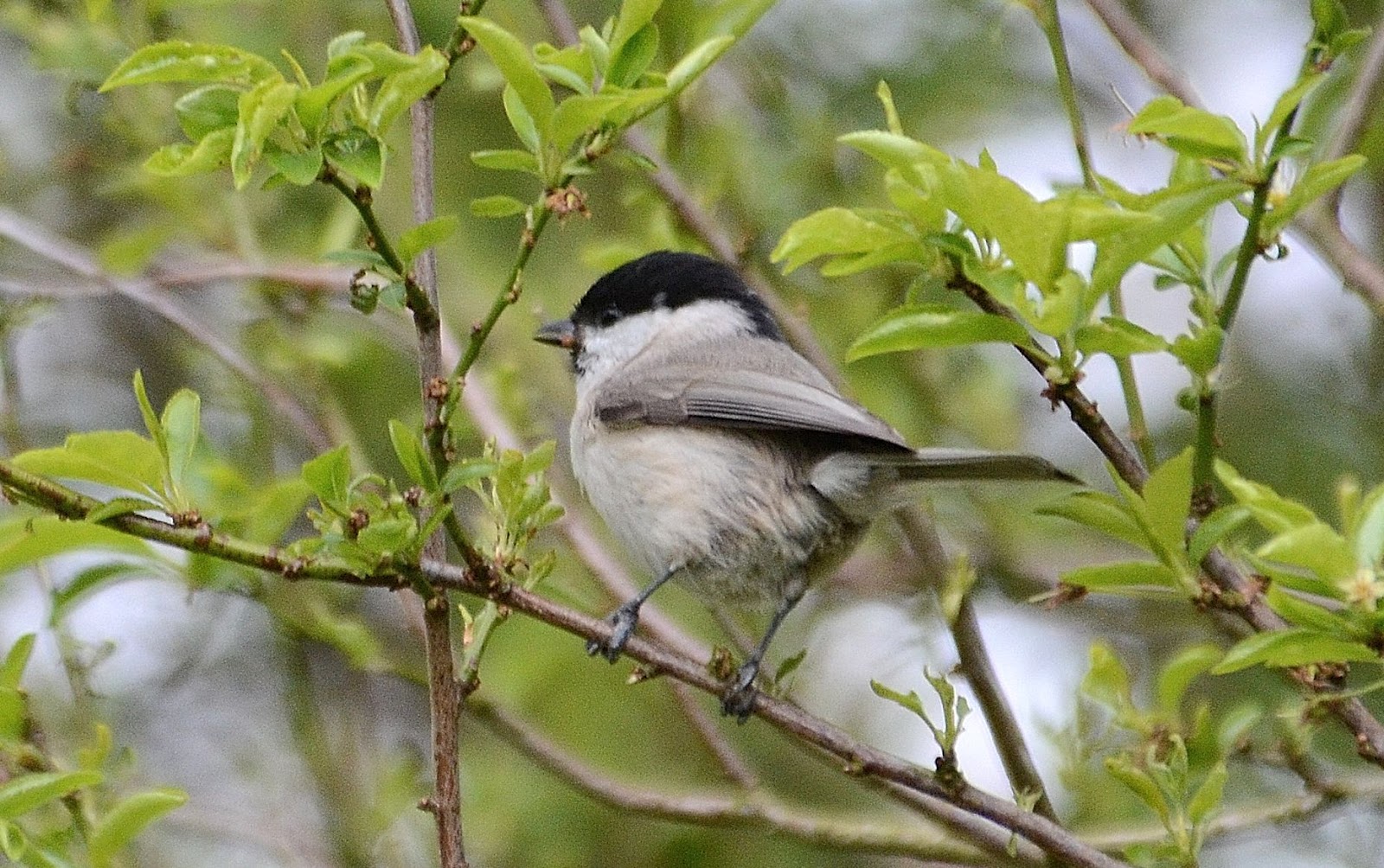
 Marsh Tit?
 Whitethroat
In the afternoon a Great Spotted Woodpecker flew over as we were  watching Willow Warblers and then there was the call of a Kestrel coming from the Redstart's tree.  We managed to frighten it off as we walked towards the tree, but while we were observing the Redstarts it tried to return on at least 2 occasions, and it was never far away.  A Garden Warbler sang briefly near the old quarry buildings, but it never came into full view.

In the morning we had chance to explore a small floral nature reserve.  There was plenty of Yellow Rattle, and a couple of spikes of Common Spotted Orchid just coming into flower, but no Bee Orchids in full flower.  There was one specimen, which had grown leaves, and looked as though it may flower in about a week or so.  The flowers seemed several weeks behind, and there were no butterflies in the heavily overcast conditions.

This is one of the most popular locations with everyone being impressed with the beauty of the landscape and the picturesque rolling hills.  The Redstarts ensured that at least some of the wildlife lived upto the wonderful setting. 

Hares
 Yellow Rattle
 Common Spotted Orchid
**PS I've just heard (evening of 13th June) that the Redstarts had fledged by 2pm today, and the Kestrel didn't get them all!  You soon may be able to hear more about the fledglings here: http://woldranger.blogspot.co.uk/

Sunday, 10 June 2012

Conclusion of Robert Fuller's Summer Exhibition

Sunday saw the final 2 events running in conjunction with Roberts Fuller’s Summer Exhibition.  The morning walk took place near an Ancient Monument.  All but one person turned up at the Gallery in good time, we waited for the 1 late comer, but she failed to show.  We therefore wasted 15 minutes before setting off.  On the way to the final venue we saw a Kestrel perched over the road, a really bright Yellowhammer, and a few scattered Swallows, but we didn’t come close to killing nearly as many Red-legged Partridges as last week.  There was a lot more room in the car park this time, and again Yellowhammers could be heard in the distance, but today other birds to be heard here including a Song Thrush, a Blackcap and a Blackbird.  On the walk down the valley a Yellowhammer was perched on the left hand side of a telegraph post, whilst a pair of Linnets disappeared into the bare field on its right, and then landed briefly on the hedgerow underneath the Yellowhammer.  A Common Whitethroat perched very briefly on a tiny hawthorn bush, whilst a Blackcap sang nearby.  There were more Willow Warblers singing than last week, but our previous visit had been in an afternoon.
Redstart (at the same location 3 years ago)
We went through a couple of gates and were almost immediately rewarded with views of a male Redstart constantly feeding its young brood in a very distinctive nest-hole.  He was definitely more obvious than the female this time.  A Great Tit was also busy just outside the nest hole, so it may also have been nesting nearby.  As we watched the Redstart there was a sneeze near at hand, and a Marsh Tit flew into the trees behind us.  Unfortunately, it didn’t hang around for a decent view.   The only other bird in this area was a Goldfinch which landed on the wires above our head.  We were just about to walk back through the gate when the Wakefield lady spotted the male Redstart sitting the nearest it had been to us all morning.  When we had returned to the site of the old railway line one chap had to retire to his car with an aching hip.
 Record shot of a Yellowhammer
 Comma
Here, a Chiffchaff sang briefly & distantly, but not long enough for me to point it out to the group.  Those near the front saw a female Blackcap collecting insects, but the male was harder to see, though he was singing strongly.  An Orange-tip passed us a few times round here, and one participant spotted a Comma.  It was near here that we encountered a family of Long-tailed Tits, but we could only snatch decent views of the adults.  A Bullfinch flew into the hedge, allowing us only to catch a view of a white rump, but its plaintive ‘pue’ call was heard by all.  Another Marsh Tit sneezed as it flew along the thick hedgerow, but it remained a blur, and failed to perch in the open.  The lady from Wakefield spotted a Hare on the hillside, which ran past a Magpie before disappearing over the brow of the hill.  In a bush on the hilltop a lovely red-breasted Linnet was drying itself after having a bath.   
Comma
 Record shot of an Orange-Tip in Flight
We came to some redundant buildings and this is where at least 4 of the party disappeared for several minutes as they reminisced about their previous uses.  Meanwhile we heard our first & only Garden Warbler, of which we managed to obtain glimpses as he sang among some fresh Ash leaves.  A Curlew sang out, so presumably they breed on the hillsides in this area.  We also heard our first proper Chiffchaff of the day, and nearly everyone saw it flitting high among the Ash leaves.  We returned the way we had come, and didn’t add any new species, but we climbed the hill with alacrity, as the dark clouds seemed to be massing for an attack, but we managed to reach the car park with only a few drops trying to soak us.  There was chaos in the car park as several people were trying to park with no available spaces.  One of our party almost had his car pranged, but eventually he was allowed to reverse from his space, so one of the newcomers could take his place. 
Ear Fungus
The afternoon session saw a similar situation arise, but this time we were the newcomers.  The car park at the new location was already brimming over, and our arrival came at a difficult time.  In the end a few of us managed to squeeze into the car park, whilst at least 3 had to abandon their cars outside the usual parking area.  We walked down the hill, and I could hear a distant Whitethroat, but we never actually caught up with this particular bird.  A pair of Red-legged Partridge heads could just be spotted in some long grass – the male poking his head up that bit higher than the browsing female.  We were much luckier with a Willow Warbler which came to suss us out, and everyone managed to get decent views, and one lady even managed to take a photo.  A large bird flying distantly looked reminiscent of a raptor, but on closer investigation proved to be only a Lesser Black-backed Gull.  We were luckier when someone spotted a Buzzard soaring over an area of conifers.  It then began to hover clumsily before it disappeared over a large deciduous woodland.   
Red-legged Partridge
 Willow Warbler
 Singing Willow Warbler


    Despite the best efforts of the Sunday afternoon traffic we eventually made it to the pond, and this was the most prolific area for the numbers of species seen well.  A pair of Whitethroats were active around the metal gate and could be seen collecting insects around the umbels of the Cow Parsley.  A Yellowhammer was heard singing, and this was eventually seen clearly.  A Treecreeper was singing nearby, and then one lady spotted it clinging to the side of a mature Ash tree.  There was another Marsh Tit in this area, but again it didn’t stay long enough for everyone to get decent views.  We went a bit further, where the lady with the camera toppled over, but luckily the camera (& the lady) were apparently undamaged.  We walked to where there had been a Tree Pipit a few years ago, but the bushes had been burnt in this area, and there was no sign of this locally scarce species.  However, we went a little further and were lucky enough to encounter a Meadow Pipit indulging in its ever-popular parachuting song-flight.  The Meadow Pipit plunged down to our side of the hill & into a gorse bush, but it was soon seen off by another male.   It was at this point that we heard the best song of a Skylark of the day.   
We returned to the pond area, but this had been taken over by paddlers, so apart from a Moorhen there were no new sightings there.  We walked a little further along the road, but the only decent sighting was of a Willow Warbler plucking flies from a barbed wire fence.  On the return journey to the car park I pointed out some ear fungus & was able to regale the group with some of the folklore and culinary qualities of this unique fungi.  We were able to return to the cars without further incident.

Friday, 11 May 2012

Ridiculous Handle-bar Moustache

Today despite the (yet again) rather unpromising forecast we travelled to the woodland with the best understorey in East Yorkshire, and therefore with the highest density of woodland species.  As we booted up outside the reserve we were regaled by a Garden Warbler, and this turned out to be the bird of the day.  We later went on to have great views of 2 different individuals during both sessions.
Although the woodland is surrounded by farmland, I can’t remember when I last saw a Grey Partridge at this site, but today a solitary male was seen in a ploughed sandy field, not far away from a pair of Red-legged Partridge.  Later, as we neared the parking area another Red-legged rocketed out of the wood and across a field.  I was hoping for a Woodcock performing this feat, but we had to put up with a Partridge instead.
Other birds seen included Blackcaps (females too), Chiffchaff, Marsh Tits, Great Spotted Woodpeckers, and we heard the ringing laugh of a Green Woodpecker.
The am group went on a detour to see the putative Red-legged Partridge egg.
In the afternoon some of the Longhorn Micromoths with the 'ridiculous handle-bar moustaches' were flying in the shaded sunshine between showers.  Also in the afternoon a discussion was held as to whether the Garden Warbler was nice enough to be kissed.  Jim said they did have a nice, gentle look, but he wouldn't kiss one!
Plants seen apart from the glorious Bluebells included Greater Stitchwort, Climbing Cordyalis, Bugle, Wild Strawberry, Water Avens and even a few Primroses were still hanging on....


Longhorn Micromoth Adela reaumrella
 Bluebell
 "Whitebell"
 Bugle
 Climbing Cordyalis
 Garden Warbler - "Kind Enough to Kiss"
 Marsh Tit
 "Corn Dolly" Hoof Fungus
 Bluebells
 ditto

Wednesday, 9 May 2012

White Triangle Bird

The weather forecast last night indicated that rain would move slowly up the  country.  In an attempt to avoid the rain the venue was changed to as far north as we could go & still be in East Yorkshire – we may have actually just strayed into North Yorkshire.  
A Yellowhammer and Linnets were first heard & then seen from the car park.  We walked down a valley, which had been cleared of many of its scrubby bushes, so the Willow Warblers have vacated this area.  However, the am group did watch a male Whitethroat dancing around a female - a performance I hadn't witnessed before.
We plunged further down to the valley’s bottom, and despite the lack of conifers we heard and then saw a couple of Goldcrests.  Next we passed through a gate towards a scheduled ancient monument and searched the old ash trees and bushes for the Redstart Tony Robinson saw at the weekend.  A female had turned up since then, so the birds were a while before they showed, and they weren’t as confiding for us, as Tony's male had been briefly for him on Saturday.  Everyone was able to obtain a view, but they were much harder to see in the afternoon.  Despite Doug’s best efforts at finding the male Redstart it disappeared again before everyone had seen it.
25 years ago shortly after passing my driving test I took my mum to today’s location.  While I was recording some birdsong my mum spotted something she hadn’t seen before.  “A strange bird just flew past, with a white triangle on its head!”  A few questions later & it seemed she’d seen a Redstart in an area where they weren’t generally supposed to be.  However, further searching has revealed that there is a small but stable population on the Yorkshire Wolds.  They seem to arrive a little earlier in the valleys with streams, pools and other running water, but they are also present a few days later in the completely dry valleys.  I’m not sure if any survey work has been undertaken to determine just how many Redstarts breed on the Yorkshire Wolds.  This population is much further East than is generally acknowledged in references to the distribution of this species in the UK.
We went back to an old railway line and saw Marsh Tits attacking the buds of an Ash tree, but there weren’t as many hedgerow birds as usual.  This could be because the summer migrants still haven’t all arrived, but could be because their favourite hedge had been severely hacked back.  We reached the village and saw a soaring Kestrel, which a couple of ‘stringers’ tried to boost into a Sparrowhawk, but they hadn’t noticed the dark border to the tail.  Of course when it flew off normally it resumed its standard Kestrel shape.  As we approached the village sightings of Swallows, Pied Wagtails and Greenfinches increased, and in the village itself House Martins and Tree Sparrows proliferated.  We also saw a male Bullfinch here and heard the beautiful song of a Garden Warbler, which was glimpsed briefly by the am group.
We returned the way we had come, but the killer hill proved rather unpopular with some participants, so 2 set back up there early, so they could take their own time, whilst an am participant waited in the village for someone to collect her by car.  The wild flowers weren't bad today & a couple of Orange Tip butterflies were seen.
During the morning session a formation of 20 planes flew North-West with another plane leading them.  We have no idea what these planes were doing in this remote area.


**STOP PRESS** It now seems we were witnessing a training exercise of the planes for the Queen's Jubilee, which were actually flying in a formation which mirrored the digits 60!
The afternoon group jumped in their vehicles, and then the first spots of rain started.  The move north had worked out to perfection.


The first 6 photos are (c) 2012 Tony Robinson & were taken on Saturday.  The rest are from today
Redstart - the White Triangle Bird!
 Redstart
 Marsh Tit
 Sparrowhawk
 Treecreeper
Treecreeper 
 Red-legged Partridge
 Garden Warbler
 Garden Warbler
 Goldcrest
 Goldcrest
 Yellowhammer
 Pied Wagtail [female]
 Water Avens
 Butterbur
 Fly-past

Sunday, 29 April 2012

2012 Dawn Chorus

The Dawn Chorus coincided with one of the few mornings without any rain.  A Barn Owl flew alongside as we approached the wood.  It was very dark when we arrived at the woodland to the songs of Robins & Blackbirds.  The most noticeable sound at first was a male Tawny Owl which called several times & seemed to be leading us along the path.  Eventually, a female also called, and there was also what sounded like the call of a chick.
Only resident birds sang at first followed by a Willow Warbler then a Blackcap, and then the Chiffchaffs started up.  It wasn’t a really bright morning, so the actual sightings of the singing birds was on the low side.  It reached a very muddy spot where both of my boots let in the water & Liz ‘s wellies were swallowed by the mud & one of them had to be pulled out!  The water up to my ankles felt icy cold at first, but constant walking seemed to raise the temperature a little.  A Treecreeper was heard, but stubbornly remained hidden in the gloom.
The heath seemed pretty sterile with just another Willow Warbler heard.  A couple of Red-legged Partridges and a Hare ran across a bare field, but they didn’t contribute to the aural atmosphere.  At this point Lisa slipped into pole position and a few minutes later flushed a bird which she thought may have been a Sparrowhawk.  However, Brian spotted it had very pointed wings, and that added to its flight from the ground leads me to believe it was a Woodcock.  A Marsh Tit was the only other bird of interest along this path.  
Laughing Green Woodpeckers punctuated the morning a few times, but on the return journey I was stopped in my tracks by a nasal twang – sure enough a single Brambling seemed to be pecking at Silver Birch buds or catkins at the top of a tree.  This remained in place long enough for everyone to see it & was a ‘lifer’ for Pam.  A Swallow, some Shelduck & Greylag Geese flew over us when we reached the heath again.  A pair of yellowhammers stopped off briefly, and some Skylarks serenaded us.  A Roe Deer leaped through a crop & travelled away from us.  In this strange late Spring the obvious holes in the chorus were a lack of Common Whitethroat, Lesser Whitethroat, Garden Warbler, Cuckoo & Turtle Dove – let’s hope they will soon be with us.
When I got back home a Brambling turned up there too & on taking my nephew round the Sunk Island area we saw our first Cuckoo of the year.

Brambling - waiting for me at home
 Brambling - as it was during the Dawn Chorus
 Woodcock - seen by 2 people on the Dawn Chorus
(an old pic from Tophill Low)
 Brambling at Home
 ditto
 Song Thrush - another unusual visitor at home
 Cuckoo - as photographed after the Dawn Chorus near Patrington