Showing posts with label Holly Blue. Show all posts

Sunday, 27 May 2012

Purring & Chafing with Pleasure

Sunday is usually a quiet day off avoiding crowded birding sites, but today I was leading a rambling group around a gem of a local wildlife site.  12 people were booked, but only 9 were able to make it on the actual morning.  It’s a shame the single afternoon participant wasn’t offered one of the available spaces, as I could have gone home for my Sunday roast!  
We began at the top of the site – the usual car park Meadow Pipits were only present in the afternoon, and neither session had the previously standard Whitethroat, Lesser Whitethroat or Linnets.   We made our way down the tarmac road past the first lake.  Here everyone managed to see a Wren belting out its strident song from the top of a Hawthorn bush.  There was a pair of Tufted Ducks on the lake itself with some Mallard, and a singing Blackcap and a purring Turtle Dove could be heard in the distance.  

Turtle Dove
 Wren
 Cockchafer
We walked up the first hill surrounded by silence – the normal singing Reed Warblers were absent – probably because the reedbeds have completely dried out – the first time this has happened since I’ve been visiting the site.  At the top of the hill the purring Turtle Doves became louder and we had occasional glimpses of them flying past us.  Also around the peak were a family of Long-tailed Tits, a Blackcap, a Whitethroat, & a Chiffchaff.  The first Orange-tips were also flittering past us, never seeming to come to rest.  However, the best sighting was something really unexpected first spotted by Dave and something I’d never seen before – a Cockchafer.  It seemed very clumsy in flight, and the enormous fan-like antennae made it look extraordinary as it bumbled among the hawthorn sprays.   
Cockchafer
At the bottom of the hill Pauline spotted a Kestrel, and this time the bushes were not completely silent because a Lesser Whitethroat was rattling away.  It did perch in the open briefly, but not everyone was able to get their binoculars on it in time.  However, they did manage to see it with their naked eyes as it circled us, flying swiftly from bush-to-bush.  We made our way along the main path separating different kinds of habitat where we saw a Sedge Warbler perching briefly in the open, before it began to hide at the bottom of a hawthorn bush in a reedbed.  We climbed a small mound and from here a Sparrowhawk was seen carrying its prey to the next-door site.  We also saw a Meadow Pipit performing its parachuting song-flight much to the delight of the attendees.   
Lesser Whitethroat
 Blackcap
 Distant shot of Heron Chicks in Nest
Willow Warbler
 ditto
On the climb up to the next hill a pair of Bullfinches were semi-concealed in a willow tree covered in fluffy seed heads, but most people got to see them.  In an open area a Willow Warbler impressed everyone with its silvery cadences, and another Turtle Dove purred loudly before flying around us & fanning out its tail as it performed a showy display flight.  On our way down to the water’s edge we came across a family of Long-tailed Tits, whilst in the afternoon a Reed Warbler was singing concealed in a hawthorn, rather than in the fringe of reeds.  A warbler landed in the reeds briefly.  I assumed it would be a Reed Warbler but didn’t have time to raise my binoculars, so was surprised to see it was a Blackcap when I checked the photos.  A Stock Dove was calling in this area in the afternoon, but the Turtle Doves were generally quieter than during the morning.  From the lake we could see at least 2 Heron chicks in the nest, but one participant was able to see at least 3 – they seemed unperturbed when another Kestrel flew over the nest.  Directly under the Herons, 2 Great Crested Grebes appeared to be in the area of their nest.  A Chiffchaff sang nearby, but it remained hidden from view. 
Record Shot of Red Kite
 Rudd [left] with Perch to the left
 Long-tailed Tit
 Common Whitethroat
Climbing back up to the open area the Willow Warbler was still singing, then Jo spotted a large bird of prey soaring in the direction of Keyingham.  I was expecting it to be a Buzzard, so was rather surprised to discover a Red Kite.  It then drifted to the North West.  At this point the morning session finished at the catering ‘truck’, but the 1-2-1 afternoon group had bypassed the first lake, so had some time in hand.  We therefore walked along the  second lake where a Whitethroat showed very well.  At the drain we saw a pair of Grey Partridges fly into a field of oilseed rape, heard a Reed Warbler near the drain, but a highlight here was a hunting Barn Owl over the land-fill area.  After enjoying this afternoon white phantom we walked along the old railway line, but this area was very quiet, but we saw our third Holy Blue, a few orange-tips and our first Small Copper & Speckled Wood butterflies.  A few minutes later I observed a Turtle Dove on the wires.  We were able to sidle along quietly on the grassy verges until we were almost underneath it. This was the best view I’ve enjoyed for quite some time, whilst it was a ‘lifer’ for Pam.  It knew we were there, and was a little nervous, but it even preened its rear quarters before flying away into dense cover.  It was a fitting finale to a scorching afternoon. 
Small Copper
 Turtle Dove

Tuesday, 22 May 2012

Blue Sky Birding

Yellowhammer

Today was a bit of a shock to the system, because it was our first decent day since March.  We met in a village “almost as nice as Surrey.”  There were a few Swifts around the green, but not screaming as usual.  The most noticeable sound was a Goldcrest singing from a nearby garden.  Everyone arrived in good time & we shared cars to nearer our eventual location.  At first the lane was very quiet, apart from an initial Skylark & a Blackcap.  The usual Whitethroat & Sedge Warbler were absent, but we took the first left turn, and immediately I could hear a ‘singing’ Yellow Wagtail.  One disadvantage of the bright sun was that it was very difficult to see.  We weren’t able to get too close before it flew off across a field.  However, only a few minutes later we had great views of a Yellowhammer, and a more elusive Whitethroat.  Other birds seen round here included Wren, Chaffinch & both Great & Blue Tits.  Not everyone managed to get a view of the Yellow Wagtail, but a Yellowhammer did the honours perching right in front of us & giving every single participant great views.   We carried on to where last year there had been an industrial car park, today it was deserted and already going back to nature.  A Marsh Harrier was being mobbed by a crow towards the river.  Orange tips began to appear & Peacock butterflies started chasing each other.  The Harrier had been replaced in the afternoon by a baby Linnet being fed in an emerging Ash tree.  The afternoon group were also able to study their first female Orange-tip as we retraced our steps down this first lane.  They also had a bold male chaffinch which was determined to have a bathe, no matter how many humans peered down on it from the fence across the little bridge.  
Yellowhammer
 Orange-Tip [female]

One we reached the original junction we carried on down the main road towards the river. At this point we were passed by a bughunter extraordinaire from the Hull Valley Group.  He was looking for some Shield bugs, which he first discovered at this venue a couple of weeks ago.  This is only the 3rd site for this particular species in Yorkshire.  After he left us 3 Tufted Ducks flew towards the marsh in the am, and the first distant Reed Warbler & Reed Bunting could now be heard from the Angling complex.  We caught up with Barry Warrington here & he was able to point out everyone’s first Woundwort Shield Bugs.  Claude got her eye in first and was able to point out several more – many of which seemed to be mating. I must admit I’d never even heard of this species before.  They are smaller than most other Shield Bugs I’d previously seen, but almost look metallic in some bright sunlight.  When we returned in the afternoon some large caterpillar tracks had destroyed the first 3 feet of verge in some places, but we were still able to find some mating shield bugs, so hopefully they will survive.
Woundwort Shield Bug (c) 2012 Barry Warrington
 Woundwort Shield Bugs
 Holly Blue

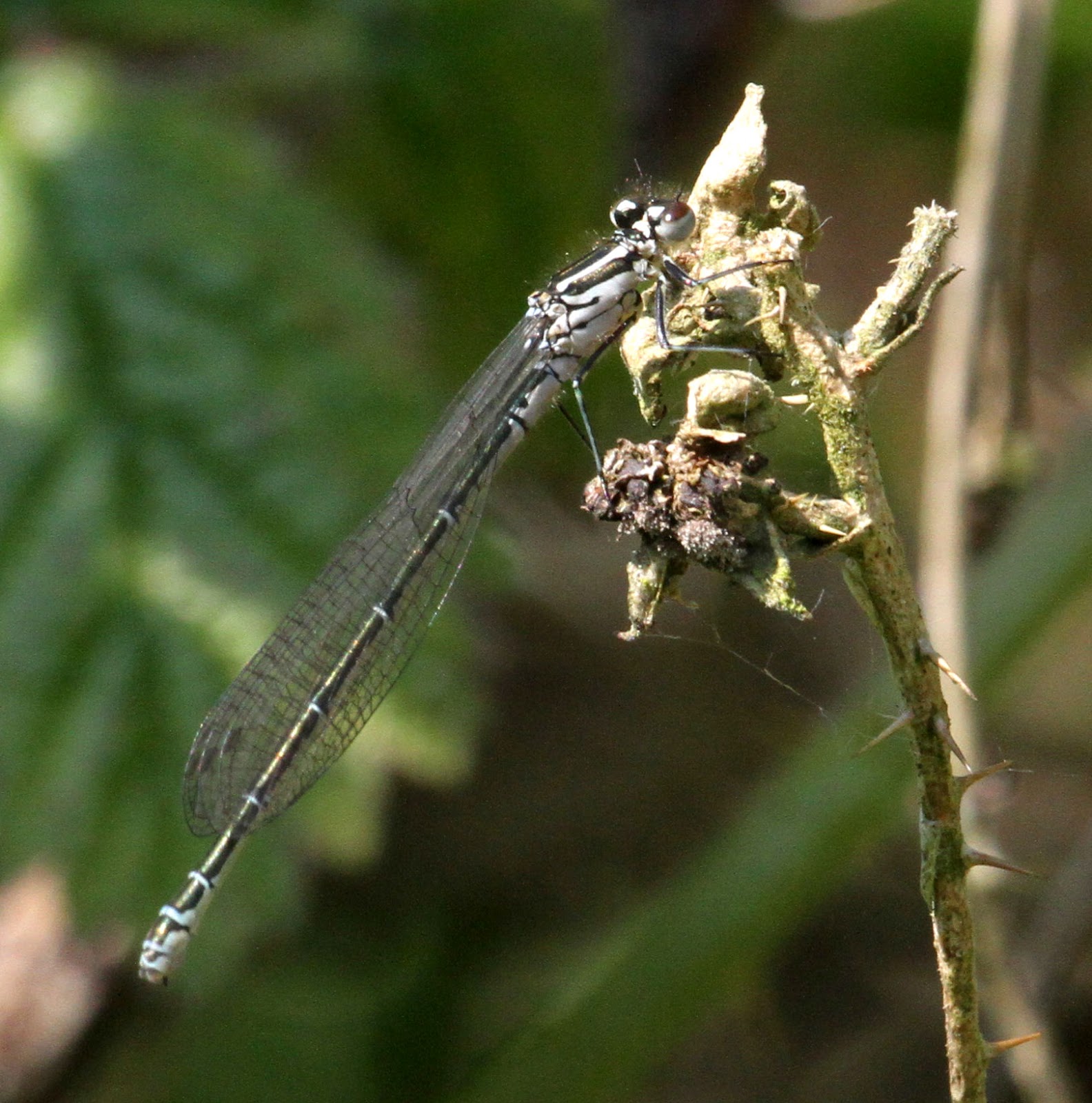
A single Holly Blue flew over while we were looking at the bugs in the morning, while in the afternoon a Holly Blue landed the other side of the bridge with the bathing Chaffinch.  There were also several Blue-tailed Damselflies in the area, and what looked like an Azure damselfly.  As we came back along this hedgerow later in the morning we came across a large Hawker Dragonfly drying off on an umbellifer stalk.  
Hairy Dragonfly
 Large Red Damselfly
 Blue-tailed Damselfly
 Fenmale Azure Damselfly (Thanks to P. Ashton)
 Chaffinch
 Flies above Di's Head
 Further down the lane we hear our first Chiffchaff, and a Willow Warbler in the afternoon, which made its typical Willow Warbler song, but which also made the sound 3 times of a speeded up Chiffchaff song – not a phenomenon of which I’ve previously been aware.  The old Cormorant tree had been cut down – probably instigated by anglers.  There were no Cormorants round here anymore, but we did flush a Heron.  An Oystercatcher was heard calling, probably over the river & there was a single Great Crested Grebe & a Mute Swan on the main lake.  While we were scanning the lake a couple of Common Terns went over us, but there was very little else to see here.  As we continued a Lesser Black-Backed Gull flew over & there was a Black-headed Gull over the river.  At the end of the lake the searching for Reed Warblers was hampered by 3 noisy dogs splashing in the water.  

As we looked out across the river a Cormorant flew across to the south bank in the morning, whilst in the afternoon about 6 were sitting on a sandbank now that their tree had been denied to them.  On the return journey a Blackcap sang clearly quite close to an abandoned garden, whilst in the afternoon a couple of Bullfinches were heard near here.  Finally, a new butterfly species was a Comma which landed on a stump of a tree for a few minutes.  The afternoon group especially, seemed quite dehydrated & at least 3 of them repaired to the local hostelry for a refreshing cool drink.
Weevils
After the morning session David & Steve moved on to another site where Steve noticed a Spotted Flycatcher!
 Spotted Flycatcher (c) 2012 David Tasker