Showing posts with label Luthien. Show all posts

Tuesday, 7 July 2015

Tolkien's Hemlock Glade, Part 2


A Hemlock Glade, The Houses of Healing, Two Towers and a Beacon: Tolkien in East Yorkshire, Part 2: Roos (& Halsham)


Please note the text explaining the latest findings about Tolkien and Roos may be read in my essay ‘Tolkien in East Yorkshire’ published in Something Has Gone Crack edited by Janet Brennan Croft & Annika Röttinger.


Cow Parsley in Roos Churchyard - May 2014
 Cow Parsley & fresh Beech leaves in Roos Churchyard - May 2015
Modern map of Roos with Dents Garth marked to the upper right (north-east) of the church

Roos


Railings surrounding the crypt stairs at the north-east corner of Roos Church (2015)

Ivy & ferns covering subterranean stairs to a crypt before undergrowth was cleared (c) 2006 Paul Glazzard
Heraldic Device of the Sykes family
Detail of the hand from the Sykes' family Heraldic Shield 


Tolkien's sketch of Beren's heraldic device


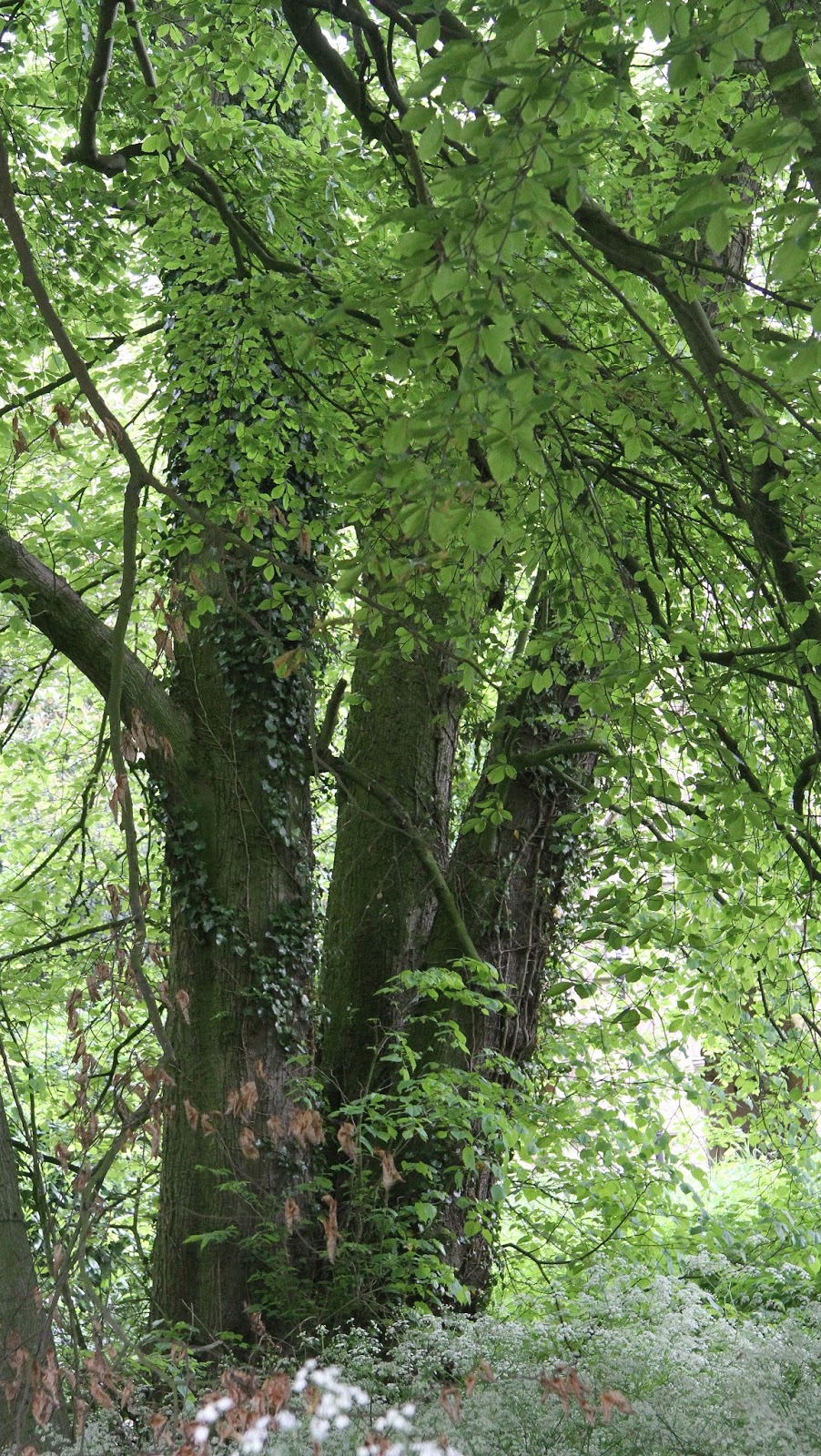
Three-trunked Lime Tree in Roos churchyard

Three-trunked Lime Tree surrounded by Cow Parsley

The almost dry course of Roos Beck - 25th May 2015
Halsham

Victorian Map showing relative densities of Roos & Halsam

Halsham Mausoleum
Halsham Mausoleum


Halsham House
North-facing alcove on Halsham Hoiuse containing a statue of the Virgin Mary.  Some of the cement work looks modern, so is the alcove a relatively modern feature, or has it just been recently repaired?

Part 1 (Introduction & Hornsea) may be read here
Part 3 (Thirtle Bridge & Withernsea) may be read here
Part 4 (Brooklands Officers' Hospital & Godwin Battery) may be read here
Part 5 (Easington & Spurn Point) may be read here  

My thanks to Marcel Aubron-Bülles, Jerry Aurand, Chris Delworth-Kerr, Linda Flowers, John Garth, Phil Mathison with whom I was able to consult on various aspects of my research while I was writing this paper.   

Footnotes

11. Mathison, p.34.
12. Carpenter, Humphrey (ed.) with Christopher Tolkien, The Letters of J.R.R. Tolkien, (George Allen & Unwin, 1981), p.221.
13. Ibid, p.345.
14. Ibid, p.420.
15. J.R.R. Tolkien, The Book of Lost Tales, Part Two, (ed.) Christopher Tolkien (George Allen & Unwin, 1984) p.11.
16. Ibid, p.18.
17. Tolkien Society Facebook page, 29 May 2015.
18. Rooster, 147, 148, 150 [July, Aug, Oct 2007].
19. J.R.R. Tolkien, Silmarillion, (ed.) Christopher Tolkien (George Allen & Unwin, 1977) p.358 & p.329.
20. Garth, p.237.
21. Kent, p.93.
22. Allison, p.39.
23. Ibid, p.32.
24.  J.R.R. Tolkien, Sauron Defeated, (ed.) Christopher Tolkien (George Allen & Unwin, 1992), p.367.
25. Ibid, p.384.
26. Mathison, p.12.
27. Ibid, p.56.

Sunday, 10 August 2014

Tolkien's Ghostly Presence

 This blogpost would not have been possible without the diligent research initially by John Garth, and subsequently by local author Phil Mathison

When childhood images crowd in upon my mind they include days spent on a beautifully sandy, virtually deserted beach during the summer holidays; a remote country churchyard surrounded by beautifully-shaped yew hedges and trees; and many visits to Yorkshire’s largest natural freshwater lake.  Later, when I left school these images were augmented by the scene of a shabby-looking building as viewed in between customers through a plate-glass bank window, and a decade afterwards my car being broken into and raided outside a building surrounded by leafy, sycamore trees.  What these mundane memories evoke seems banal enough, but rather surprisingly each one is connected with places known intimately by that master of modern fantasy writing, the author of The Lord of the Rings almost a century ago.

 All Saints’ Church, Roos.  View from the west looking along the Yew Avenue to the Church.
 Easington Cliffs and beach looking south towards Kilnsea.
My parents took us every summer to the virtually deserted beaches at Spurn Point or Kilnsea because they had an aversion to crowded resorts.  The peninsula is dotted with strange gun emplacements, watch towers, and fragments of railway line that seem to emerge from nowhere, continue for a few yards, and then disappear into nothingness again.  These were very intriguing and mysterious to a child, but I knew that they were related to wartime activity.  However,  it was only many years later that I discovered that J.R.R. Tolkien was stationed at Kilnsea, and nearby Easington in the First World War as part of the garrison guarding the East Yorkshire Coast.  While I secreted and lost a fifty pence piece given to me for my birthday among the crumbling defences on the East coast in the 1970s, more than half a century earlier Tolkien had been in the same vicinity, but with a much more serious object in view, helping to protect the coast against possible foreign incursions. 
Easington Cliffs looking south towards Kilnsea.  The barbed wire compound is reminiscent of how this stretch of coast may have looked in 1917-18. 
 Similarly, while my father was involved in heavy physical labour in Roos churchyard and I watched enthralled nearby as a Spotted Flycatcher took off on one of its amazingly versatile sorties in pursuit of a specific insect, I was completely unaware that Tolkien was inspired by his wife’s dance only a few hundred yards away, and over fifty years earlier to write one of his most personally felt, and satisfying mythological tales.  Likewise, many childhood visits were made to the beautiful Hornsea Mere to observe the wildfowl and other birds in absolute ignorance that Tolkien resided there for a time, and probably underwent firearms training nearby.  Likewise, when Hull University staff from the Dennison Centre reported my car being broken into, when it was parked outside, I was blithely ignorant that one of my favourite authors spent several months convalescing inside the building, as his huge mythological edifice began to cohere and take shape.  
The Dennison Centre Cottingham Road, Hull. Previously Brooklands Officers’ Hospital, as taken from the entrance to the University of Hull.
 It must have been in 1981 on publication of the Letters of J.R.R. Tolkien that I became aware that a small village called Roos was mentioned three times.  Could this actually be the same tiny place I was taken as a child when my father was employed in heavy physical labour within the churchyard?  On further investigation it was clear Tolkien’s Roos was identical to the one I knew in East Yorkshire.  I can still recall how surprised I was to learn that Tolkien was inspired to write about the Elven princess Lúthien Tinúviel by watching his young wife dance for him in a wood near the seemingly-insignificant Roos.  Shortly afterwards I read Humphrey Carpenter’s J.R.R. Tolkien: A Biography for the first time even though it had been published several years earlier.  It became clearer from the biography that Tolkien was stationed for a brief period in the Roos area, and also convalesced for a time at Brooklands Officers’ Hospital in Hull, but the account is very brief, and from the breezy tone of the book, the war period, despite the inherent and obvious dangers doesn’t appear as being especially significant in Tolkien’s long life and writing career.  Not long after reading the biography my school days came to an end and after a few years spent stamping Hull people’s cheques and credits, and even on one occasion having to bellow at Philip Larkin in a bank on Cottingham Road, I was transferred to Withernsea, a bleak and rundown town on Yorkshire’s east coast.  It was to be nearly another two decades before I realised that even this location had a Tolkien connection.  I had no idea when I glanced out of the window between customers at a bank in Withernsea I was looking directly into the doorway of Edith Tolkien’s 1917 lodging house.  
The view from the bank's window: 76 Queen Street, Withernsea.  Edith Tolkien lodged here from 12th July – 21st August 1917.
 The entrance to the lodging house in 1917 was on the far left of this building.

Five years of drudgery in Withernsea made me wish to resume my higher education, and I enrolled in an English Language and Literature course at the University of Hull.  Tolkien had a very low profile here, so I was surprised to see a copy of The Lord of the Rings on my favourite tutor’s bookshelf, but his fiction wasn’t available to be studied on any of the existing modules.  It may have been for this reason that I chose Old English, and at least here Tolkien’s importance as a Beowulf scholar was emphasized.  As a mature student I was one of the relatively few students with a car, and if I was only visiting the library or campus for a brief period my early morning parking spot was just outside the Dennison Centre.  However, a further Tolkien connection was not learned until nearly 20 years after graduation.  
The Dennison Centre Cottingham Road, Hull. Previously Brooklands Officers’ Hospital.  The hospital was on the right (west side) of this building.

 The Dennison Centre Cottingham Road, Hull. Previously Brooklands Officers’ Hospital.  The rear view, from the gardens.
The vague hints of Tolkien’s stay in East Yorkshire and correspondences with locations in my own life didn’t really coalesce until after I first read John Garth’s Tolkien and the Great War.  This work concentrated a lot more on Tolkien’s time in the area than Carpenter.  One also gets the impression that Garth actually visited the East Yorkshire locations and understood how these unique landscapes affected and inspired a writer in a way Carpenter’s rather “Oxford-centric” approach never does.  Indeed, although Garth is a professional journalist his prose takes on an almost poetic quality at times, especially when he is describing the eerie qualities of the topography and the fragility of the Holderness peninsula.  Garth quietly modifies some of Carpenter’s incorrect dating of events, and provides more detail to the bones of the original skeletal biographical account.  For instance, the dating of the inspirational dance at Roos is changed from 1918 to spring 1917, and Tolkien’s time at Thirtle Bridge, Easington and Hornsea is fleshed out, and Brooklands is identified as being on Cottingham Road in Hull.  Although I know many tiny nooks and crannies in Holderness, I had never even heard of Thirtle Bridge before reading Garth’s book.  This wasn’t surprising as Thirtle Bridge was a temporary army camp, only constructed for purposes of war, and not likely to leave a large architectural legacy.  Garth highlights just what Tolkien was working on at his time in East Yorkshire, and includes several very acute analyses of specific poems and his emerging mythology, explaining just how and why they were affected and influenced.   
Thirtle Bridge Officers’ Mess, now renamed Mona House, and much extended and altered.  The original officers’ mess was on the site of the left-hand side of the present building.
Thirtle Bridge Cookhouse, now used as a barn.
 Finally, in 2012 a slim local volume was published which filled in several of the remaining blank spaces, and coincidentally hammered home the personal resonances for me.  Unlike Carpenter’s breezy style, and Garth’s poetic journalistic combination, Phil Mathison’s meticulous workmanlike research sifted every available scrap of postcard, envelope, and war office medical board report in order to tease out as far as is possible an exact chronology and itinerary of Tolkien’s time in East Yorkshire.  Therefore we learn of the exact addresses at which Edith and Jennie Grove lodged in Hornsea and Withernsea and for how long.  Mathison even manages to locate some structures on the Thirtle Bridge site, and proves that a couple of them have managed to survive into the 21st-century.  Mathison also manages to pinpoint the precise modern-day location of Brooklands Officers’ Hospital, which turns out to be my favourite university parking place, immediately opposite the university entrance!  Mathison also reveals that Tolkien was treated at a second hospital at the Godwin Battery right on the edge of the thundering North Sea.  This was the most surprising revelation of all for me, because for the last decade I’ve been leading my students past the exact spot on the way to watch some of Britain’s most threatened breeding sea birds.
Hornsea – the most picturesque approach.  Tolkien’s fascination with place-names would have told him that Hornsea’s name was derived from its development near its inland sea – the mere – not its proximity to the German Ocean. 
 1 Bank Terrace, Hornsea.  Edith Tolkien and her cousin Jennie Grove lodged here from 1st May – 1st June 1917.
 Blue Plaque on 1 Bank Terrace, Hornsea. NB Jennie Grove is incorrectly said to be Tolkien’s cousin, and her first name is also spelled incorrectly.
 View from Dents Garth, Roos looking towards Thirtle Bridge.
 Golden Sands Caravan Park, Kilnsea.  The site of the Godwin battery hospital was just behind the notice.
It is now possible after Mathison’s research to follow in Tolkien footsteps in East Yorkshire, although wartime restrictions on information mean that some details still remain a little vague.  We know that Tolkien was expected locally any time after 27th November 1916, but he didn’t actually arrive in East Yorkshire until 19th April 1917.  Shortly afterwards Edith lodged at 1 Bank Terrace, Hornsea, while she thought Tolkien was going to be based at the nearby Hornsea musktry camp.  However, when it became clear he was more likely to be stationed at the more distant Thirtle Bridge Camp she left Hornsea.  There is no extant correspondence for the six weeks after Edith left Bank Terrace, so either letters have been lost, or there was no need for letters.  It is possible that the young married couple may have been able to stay together for those six weeks.  At the end of this time Edith took lodgings in Withernsea, which was only 3 miles from Tolkien at Thirtle Bridge.  In May 1917 Edith danced near Roos, and the inspiration for Lúthien and Beren was sparked.  On the 13th of August Tolkien was admitted to Brooklands officers’ Hospital for the first time.  In total he spent more than twenty weeks of his eighteen months in the region in those congenial surroundings. It was at Brooklands that he was able to devote the longest concentrated time on his emerging mythology than at any earlier period.  In that time he wrote the first versions of ‘The Tale of Tinúviel’ and ‘The Tale of Turambar.’  These are arguably the two most important and central narratives which make up The Silmarillion, and they were to take hold of Tolkien’s imaginative writing for decades to come.  While Tolkien was hospitalised he was under the auspices of local land-owner Margaret Strickland-Constable.  She was a keen linguistic herself, apparently proficient in German, French, Swedish, Norwegian and Danish, and one wonders if she and the putative author discussed this common connection?  It is known that Tolkien consolidated his knowledge of Italian and Spanish, and even began to study Russian while he was hospitalised.  Of course Tolkien’s invented languages play a crucial part in his developing stories and he was also able to devote a lot of time expanding his lexicon and grammar of Qenya and Goldogrin, thus providing a substantial linguistic groundwork for his imaginative world.    
Margaret Strickland-Constable (1863-1961).  Operated the Brooklands Officers’ Hospital in Hull when Tolkien was hospitalised.
After Mathison’s research there may not be much more new material to unearth regarding Tolkien’s time in East Yorkshire, but we can always remain hopeful.  Some intriguing loose ends do still remain.  For instance, when Tolkien was in the Humber Garrison he travelled to Dunstable to sit a Signalling Course exam in the second half of July 1917.  Were Tolkien’s duties as a signalling officer connected in any way with the largest surviving remnant of the Great War in Holderness?  This is something which remained unmentioned by both Garth and Mathison.  In 1916, or possibly 1917, according to local historian Jan Crowther, an Acoustic Sound Mirror was erected at Kilnsea to listen out for approaching zeppelins and other aircraft.  The sound was focussed by the concave dish to the “collector’s head” mounted on the metal pipe still visible in modern photographs, on which was a rudimentary microphone.  Wires from this led down to a trench in which an operator with headphones would listen for approaching aircraft, and would provide an early warning.  We will probably never know if Tolkien was one of those “listeners”, but even if not, when he was in Kilnsea he could not have failed to see this brutal, monumental concrete structure.  Incidentally, this 16-feet high piece of concrete remains the only listed building in Kilnsea. 
Acoustic Sound Mirror, Kilnsea.  Installed 1916/17.  Would a Signalling Officer have used this to monitor approaching aircraft?
Acoustic Sound Mirror, Kilnsea. The post which held the rudimentary microphone may be seen directly in front of the dish.
Obviously Oxford, and the outskirts of Birmingham are pre-eminently important in understanding Tolkien’s life and work, but East Yorkshire, although much more briefly connected to Tolkien, still played a crucial part at a very difficult period in his life, and as an inspiration for the foundation of his emerging mythology.  Philip Larkin famously liked Hull, because it was away from the literary salons of London, and because it was out on the edge of things.  However, Hull’s isolation doesn’t always work in its favour.  Hull and Holderness are often sidelined from the mainstream because of their particular geological location, but at the moment they also seem to getting continually sidelined by the less concrete assertions of other localities.  Among these the Burren in Ireland and Stoneyhurst College in Lancashire seem to be garnering plenty of media attention in newspaper articles, but if you examine their claims in detail it is evident that the texts they were meant to have inspired were virtually completed by the time Tolkien visited those locations.  Further afield the claims of Ethiopia and Pawneeland as the ‘real’ inspirations for Middle-earth have spawned book-length theses bolstering their claims.  In contrast, Tolkien’s time in East Yorkshire occurred at a tumultuous period in world history, but also at a significant period in both his personal life and literary development.  Despite the threatening presence of Zeppelins appearing on the Yorkshire coast, Tolkien was able to spend a brief idyllic time with his young wife on the outskirts of Roos, until the peripatetic life of an army wife and Tolkien’s own ill health became too much for Edith, and she returned to Cheltenham to give birth to her first child.  More importantly for literary history the dance in an unassuming quiet village in East Yorkshire to use Tolkien’s own words inspired the “kernel of the mythology, the matter of Lúthien Tinúviel and Beren, arose from a small woodland glade filled with ‘hemlocks’ (or other while umbellifers) near Roos on the Holderness peninsula.”  To those who are interested in one of the genuine inspirations for Tolkien’s imaginative fiction, Roos and associated localities in East Yorkshire will hopefully one day take their rightful place behind Birmingham and Oxford, but ahead of what amounts to barely more than fraudulent claims by other locations, as an important milestone on the Tolkien literary trail.  
Cow Parsley in Roos churchyard May 2014. 
Hull’s appointment as City of Culture occurs in 2017, which coincides with the centenary of Tolkien’s tenure in the area, and more significantly the centenary of the genesis of the Beren and Lúthien story in the May of 2017.  Hopefully, some enterprising Tolkien aficionado will ensure that an event will be organised to celebrate and commemorate this momentous literary occasion.


Some Other Holderness Locations:
The Two Towers of Easington:
‘The Tower’, Easington.  In 1917-18 Robert Walker, the owner, rented his properties to army families.
 The Old Coastguard House, Easington.  Local landmark.
 Tunstall Hall.  During WW1 used as Officers’ headquarters and lodgings for officers.
 Roos, North side of Dents Garth looking south.
Roos, South side of Dents Garth looking north.
 Plaques on Blue Bell, Kilnsea. They illustrate the destructive  power of the North Sea. 
 North Side of the Blue Bell, Kilnsea.  This was a public house when Tolkien was at the nearby Godwin Battery.
 All Saints’ Church, Roos.  View of the north side including watch tower.

Monday, 9 June 2014

A Hemlock By Any Other Name...


          The leaves were long, the grass was green,
       The hemlock-umbels tall and fair,
And in the glade a light was seen
   Of stars in shadow shimmering.
[The Fellowship of the Ring, ‘A Knife in the Dark’, p.191]

Umbellifers in Roos Graveyard, East Yorkshire, May 2014

It is the 9th of June 2014, and we have recently passed the 97th anniversary of the moment when the invalided soldier J.R.R. Tolkien was mesmerised by his young wife, Edith, dancing for him near Roos in East Yorkshire.  He later acknowledged to his son, Christopher, in a letter dated 11th July 1972 that this event inspired the romantic fictional encounter between the immortal Elven Princess, Lúthien Tinúviel with the mortal hero Beren.  In this correspondence to his youngest son Tolkien mentioned the location, but also that the event took place in “a small woodland glade filled with ‘hemlocks’ (or other white umbellifers).”(1)

Woodland at Dents Garth, Roos, East Yorkshire
The importance of this event to Tolkien can be illustrated by the number of times he reworked this meeting in both poetry and prose between 1917 and 1954.  He wrote at least four different versions of the encounter, and at least two summaries in which the ‘hemlocks’ aren’t mentioned.  There are doubtless other versions which have not so far been reprinted.  In addition to the letter informing Christopher, he related the same genesis of the story to his American publishers in 1955 (2), and in a letter to Christopher Bretherton in 1965 (3).  The symbolic importance to Tolkien of the woodland dance is also emphasised by that fact his own gravestone is inscribed with the name of ‘Lúthien’ under the name of Edith, and the fictional ‘Beren’ under his own name.  Although the inspiration took place during World War One, it was of sufficient importance for Tolkien, more than half a century later, to insist that this event be memorialised by the addition of ‘Lúthien’ to his wife’s tombstone.

Tolkien's Gravestone in Wolvercote Cemetery, Oxford
Photo courtesy (c) 2014 Daniel Helen
So, why was this West Midlander J.R.R. Tolkien in a remote peaceful woodland glade in East Yorkshire, while the First World War was still raging several hundred miles to the south?  Tolkien enlisted in the war as soon as he had sat his University finals, and in June 1916 he was sent to France to join the rest of the Lancashire fusiliers.  After involvement in the Battle of the Somme in July he contracted Trench Fever, and he returned to England in November to convalesce.  Initially, Tolkien worked on his emerging mythology at Great Heywood in the Midlands, but in the spring of 1917 he was posted to the Humber Garrison in East Yorkshire.  One result of Trench Fever were recurrent bouts of high temperatures and debility, and it was during these that Tolkien spent some time recuperating at Brooklands’ Officer’s Hospital in Hull through 1917 and 1918.  This period of recuperation saw “Tolkien’s Mythology for England” really begin to take shape, and he first wrote about two characters, which he would later state was the most central story of his mythology.  His readers first became aware of Beren and Lúthien as background figures when they were captivated by The Fellowship of the Ring (1954), but their true significance was only really appreciated when The Silmarillion was published posthumously in 1977.

Blue Plaque on Former Brooklands Officers Hospital, Hull
Determining which particular species Tolkien was referring to when he used the word ‘hemlocks’ may help to both visualise the setting and approximately date the event, as different umbellifers flower at specific times of the year.   In the official biography, which was published in the same year as The Silmarillion, Humphrey Carpenter dated these events to spring 1918, but the diligent research of John Garth has shown that spring 1917 is the correct year.  According to Richard Fitter “many other umbellifers are loosely referred to as hemlock”(4), and Tolkien’s letter quoted above indicates this was precisely the case with him.  Rather surprisingly the linguistically precise Tolkien was vague about this particular subject.  So, was the species he saw actually Hemlock (Conium maculatum)?  “Tall” is one of the most constant adjectives ascribed to hemlocks in the many versions of the fictional encounter Tolkien wrote, including the extract from the poem quoted at the head of this article.  There is no doubt that Hemlock, which can exceed seven-feet in height amply fulfils that criterion.  However, there are legitimate reasons for believing that the poisonous plant Hemlock is not the species, which surrounded the dancing Edith.  Hemlock gives off a really unpleasant scent even before it comes into flower, sometimes likened to an infestation of mice.  When Hemlock begins to flower the smell is even more intense and pungent, and there can hardly be a less romantic aroma to accompany a real-life, or fictional love story.  Also, Tolkien explicitly states that the actual dance took place in a woodland glade, and this is not really the suitable habitat for a large growth of Hemlock.  They are much more likely to be found in open areas not shaded by trees, such as waste ground or by roads and stream-banks.  

Hemlock (Conium maculatum)
Another possible contender for the species which Tolkien saw could be Cow Parsnip, also commonly known as Hogweed (Heracleum sphonydylium).  In some respects this seems more likely than Hemlock, as it does not have an unpleasant smell, and it commonly grows in woodland.  Flora Britannica notes that in June “areas of rough grassland full of the large white flower discs can seem almost luminous under the full moon.”(5)  On the negative side it does not grow as tall as Hemlock, or some other umbellifers, and its larger, flatter flower discs do not cluster in such a way that fits Tolkien’s description of the flowers as like a “cloud” (6) or a “mist” (7).  Phil Mathison discovered during research for his book Tolkien in East Yorkshire, that the spring of 1917 in East Yorkshire was “of an exceptional nature, brilliantly fine and warm.”(8).  The spring of 2014 was similarly advanced, so it may be possible to approximately date Edith’s dance by comparing the flowering period of the relevant umbellifer species.  In 2014 both Hemlock and Hogweed began to flower in the Roos area on almost exactly the 1st of June, and both should continue to flower for at least two months, and longer in the case of the Hogweed.  Superficially this agrees with the earliest surviving version of the story, which states that “on a time of June they were playing there, and the white umbels of the hemlocks were like a cloud about the boles of the trees.” (6).

Hogweed (Heracleum sphonydylium)
Despite the explicit use of June in the first version, Tolkien complicated the spring time-frame by including additional botanical details in later versions.  In The Lay of Leithian the meeting of the lovers takes place after the chestnuts had recently shed their flowering candles (9).  In 2014 at the latitude of Roos the Horse Chestnuts (Aesculus hippocastanum) started to flower before the end of April, and the flowers had all been dropped by around the third week in May.  This version would seem to be set earlier than June, as by then the chestnut flowers would have turned brown, and started to rot away.

Delicate Flowers of Queen Anne's Lace or Cow Parsley (Anthricus sylvestris)
 A third species of umbellifer, Cow Parsley (Anthricus sylvestris) also known as Queen Anne’s Lace flowers at the correct time.  According to Flora Britannica: “Cow Parsley is arguably the most important spring landscape flower in Britain.  For nearly all of May, almost every country road is edged with its froth of white blooms.”(10).  The froth of white blooms of Queen Anne’s Lace is the most accurate fit with Tolkien’s description of the hemlocks as being “like a cloud” or “like a mist,” and, as many of the flowers exceed six feet in height, the epithet “tall” is also fitting.  John Garth’s researches in East Yorkshire led him to identify Tolkien’s ‘hemlocks’ as Queen Anne’s Lace or Cow Parsley (11), and Dinah Hazell in the Plants of Middle-earth concurs (12).

Cow Parsley Under Sycamores at Dents Garth, Roos
It may be possible to roughly estimate the date of Edith’s dance by comparing the flowering period of Queen Anne’s Lace at Roos in the spring of 2014 and extrapolating that back to 1917.  This year the white umbels began to open in sheltered spots around the 1st of May, and by 10th of May it was a fine spectacle - it remained in this condition for most of the rest of the month.  However, in Dents Garth, the supposed site of Edith’s dance in Roos, the flowering was definitely beginning to look tired and faded in most places of the woodland by 27th of May.  Heavy rain both on and subsequent to that date ensured it did not survive into June.  It is unlikely that Tolkien would have commented favourably on the beauty of the whiteness of the ‘hemlocks’ if it had already begun to fade, so a date in June seems rather unlikely.  This would suggest that Edith Tolkien’s dance occurred during the month of May 1917, with some time after the tenth of the month being the most likely. 

Cow Parsley Under Sycamores and Ash at Dents Garth, Roos
When Aragorn quotes the lines of verse about Beren and Lúthien given at the top of this page, it would not have been appropriate for him to have called the flower Queen Anne’s Lace.  The name of a seventeenth-century English monarch would not have fitted easily either into the scansion of the poem or a narrative set in a remote past!  It would have been an equally unsuitable name for events from the First Age of Middle-earth, which is placed in an even more remote millennia.  The alternative name of Cow Parley may not have been aesthetically pleasing to Tolkien for different reasons, but there are many other localised names he could have used.  In various parts of the United Kingdom Cow Parsley is known as Mother Die, Step-mother, Grandpa’s Pepper, Hedge Parsley, Badman’s Oatmeal and even Rabbit Meat!  Of these only Hedge Parsley seems acceptable as a possible alternative for the hemlock, which was the one he utilised.  Tolkien may have been unaware when he wrote the Book of Lost Tales with its diminutive protagonists that another vernacular name for Cow Parsley is the highly appropriate Fairy Lace!   Of course Tolkien may simply not have been interested in knowing the precise name used by botanists or local rural folk.  He called all similar umbellifers ‘hemlocks’, and what was good enough for him was also good enough for his story of tragic lovers.

Cow Parsley lines path along edge of Dents Garth, Roos
Anyone with a vaguely classical education in the late-nineteenth century would have been aware that Socrates was sentenced to death, and was poisoned by a fatal drink of hemlock.  Socrates, despite the urging of his friends accepted the courts’ decision and nobly drank the fatal dose whilst still discoursing to his disciples.  Hemlock is therefore associated from ancient times with a story of noble self-sacrifice, and it seems highly appropriate that Tolkien utilised the name hemlock at the very commencement of his great story of love and self-sacrifice.  It seems Tolkien selected the name 'hemlock', either from a lack of precise botanical knowledge of the exact species he saw, or because he felt that that word fitted best within his story. 

The West End of Dents Garth, Roos
 The East End of Dents Garth, Roos
I have shown beyond reasonable doubt that Cow Parsley is the species Tolkien intended as the “great misty growth” of “white umbels...like a cloud about the boles of the trees”(6).  This identification and the examination of the flowering period of the plant at Roos this spring confirms that Edith’s dance almost certainly occurred after 10th of May and before the 31st of May 1917.
 Unusual Watch-Tower on Roos Church.  
The beginning of Dents Garth woodland may be seen to the Left
PostScript: I travelled approximately 30 miles north of Roos on 11th of June to Wharram Percy (near Wetwang) on the Yorkshire Wolds, and was surprised to see Cow Parsley still in flower. In fact it was in better condition than those in Roos on 27th May. Roos is more or less at sea level, but Wharram Percy is approx 550 feet above sea level. It's amazing the difference 30 miles north & a much higher location, which faces north can have on flowering times!
Notes
1. Letters, No.340, p.420.
2. Ibid., No. 165, p.221.
3. Ibid., No. 257, p.345.
4. Wild Flowers, p.180.
5. Flora Britannica, p.294.
6. Book of Lost Tales II, p.10.
7. Lays of Beleriand, p.174.
8. Tolkien in East Yorkshire, p.45.
9. Lays of Beleriand, p.174.
10. Flora Britannica, p.283.
11. Tolkien & the Great War, p.238.
12. The Plants of Middle-earth, p.54.

Further Reading
Humphrey Carpenter, J.R.R. Tolkien: a Life, London: Allen & Unwin, 1977.
Richard Fitter et al, Wild flowers of Britain &Ireland, London: A & C Black, 2003.
John Garth, Tolkien and the Great War, London: Harper Collins, 2003.
Dinah Hazell, The Plants of Middle-earth: Botany and Sub-Creation, Kent: Kent Univ Press, 2006.
Richard Mabey, Flora Britannica, London: Chatto & Windus, 1997.
Phil Mathison, Tolkien in East Yorkshire 1917-1918: An Illustrated Tour, Newport: Dead Good, 2012.  

Tolkien's Works Consulted
The Lord of the Rings: 50th Anniversary Edition, London: Harper Collins, 2004.
The Silmarillion, London: Harper Collins, 1999.
Letters of J.R.R. Tolkien, London: Allen & Unwin, 1981.
The Book of Lost Tales Part Two, London: Harper Collins, 2002.
The Lays of Beleriand, London: Harper Collins, 2002.
The Shaping of Middle-Earth, London: Harper Collins, 2002.
The Lost Road, London: Harper Collins, 2002.
Morgoth's RingLondon: Harper Collins, 2002.
The War of the Jewels, London: Harper Collins, 2002.