Showing posts with label Spotted Flycatcher. Show all posts

Thursday, 19 July 2012

Gearing up for the Autumn Migration

This September every class will be visiting Spurn at the time of year when we are most likely to see the greatest variety of species on migration.  Below are photos taken during just 2 days in September 2008.  
Male Redstart on Migration at Spurn
 Immature Cuckoo
 Many adult Cuckoos and several immature Cuckoos have already left the UK, but in September there may still be a few lingerers.  As Cuckoos are becoming harder to see every year, and many people probably didn't manage to see or even hear one this spring, then will will make a determined effort to track any late leavers at Spurn this Autumn.
Immature Cuckoo
Another bird which has been in steep decline in recent years is the Spotted Flycatcher.  They were particularly difficult to find in East Yorskhire this spring.  I believe even Tophill Low didn't manage to host a breeding pair this year.  However, these are another of the so-called "common migrants" which we should be lucky enough to encounter on their leisurely southwards migration in September.
Spotted Flycatcher
 The Pied Flycatcher has never been a common breeding bird in East Yorkshire during my lifetime, so Autumn is the best time to try and locate this species in this county.
Pied Flycatcher
200 years ago the Red-Backed Shrike was quite a widespread breeding bird in England & Wales, but it hasn't been a regular breeder in the UK since the final bird nested in 1988.  Some Autumns there can be quite a scattering of individuals at coastal sites, and if there are any in 2012, I will try and ensure every course participant gets to see one of these Butcher Birds.  
Red-Backed-Shrike
Unlike the Red-Backed Shrike, its larger cousin is a winter visitor, but it may arrive on these shores at the same time as the smaller bird.  The individual below had just been ringed and was being show to the appreciative masses before it was released.  This year every class member will be given the opportunity to witness a range of birds being captured, ringed and released.  It is a real privilege to witness the process of ringing, and to see these birds at close quarters in the hand, so a small donation to help with the cost of this scientific work will be levied in this particular case.
 Great Grey Shrike
The Wheatear only passes through East Yorkshire on its way to and from its breeding areas on higher ground.  These are very popular birds with course participants as like many members of   the chat family they will pose in the open somewhere obvious giving birders plenty of time to get them in their binoculars.   Wheatears do arrive at Spurn on both their Spring and Autumn migration, but we are likely to see a wider range of plumages on display in the Autumn.  This is a young bird illustrated below. 
Wheatear
Another member of the chat family is the Redstart.  We do have a small breeding population in the very north corner of East Yorkshire, but again the coast is the best local area to encounter this species in any numbers.  At their breeding sites they can be fairly secretive, when they aren't feeding their young, and rather surprisingly these bright birds can be fairly difficult to see when the male is singing.  However, as in this example and the illustration at the top of this blog they will perch in the open during the Autumn migration. 
Male Redstart
 Female Redstart
The Stonechat is another member of the chat family.  Unlike every other perching bird mentioned in this post, the Stonechat has been increasing as a breeding bird in the UK.  Also, unlike most of the other small birds referred to  here, the Stonechat remains in the UK throughout the winter.  This seemed a sensible strategy when we were having mild winters, but it has declined markedly after the last 3 winters.  I can no longer guarantee we will see a Stonechat, but we will do our best to find one!
Stonechat
A final member of the chat family we may see in September is the Whinchat.  In the early 1980s this could be seen in the breeding season near Kiplingcotes, but those birds have long gone. In June and July the nearest birds are probably either on the North Yorkshire Moors or in South Yorkshire on some of the Humberhead peat levels, but in September a few individuals will still pass through Spurn on their way to Africa.

Whinchat
Most of the birds I've referred to so far are passerines, or songbirds, but you may see other families at the coast in September.  One wading bird which we are likely to observe is the Snipe.  Its cryptic plumage makes it very difficult to locate when it is feeding among dead and dry grasses, but it stands out quite well like this individual when it is in on a shorter lawn.
 Snipe
 September is a little early for the largest influx of Short-eared Owl, which usually occurs much later in the year, but in 2008 this bird was flying around early on the day of our visit.
Short-eared Owl

I am now taking bookings for the Autumn term, which begins on 4th of September. There are a couple of vacancies on most sessions, but Wednesday mornings, Thursday mornings & Thursday afternoons are either full or nearly full. For 2 hours a week for 10 weeks encounter the natural world as a completely new sensual experience. You'll be amazed what you'll find just by listening, and not only by looking! In the Autumn we'll be paying special attention to birds migrating along the East coast & Humber estuary. Specific birds we'll be hoping to see include: Bearded Tit, Hobby, Bittern, Kingfisher, Barn Owl, Red Kite, and nearly 100 other species! So, if you are interested in learning more about your local wildlife in beautiful and secluded venues for less than £10 a week, then this is the course for you! We visit a different local hotspot each week and identify all the birds and as much other wildlife as we can. Each session lasts at least 2 hours. The course runs twice daily Tuesday to Friday. 

Sunday, 3 June 2012

Red Stars

Male Redstart [at this location 3 years ago]
 Female Redstart
 Spotted Flycatcher
 Mayflies
 Micromoth
Rockrose

Yesterday afternoon was the first of the daytime wildlife events organised to coincide with Robert Fuller’s summer exhibition.  Four people met in the gallery from where we shared cars, and another 2 were waiting for us at the destination.  I also brought along my nephew who was often able to spot things quickly for the attendees.   On the journey we nearly slaughtered 8 Red-legged Partridges and an escaped lamb, but we managed to successfully avoid adding blood stains to the road.  Along the way there was a singing Meadow Pipit which I actually managed to spot on the return trip.  
From the car park we could hear a Yellowhammer singing just across the road, and this bird flew right over us and landed in the hedgerow we were shortly to walk past.  Here were also Goldfinches around the car park, but the usual Linnets were absent.  We plunged down the valley, and from the scrub there were distant Blackcaps and Willow warblers, but a more vibrant Song Thrush whilst another was visible on top of the Hawthorns.  One thing I noticed straight away was how noisy it is on weekends when there are a lot more non-birdwatchers in the area.  There was one family in particular of about 8 daughters, only half of whom were dressed in the compulsory pink who dawdled & made a hell of a lot of noise, and made my task that bit more difficult.  It was noticeable that Ben (12) did most of the complaining at the behaviour of the public, and came across as an old man!  
In the valley bottom I could hear a male redstart singing.  We went through a handgate an almost immediately I spotted a bird going into a cavity where Redstarts had nested 2 or 3 years ago.  I couldn’t believe they were using the same dirty old hole, but they were.  Both parents were going in and out regularly, so it was clear that their young were being fed.  We remained there for about half an hour, and although the Redstart’s movements at first were too quick for some of the viewers eventually both genders sat perched long enough looking for most people to get decent views.  This was a more colourful female than many, as a definite peachy blush could be discerned on her breast.  A Spotted Flycatcher also appeared briefly, and some Bullfinches flew over, and there were some Goldfinches perched on one of the dead Hawthorns.  
When we left the Redstarts and began to walk along the old railway line I could hear the very distinctive ‘chup’ of Crossbills, so these must have been in the stand of conifers which had been behind us when we were watching the Redstarts.  Along the early part of this walk we heard both a Chiffchaff and a Willow Warbler, and the latter was even spotted with its wings outstretched.  We also heard a Blackcap, but this could only be glimpsed among the thick hedgerow, although it was seen in flight, as it flew from one side to the other.  A Mayfly was clinging to a nettle, and when I looked at the photo there were actually 2 mayflies there.  There were singing Chaffinches, a Wren and another Chiffchaff near the quarry.  Meanwhile we had Swifts, House Martins and Swallows flying over us at various times.  
On the return to the gallery there were almost as many red-legged Partridges dicing with death, but the only new birds seen were a pair of Linnets flew up as we drove back past a quarry.

Tuesday, 22 May 2012

Blue Sky Birding

Yellowhammer

Today was a bit of a shock to the system, because it was our first decent day since March.  We met in a village “almost as nice as Surrey.”  There were a few Swifts around the green, but not screaming as usual.  The most noticeable sound was a Goldcrest singing from a nearby garden.  Everyone arrived in good time & we shared cars to nearer our eventual location.  At first the lane was very quiet, apart from an initial Skylark & a Blackcap.  The usual Whitethroat & Sedge Warbler were absent, but we took the first left turn, and immediately I could hear a ‘singing’ Yellow Wagtail.  One disadvantage of the bright sun was that it was very difficult to see.  We weren’t able to get too close before it flew off across a field.  However, only a few minutes later we had great views of a Yellowhammer, and a more elusive Whitethroat.  Other birds seen round here included Wren, Chaffinch & both Great & Blue Tits.  Not everyone managed to get a view of the Yellow Wagtail, but a Yellowhammer did the honours perching right in front of us & giving every single participant great views.   We carried on to where last year there had been an industrial car park, today it was deserted and already going back to nature.  A Marsh Harrier was being mobbed by a crow towards the river.  Orange tips began to appear & Peacock butterflies started chasing each other.  The Harrier had been replaced in the afternoon by a baby Linnet being fed in an emerging Ash tree.  The afternoon group were also able to study their first female Orange-tip as we retraced our steps down this first lane.  They also had a bold male chaffinch which was determined to have a bathe, no matter how many humans peered down on it from the fence across the little bridge.  
Yellowhammer
 Orange-Tip [female]

One we reached the original junction we carried on down the main road towards the river. At this point we were passed by a bughunter extraordinaire from the Hull Valley Group.  He was looking for some Shield bugs, which he first discovered at this venue a couple of weeks ago.  This is only the 3rd site for this particular species in Yorkshire.  After he left us 3 Tufted Ducks flew towards the marsh in the am, and the first distant Reed Warbler & Reed Bunting could now be heard from the Angling complex.  We caught up with Barry Warrington here & he was able to point out everyone’s first Woundwort Shield Bugs.  Claude got her eye in first and was able to point out several more – many of which seemed to be mating. I must admit I’d never even heard of this species before.  They are smaller than most other Shield Bugs I’d previously seen, but almost look metallic in some bright sunlight.  When we returned in the afternoon some large caterpillar tracks had destroyed the first 3 feet of verge in some places, but we were still able to find some mating shield bugs, so hopefully they will survive.
Woundwort Shield Bug (c) 2012 Barry Warrington
 Woundwort Shield Bugs
 Holly Blue

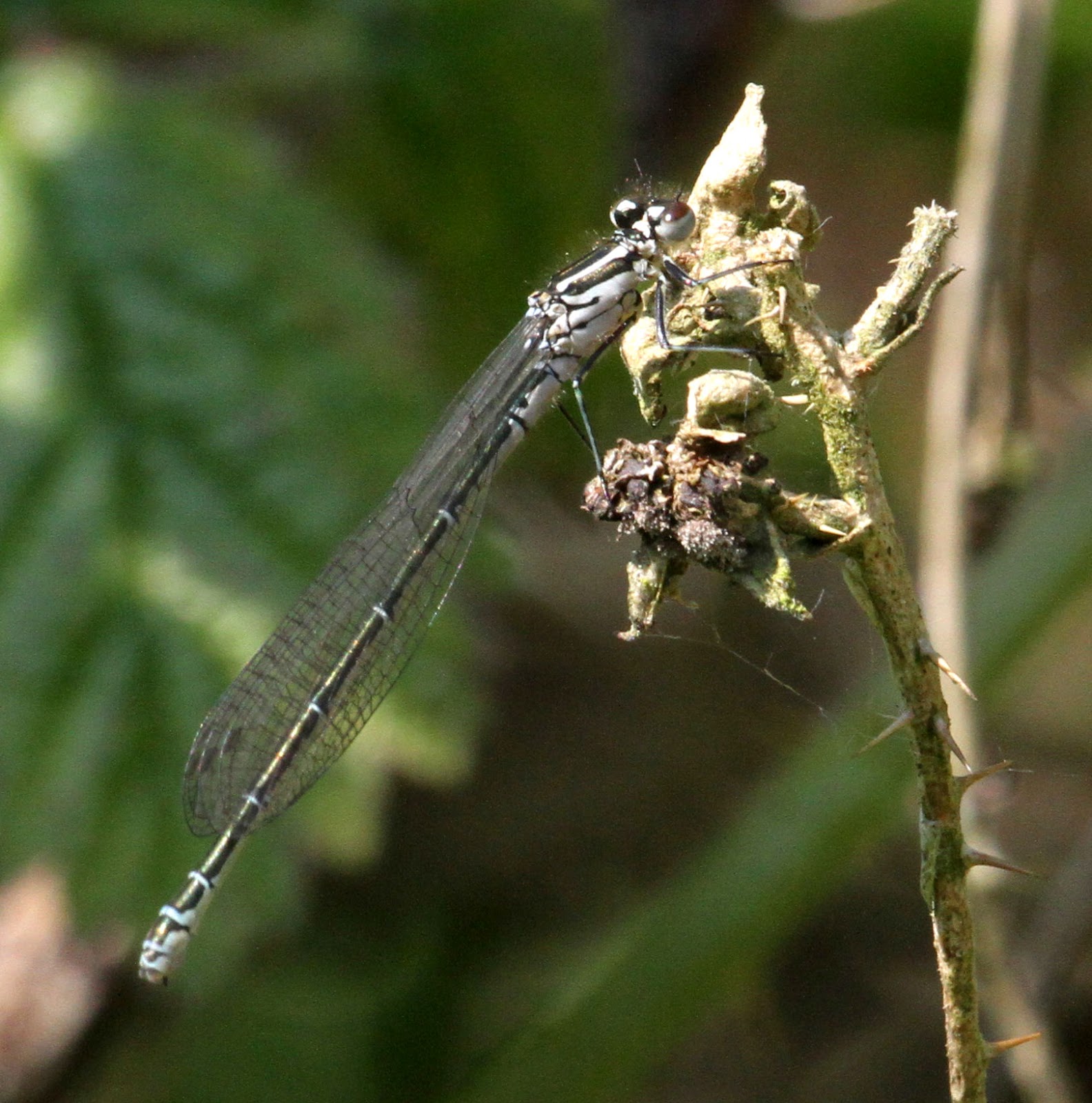
A single Holly Blue flew over while we were looking at the bugs in the morning, while in the afternoon a Holly Blue landed the other side of the bridge with the bathing Chaffinch.  There were also several Blue-tailed Damselflies in the area, and what looked like an Azure damselfly.  As we came back along this hedgerow later in the morning we came across a large Hawker Dragonfly drying off on an umbellifer stalk.  
Hairy Dragonfly
 Large Red Damselfly
 Blue-tailed Damselfly
 Fenmale Azure Damselfly (Thanks to P. Ashton)
 Chaffinch
 Flies above Di's Head
 Further down the lane we hear our first Chiffchaff, and a Willow Warbler in the afternoon, which made its typical Willow Warbler song, but which also made the sound 3 times of a speeded up Chiffchaff song – not a phenomenon of which I’ve previously been aware.  The old Cormorant tree had been cut down – probably instigated by anglers.  There were no Cormorants round here anymore, but we did flush a Heron.  An Oystercatcher was heard calling, probably over the river & there was a single Great Crested Grebe & a Mute Swan on the main lake.  While we were scanning the lake a couple of Common Terns went over us, but there was very little else to see here.  As we continued a Lesser Black-Backed Gull flew over & there was a Black-headed Gull over the river.  At the end of the lake the searching for Reed Warblers was hampered by 3 noisy dogs splashing in the water.  

As we looked out across the river a Cormorant flew across to the south bank in the morning, whilst in the afternoon about 6 were sitting on a sandbank now that their tree had been denied to them.  On the return journey a Blackcap sang clearly quite close to an abandoned garden, whilst in the afternoon a couple of Bullfinches were heard near here.  Finally, a new butterfly species was a Comma which landed on a stump of a tree for a few minutes.  The afternoon group especially, seemed quite dehydrated & at least 3 of them repaired to the local hostelry for a refreshing cool drink.
Weevils
After the morning session David & Steve moved on to another site where Steve noticed a Spotted Flycatcher!
 Spotted Flycatcher (c) 2012 David Tasker