Showing posts with label Blue-tailed Damselfly. Show all posts

Sunday, 15 July 2012

A 'Butterfly' Walk at Noddle Hill

Yesterday the Yorkshire Wildlife Trust organised a Butterfly Walk at the Noddle Hill Nature Reserve, and they even arranged for it not to rain!  Approximately 12 members of the public turned up  including a young media star, who recently found some Speckled Bush Crickets near the Humber Bridge.  Helen had plenty of ID sheets for anything other than butterflies we might see, and the children each took a net and some jars and magnifiers to observe any insects in detail.
Small Skipper
We set off down Red Admiral Alley, but my expectations weren't terribly high after the recent unsettled weather.   However, this alley is quite sheltered and quite soon we saw a few Ringlets, a high-flying Comma, a migrant Silver-Y-moth, and a smaller brown moth.  A pair of Blue-tailed Damselfies flew off before their picture could be taken.  There was no sign of the Speckled Wood butterflies, which had been in this area the other week.  However, we could be between their 3 or 4 broods.
Ringlet
 Silver-Y Moth

We emerged from the alley into a more open area, and pretty soon there was a fast moving skipper butterfly, and another dark brown moth, which may have been a carpet moth species.   There were plenty of wild flowers including Red and White clovers, Mellilot, and other members of the pea family.  An insignificant white-mauve flower was spotted by Helen and after investigation seemed to be the Smooth Tare.
Shaded Broad-Bar (thanks to Barry Warrington for ID)
 Caterpillar
  Caterpillar
 
Not long after this Maggie caught the first Meadow Brown of the day.  It seems hard to believe that this is the most numerous butterfly in the UK.  Only a little further one was a Soldier beetle, and we were going to see a lot more of them before the session ended.  We then came across a flooded area, which isn't really surprising considering the recent rain we've had.  It was along here that a Sedge Warbler could be heard singing from a bramble patch.  
Meadow Brown
 Smooth Tare
 Small Skipper
Soldier Beetle
Narrow-Bordered 5-Spot Burnet-Moth
 In an area with a lot of clover we saw a Narrow-Bordered 5-Spot Burnet-Moth flying around, which we were unable to catch in a net, but there were several more in the area.  The children wandered off the path to a fenced-off area where there may have been an old tip.  Near here we heard the strange scratchy sound of a Grey Partridge, which was great as numbers of this gamebird have plummeted in recent years.   Ten minutes later we flushed another in a different area, so hopefully there is at least 1 pair in the area.  Gail, Jacob's mum, moved a stone & disturbed a large moth.  This seemed to be injured and was very difficult to photograph as its wings were fluttering even more rapidly than the Silver-Y.  It didn't appear to be pumping up its wings after it emerges as a moth from the chrysalis for the first time, but there was a very active ants' nest near to where it was found, so they may have been attempting to devour it until it was disturbed.
Oak Eggar

 The children were hungry, so when we reached a bench they had a few sandwiches, and it was at this point that one young searcher and his parents headed back to the car.  As they ate their lunch a Grasshopper Warbler started to 'reel', and its strange insect-like song rose and fell for the next quarter-of-an-hour.  The second half of the walk wasn't as fruitful as the first, as it had clouded over, so there weren't as many insects on the wing.  A Yellowhammer could be heard singing faintly over Foredyke Drain, while Reed Buntings stuttered their simple ditties closer at hand.  

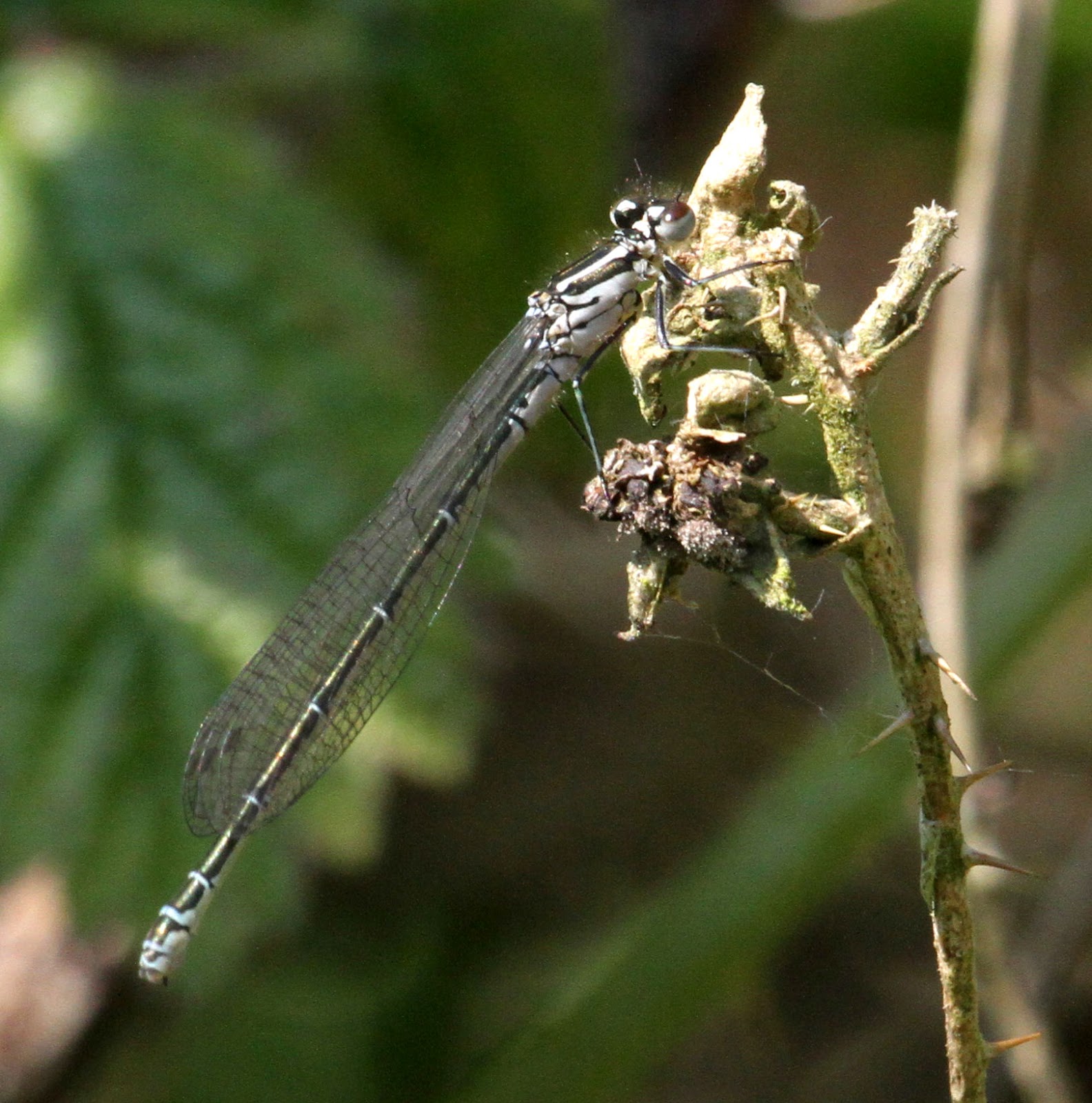
One of the highlights on the return journey was a noisy female Sparrowhawk which soared for a while before plunging into thick vegetation, and then finally setting off in a northerly direction.  We reached the ponds where we found a female Blue-tailed damselfly resting on a reed.  It stayed long enough for everyone to study it.  
Sparrowhawk 
 ditto
 Blue-tailed Damselfly
My initial fears proved groundless, because although there weren't exactly hundreds of butterflies, and there weren't as many bird species to see as there had been in May, there was still plenty to see and observe, and hopefully everyone went home impressed with Noddle Hill and the wildlife they had studied there.

Tuesday, 22 May 2012

Blue Sky Birding

Yellowhammer

Today was a bit of a shock to the system, because it was our first decent day since March.  We met in a village “almost as nice as Surrey.”  There were a few Swifts around the green, but not screaming as usual.  The most noticeable sound was a Goldcrest singing from a nearby garden.  Everyone arrived in good time & we shared cars to nearer our eventual location.  At first the lane was very quiet, apart from an initial Skylark & a Blackcap.  The usual Whitethroat & Sedge Warbler were absent, but we took the first left turn, and immediately I could hear a ‘singing’ Yellow Wagtail.  One disadvantage of the bright sun was that it was very difficult to see.  We weren’t able to get too close before it flew off across a field.  However, only a few minutes later we had great views of a Yellowhammer, and a more elusive Whitethroat.  Other birds seen round here included Wren, Chaffinch & both Great & Blue Tits.  Not everyone managed to get a view of the Yellow Wagtail, but a Yellowhammer did the honours perching right in front of us & giving every single participant great views.   We carried on to where last year there had been an industrial car park, today it was deserted and already going back to nature.  A Marsh Harrier was being mobbed by a crow towards the river.  Orange tips began to appear & Peacock butterflies started chasing each other.  The Harrier had been replaced in the afternoon by a baby Linnet being fed in an emerging Ash tree.  The afternoon group were also able to study their first female Orange-tip as we retraced our steps down this first lane.  They also had a bold male chaffinch which was determined to have a bathe, no matter how many humans peered down on it from the fence across the little bridge.  
Yellowhammer
 Orange-Tip [female]

One we reached the original junction we carried on down the main road towards the river. At this point we were passed by a bughunter extraordinaire from the Hull Valley Group.  He was looking for some Shield bugs, which he first discovered at this venue a couple of weeks ago.  This is only the 3rd site for this particular species in Yorkshire.  After he left us 3 Tufted Ducks flew towards the marsh in the am, and the first distant Reed Warbler & Reed Bunting could now be heard from the Angling complex.  We caught up with Barry Warrington here & he was able to point out everyone’s first Woundwort Shield Bugs.  Claude got her eye in first and was able to point out several more – many of which seemed to be mating. I must admit I’d never even heard of this species before.  They are smaller than most other Shield Bugs I’d previously seen, but almost look metallic in some bright sunlight.  When we returned in the afternoon some large caterpillar tracks had destroyed the first 3 feet of verge in some places, but we were still able to find some mating shield bugs, so hopefully they will survive.
Woundwort Shield Bug (c) 2012 Barry Warrington
 Woundwort Shield Bugs
 Holly Blue

A single Holly Blue flew over while we were looking at the bugs in the morning, while in the afternoon a Holly Blue landed the other side of the bridge with the bathing Chaffinch.  There were also several Blue-tailed Damselflies in the area, and what looked like an Azure damselfly.  As we came back along this hedgerow later in the morning we came across a large Hawker Dragonfly drying off on an umbellifer stalk.  
Hairy Dragonfly
 Large Red Damselfly
 Blue-tailed Damselfly
 Fenmale Azure Damselfly (Thanks to P. Ashton)
 Chaffinch
 Flies above Di's Head
 Further down the lane we hear our first Chiffchaff, and a Willow Warbler in the afternoon, which made its typical Willow Warbler song, but which also made the sound 3 times of a speeded up Chiffchaff song – not a phenomenon of which I’ve previously been aware.  The old Cormorant tree had been cut down – probably instigated by anglers.  There were no Cormorants round here anymore, but we did flush a Heron.  An Oystercatcher was heard calling, probably over the river & there was a single Great Crested Grebe & a Mute Swan on the main lake.  While we were scanning the lake a couple of Common Terns went over us, but there was very little else to see here.  As we continued a Lesser Black-Backed Gull flew over & there was a Black-headed Gull over the river.  At the end of the lake the searching for Reed Warblers was hampered by 3 noisy dogs splashing in the water.  

As we looked out across the river a Cormorant flew across to the south bank in the morning, whilst in the afternoon about 6 were sitting on a sandbank now that their tree had been denied to them.  On the return journey a Blackcap sang clearly quite close to an abandoned garden, whilst in the afternoon a couple of Bullfinches were heard near here.  Finally, a new butterfly species was a Comma which landed on a stump of a tree for a few minutes.  The afternoon group especially, seemed quite dehydrated & at least 3 of them repaired to the local hostelry for a refreshing cool drink.
Weevils
After the morning session David & Steve moved on to another site where Steve noticed a Spotted Flycatcher!
 Spotted Flycatcher (c) 2012 David Tasker