Showing posts with label House Martin. Show all posts

Saturday, 6 October 2012

The Past Week

The past week wasn't the greatest for photo opportunities.  Tuesday should have featured a visit to the South Bank, but strong winds curtailed this trip, and North Cave Wetlands was lousy for taking pictures - none survive from that trip.  It was windy again at Tophill Low, so there weren't that many chances of taking photos of the best birds 300+ House Martins and 3 Chiffchaffs.  The wind was blowing straight into North Marsh, so there was very little chance that the Kingfisher would be on its perch, and we had a fruitless vigil.  As the morning session was about to end attention was drawn to a small feisty raptor attacking & being mobbed by Crows.  At first it seemed to be a young Hobby, but the wings weren't swept back enough and on one occasion its role was taken over by a male Sparrowhawk which was noticeably larger and broader-winged.  Then when the first bird passed behind some dark vegetation and flipped over, so we could see from its front that it was a female Merlin.  She then flew higher right through the large flock of House Martins a couple of times before she singled one out.  Needless to say the House Martin easily managed to evade her attentions.

On Thursday and Friday we travelled to Fairburn Ings.  The Lin Dike area was supposedly flooded, so we walked from the Visitor Centre to Bob Dickens Hide.  The Thurs pm & Friday am groups were the only 2 which were rewarded with the immature male Kingfisher, although a Thurs am 'student' remained behind if only to prove that Kingfishers aren't in the same category as leprechauns, fairies and pure moonshine - his life ambition achieved, I wonder what his next bogey bird will be?  The immature Green Woodpecker on Thursday am was a nice compensation.  

There were plenty of Redpolls and Siskins and a few Jays at Fairburn - all birds which are a little thin on the ground in East Yorkshire.  However, late September and early October, doesn't seem to be the best time to visit Fairburn, I wonder what is?
Immature Male Kingfisher - Fairburn
 Blackcap - in the garden
 Woodpigeon Squab - on the Fairburn Boardwalk
 Green Woodpecker - Fairburn (c) 2012 Phil Todd
 Lapwings (c) 2012 Phil Todd
Lesser Redpoll
 Record shot of Goldcrest - Tophill Low
 Comma - Tophill Low
 Common Darters - Fairburn
 Darter - Fairburn

Monday, 17 September 2012

Wolds Walking Festival

This weekend was the Wolds Walking Festival, and I was involved in at least one event on Saturday, Sunday and Monday.  On Saturday 5 individuals turned up in beautiful warm and sunny weather: one couple from Helmsley, another from Beverley, and one local inhabitant of Thixendale.  We walked down the hill from Robert Fuller's Gallery, but were unable to find the Tawny Owls, which usually inhabit these sycamores.  In fact any sort of birdlife was noticeable by its absence.  I had to fill in by talking about our local Swallow behaviour, plus the latest news of what was happening on the birdfront at Spurn, Blacktoft and other East Yorkshire sites. Needless to say there was no sign of the local Little Owls either.  The only birds seen at this stage were Woodpigeons flying over.  However, flying closer to us was a Migrant Hawker Dragonfly, which did give good views as it hunted for insects along the hedgerow, and almost seemed as large as a Goldcrest!  We were a long way from any appreciable water, but these can be long distance fliers.  
Barnacle Goose
 Red Kite being mobbed
 At the bottom of the hill we took a right turn on to the Wolds Way.  A tilled field was covered with Red-legged Partridges - possibly as many as 10.  The Yellowhammers, and Meadow Pipits which had been so vociferous in the Spring and Summer had all gone quiet, and it wasn't until we went through the second gate that things picked up.    We were watching a hovering Kestrel as it hunted for voles in the long grass in the steep slopes of the dale.  It plunged into the verdure several times, but when it rose again, there was nothing in its talons.  As we observed this young bird, I could hear the high-pitched telltale sounds of a Treecreeper in the mature Ash trees behind us.  We swung round and everyone was able to spot the bird as it inched its way up the main trunk of the tree, before it spiralled round to the back of the trees, and it was lost to sight.  
Cream-Crown Marsh Harrier
 Migrant Hawker
 Bracket Fungus
 Stoat
 Stoat
We hadn't gone much further when there was a strange sound above us.  At first the only birds I could see were a couple of gulls flying north, but then I spotted a bird of prey.  A Buzzard seemed to be the most likely candidate in this habitat, but through the binoculars it was uniformly dark brown despite the tattiness of many of its feathers.  It was a Marsh Harrier.  Later, we heard that the gulls and the Harrier had been in a brief skirmish, which was the origin of the unusual sound.  We carried on to the sight of a baffling turf sculpture, which apparently looks much better and explicable from the top of the hills.  While the turf sculpture was being explained to us by the local inhabitant a bright orange Comma butterfly flew south.  Fairly soon after this a genuine Buzzard came into view - its mixture of dark wing edges and central white patches were in marked contrast to the earlier bird.  On the return journey we could hear Swallows twittering and House Martins "farting", but our best birds had definitely been on the  Wolds Way.  We passed BBC Look North's Simon Clark and  friend making the most of the nice weather by walking part of the Wolds Way.  The Cirrus clouds looked fine against the blue sky, but they didn't bode well for the weather on Sunday...

5 individuals again turned up for the Sunday Wolds Red Kite Roost event.  Unfortunately my sat nav led the attendees from Robert Fuller's Gallery on a circuitous, but picturesque route seemingly all over the wolds.  However, we did eventually arrive at the viewpoint.  At first it seemed very few birds were present apart from some very noisy female Mallards opposite our site.  However, a Heron flew through, which was a sign of better things to come.  Unfortunately, it was spitting with rain, so I didn't expect too many birds of prey.  It wasn't too long before our first Red Kite appeared to the right of the site, spotted by a Pocklington couple.  It flew over the woodland and disappeared to the left and below a very distinctive tree.  We then enjoyed sightings of several lone birds, sometimes they appeared distantly over the brow of the wooded hillside.  On other occasions they began to emerge in the far distance in the north, but always making for the same general area.  At least 2 birds showed interest in a green field, which may have hosted some carrion, but the roost site seemed to be the favoured area with all the other birds.  

Another Heron made its distinctive slowly flapping flight over the  woodland - seemingly with a wingspan only marginally greater than some of the Red Kites we had been watching.   Unfortunately, the lowering clouds began to look ever more threatening.  At one time 4 birds could be discerned in the northern distance through what looked like mist, but this was the first sign of a more significant shower of rain moving in.  We decided to call it a day, but we had seen over 10 Red Kites flying into the woodland.

On Monday we revisited Friday's location in worse light, so there were fewer photo opportunities.  North Cave Wetlands seems to be a fairly well-known site locally, so it was an unusual experience to introduce the venue for 5 people (100% of the attendees) who were trying it out as part of the Wolds Walking Festival.  The birds and dragonflies we saw today were very similar to those last week.    A mammal highlight were 2 Stoats - one running towards us, and another running away.  The Barnacle Goose showed really well, but seemed a very isolated individual, and was virtually the last bird we saw, so brought the session to a fitting end.  Please see Friday's photos here: Friday

Wednesday, 5 September 2012

Juvenilia


The first Wednesday session of the Autumn term saw us venturing into Lincolnshire. We shared cars over the Humber Bridge at the recently discounted rate. The tide was still coming in when we were due to start, so I was hoping for some close views of waders, but the site has been silting up. 

 Yellow Wagtail
 Immature Swallow
 Immature Willow Warbler
 
 Black-tailed Godwits [mainly]
 Black-tailed Godwits [foreground]
 Little Egret
 Long-tailed Tit (c) 2012 Aileen Urquhart
 Long-tailed Tits
 Small Tortoiseshell
 Common Blue
Common Blue [female]
Record shot of Immature Water Rail
Ruddy Darter


From the car park I heard Whimbrel and Bullfinch, but couldn't actually see either of them there. Meadow Pipits were heard calling and a pair of Stock Doves flew over. Before we arrived at the 1st hide the class marvelled at a flock of Black-tailed Godwits as they circled the pool several times before coming in to land. There were a couple of Dunlin among the Black-headed Gulls. At the hide itself there were plenty of distant Teal, Shoveler, and a few Shelduck. An unusual call turned out to be a Spotted Redshanks, which landed for a few minutes before heading off with a bog-standard Redshank heading West. A Ringed Plover called several times before being lost to sight. The whole day was punctuated by the calls of Greenshank, but they weren't as easy to see as yesterday.
Along the high bank path we saw at least 10 Yellow Wagtails and a Reed Warbler. As we watched these about 50 Swallows were catching insects above our heads, and these had 2 House Martins in tow. A family of Long-tailed Tits were seen in some bushes along the path, and while we were observing these 3 very bright young Willow Wagtails were seen.
In the final hide Miles spotted something in the reeds, which seemed to be half a mile away. It turned out to be an immature Water Rail, and another passed through the reeds nearby.  The juvenile Water Rail was still there in the afternoon.
After lunch some very strange sounds seemed to emanate from a pair of Little Egrets - I've never heard them make a sound before.  the large flocks of Swallows had been replaced by 4 soaring Buzzards - one with very tatty wings.  

Wednesday, 13 June 2012

Shock! Horror! We Went on a Dirty Twitch!

Today’s planned venue seemed to have quietened down recently, so we did something we have really never done before in 8 years of these classes – we went on a twitch!


The morning group met at Hornsea Mere, and while there we saw a Black Swan chasing a Mute Swan just off shore.  Keeping up the ‘plastic’ theme, through the telescope we could just make out a single drake Red-Crested Pochard with 2 females in the far distance.  There were quite a number of bog standard Pochards, and Tufted Ducks and seemingly hundreds of Coots.  Anthony spotted a single Common Tern on a buoy, which stayed long enough for everyone to get a decent view.
We shared cars to Aldbrough and parked at the designated car park – we seemed to be the only ones present.  A Whitethroat was singing as soon as we opened the car doors, and House Martins were ‘farting’ around the farm buildings.  We emerged from the farm drive and looking across the road there was no sign of the Roller on its accustomed post.  Then we spotted some chaps at the top of the hill on the bend, who waved us towards them.  We carefully negotiated the grassy verge punctuated with muddy & wet drainage slots.  On the brow of the hill about 5 birders were lined up on the Roller which was perched in a small bare tree in the trees which surrounded the farmhouse.  The bird had its back to us, so at that distance appeared mainly brown (although technically it has been described as cinnamon pink).  However, it was preening itself and when it turned its head the remarkable blue colour could be glimpsed.  There was a singing Skylark in the distance and then Brian spotted a Yellow Wagtail flying over the wheat.  Sure enough there was a pair and another single male.  Shortly afterwards Eileen saw a male Yellowhammers, while Swallows chased insects over the crop.  Later, they were joined by a couple of Sand Martins.  Once everyone had observed the Roller through the telescopes, as well as their own binoculars, and because the bird looked quite settled we shared cars to some woodland.  
The Roller photographed a few days ago when it favoured the bare field (c) 2012 Vince Cowell
 ditto
 Red-Crested Pochard (c) 2012 Tony Robinson [photographed elsewhere]


At the woodland those who didn’t have a coffee break were rewarded by saw a pair of Buzzards soaring over the woodland, and a Sparrowhawk moved far more purposefully just over the canopy.  In a ring of bushes we could hear a family of Long-tailed Tits, while a Reed Bunting perched briefly on the top.  Then there was a distinctive ‘chupping’ sound as 11 Crossbills flew north.  Only a few mintues later another was spotted at the top of a pine being bothered by a Pied Wagtail.  15 minutes later another pair were seen briefly feeding on the edge of a pine branch, but they soon flew towards the Mere.  There was no sign of any of these Crossbills in the afternoon, but we did hear a distant Cuckoo while we were standing in the same place.  The afternoon groups also had good views of a male Great Spotted Woodpecker feeding a much less colourful youngster.  A distant Chiffchaff could be heard, as could the ‘raunchy’ cooing of a Stock Dove.  Anthony glimpsed an Egyptian Goose back at the Mere at lunchtime, but it had hidden itself away before I’d had chance to set up the scope.
In the afternoon we went straight to Albrough.  This time about 5 birders were scutinizing the tilled field, so it looked as though the Roller was much closer to the road.  When we walked to the end of the drive we discovered we were mistaken and that the Roller hadn’t been seen for over an hour even by the 3 RSPB employees.  Rather than stare at an empty field I crossed the road & walked partly up the hill & checked out the trees around the farm.  The Roller wasn’t where it had been in the morning, but I could make out something blue in another tree.  This time the bird was facing the watchers, so its stunning colour was more obvious.  Everyone else came across, but despite my directions initially no one else was able to get on to the bird.  As well as setting up my telescope I was then asked to lock on to the bird through the RSPB’s scope.  Then everyone tried to see the bird through the telescope, and once they had done so, they also attempted to find it through their own binoculars, which proved rather tricky for some.  Before everyone had had their turn looking through the scope a twitcher who had travelled some distance, insisted he should have a look, as he’d left his telescope in the car & was petrified that the bird may have flown away before he had retrieved it, and he may actually miss out on seeing the bird.  My ‘student’ was too polite to tell him where to go, and he saw it through the scope before they did!  We  were watching the bird from the safety of the grass verge, but we were still photographed by a mad local person going past in a speeding car.  Once everyone was satisfied with the views they had obtained we shared cars back to the Mere.  The behaviour of the Roller seems to have altered.  It doesn’t seem to be spending anywhere near as long feeding in the tilled field.  I wonder if it’ll be leaving soon?
House Martin

 Sand Martin [left] & House Martin [right]
 Sand Martin
 ditto
 Swift
Unfortunately, the Red-Crested Pochard & Egyptian Goose were no longer in view, but there were several Great Crested Grebes present and a single Gadwall.  The clouds had darkened and looked more threatening than in the morning & there was a resultant huge increase in the number of hirundines over the water.  Numbers of House Martins & Sand Martins heavily outnumbered the swallows, and several unrelated Swifts flew just over our head, and one of them actually displayed its white chin.  
The visit to the woodland was less eventful in the afternoon, an apart from the woodpecker already mentioned the best find was probably a Treecreeper, which was fairly confiding.  We dipped our toes into the murky water of twitching, and everyone was happy to see the Roller, but I don’t think we’ll be making a habit of it!  There was a bitty quality to the day, which was quite alien to the happily-established norm of an in-depth 2-hour session.
PS I’m not really sure if today’s events really qualifies as a dirty twitch – whatever one of those is!

 Buzzard

Sunday, 3 June 2012

Red Stars

Male Redstart [at this location 3 years ago]
 Female Redstart
 Spotted Flycatcher
 Mayflies
 Micromoth
Rockrose

Yesterday afternoon was the first of the daytime wildlife events organised to coincide with Robert Fuller’s summer exhibition.  Four people met in the gallery from where we shared cars, and another 2 were waiting for us at the destination.  I also brought along my nephew who was often able to spot things quickly for the attendees.   On the journey we nearly slaughtered 8 Red-legged Partridges and an escaped lamb, but we managed to successfully avoid adding blood stains to the road.  Along the way there was a singing Meadow Pipit which I actually managed to spot on the return trip.  
From the car park we could hear a Yellowhammer singing just across the road, and this bird flew right over us and landed in the hedgerow we were shortly to walk past.  Here were also Goldfinches around the car park, but the usual Linnets were absent.  We plunged down the valley, and from the scrub there were distant Blackcaps and Willow warblers, but a more vibrant Song Thrush whilst another was visible on top of the Hawthorns.  One thing I noticed straight away was how noisy it is on weekends when there are a lot more non-birdwatchers in the area.  There was one family in particular of about 8 daughters, only half of whom were dressed in the compulsory pink who dawdled & made a hell of a lot of noise, and made my task that bit more difficult.  It was noticeable that Ben (12) did most of the complaining at the behaviour of the public, and came across as an old man!  
In the valley bottom I could hear a male redstart singing.  We went through a handgate an almost immediately I spotted a bird going into a cavity where Redstarts had nested 2 or 3 years ago.  I couldn’t believe they were using the same dirty old hole, but they were.  Both parents were going in and out regularly, so it was clear that their young were being fed.  We remained there for about half an hour, and although the Redstart’s movements at first were too quick for some of the viewers eventually both genders sat perched long enough looking for most people to get decent views.  This was a more colourful female than many, as a definite peachy blush could be discerned on her breast.  A Spotted Flycatcher also appeared briefly, and some Bullfinches flew over, and there were some Goldfinches perched on one of the dead Hawthorns.  
When we left the Redstarts and began to walk along the old railway line I could hear the very distinctive ‘chup’ of Crossbills, so these must have been in the stand of conifers which had been behind us when we were watching the Redstarts.  Along the early part of this walk we heard both a Chiffchaff and a Willow Warbler, and the latter was even spotted with its wings outstretched.  We also heard a Blackcap, but this could only be glimpsed among the thick hedgerow, although it was seen in flight, as it flew from one side to the other.  A Mayfly was clinging to a nettle, and when I looked at the photo there were actually 2 mayflies there.  There were singing Chaffinches, a Wren and another Chiffchaff near the quarry.  Meanwhile we had Swifts, House Martins and Swallows flying over us at various times.  
On the return to the gallery there were almost as many red-legged Partridges dicing with death, but the only new birds seen were a pair of Linnets flew up as we drove back past a quarry.

Thursday, 31 May 2012

A Logical Viewpoint

All pictures (c) 2012 Richard Whateley
Thursday morning was our final visit to an urban nature reserve.  Everyone but the lady from Castle Howard seemed to find it OK, but she probably isn’t used to real urban driving!  The car park was quieter in the gentle drizzle, but we did see a few Linnets, a House Sparrow and low-flying Swifts and House Martins.  I left my camera at home because my previous one ‘died’ in heavy rain, and downpours were forecast.  Richard was braver, so I’m completely reliant on him to illustrate this blog.  On the playing field there were 2 Lesser-Black Backed Gulls for the first time, and the Starlings, Rooks, Carrion Crows, Magpies and Jackdaws were still present.  A male Bullfinch flew from left to right just at the beginning of the walk but it couldn’t be relocated.  There were actually more birds singing on the walk up the hill in today’s bad weather than the 2 gorgeous days we visited last week.    
Water Vole

 Linnet
For the second Thursday am running we heard a Cuckoo, but this time despite several apparently close encounters we failed to see it.  The Warblers were harder to see this time, though we did have an early Chiffchaff near the beginning and then a definite Willow Warbler at the end.  The Lesser Whitethroat had gone silent again, and we only heard a couple of Whitethroats this time.  A Chiffchaff was heard, but it was harder to locate this time.  There were a few Blackcaps singing from deep cover on the path parallel to the Poplar Avenue, but apart from one brief flyover, again these remained concealed from sight. 
Chiffchaff
 We waited for a time on the bridge but there were fewer things to see round here too.  2 Great Spotted Woodpeckers flew from a young Ash tree on the bank & headed into the reserve towards some large Willow trees.  The adult soon flew off, but a fledgling remained for several minutes.  I don’t think everyone managed to lock onto it in time, but those that did were able to watch trying to peck at the bark for and climb the tree.  People were discussing this sighting when Phil G spotted something swimming across the drain.  Everyone spun round and got a great view of a Water Vole.  It was then busy for a few minutes on our side of the bank, because we could see the ripples spreading out from our side, but the vegetation screened it from any further views.  
Immature Great Spotted Woodpecker
 ditto
 Chaffinch
We popped into the reserve again, but took a different circular path, which took us past a Willow Warbler and the den area, which was recently featured in the local press.  There were fewer butterflies and other insects to see because of the drizzle, but we were climbing the steps out of the reserve when the Cuckoo stared calling again nearby.  Unfortunately, a Search & Rescue helicopter then flew low over us, and we weren’t able to track it down.  The final sight of the morning was provided by a Greenfinch, which at first twittered & wheezed in the car park before embarking on its slow-motion butterfly courtship flight.  A nice way to bring these urban visits to an end.
 Willow Warbler
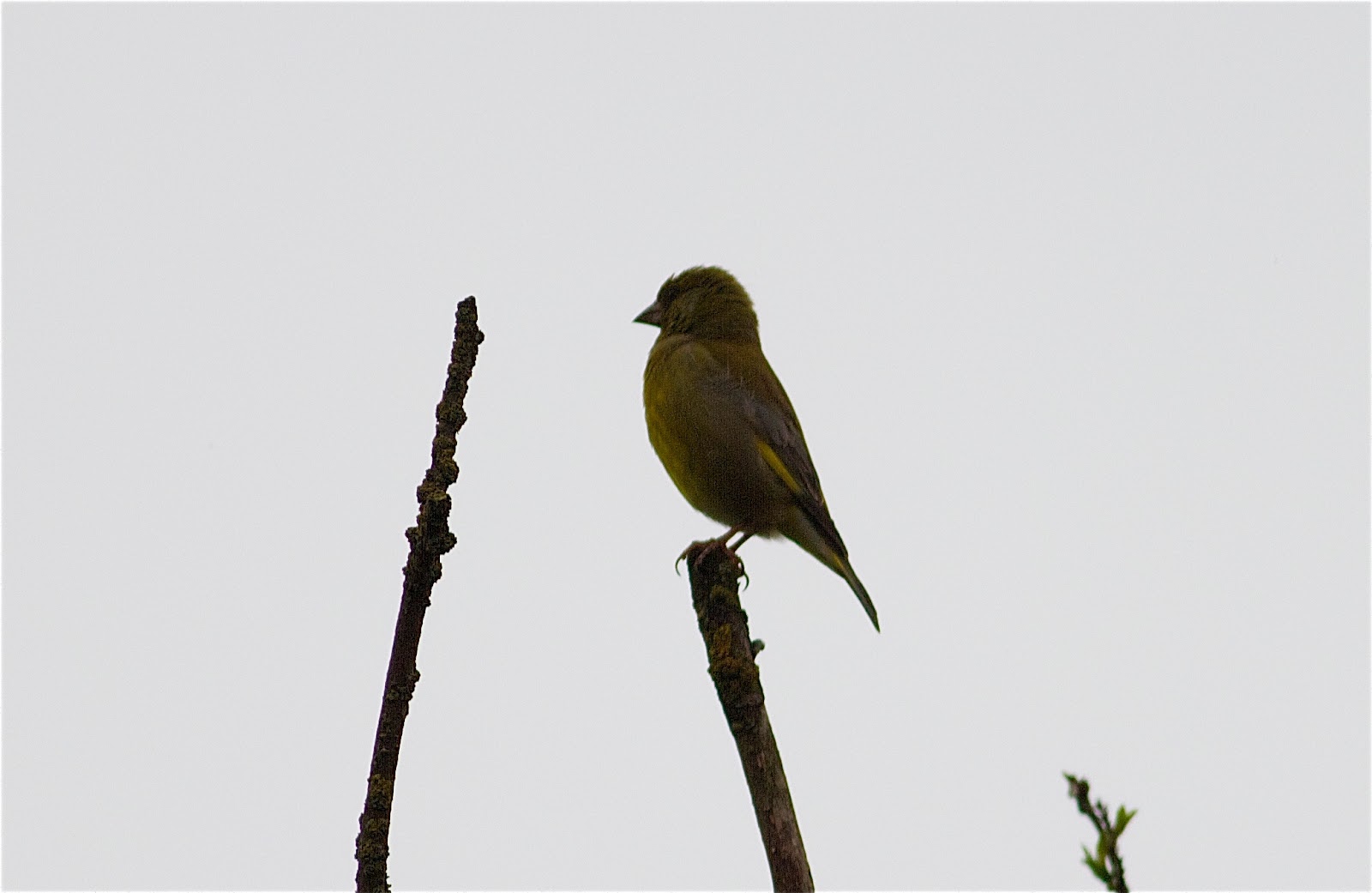
Greenfinch