Showing posts with label Migrant Hawker. Show all posts

Wednesday, 26 September 2012

Spurn Turns up Trumps

I've been to Spurn most days within the past week, and we've seen some good birds...
Osprey (c) 2012 Maggie Bruce
 Osprey (c) 2012 Aileen Urquhart
 Osprey (c) 2012 Tony Robinson
 Red-breasted Flycatcher (c) 2012 Aileen Urquhart
 Red-breasted Flycatcher (c) 2012 Tony Robinson
 Pied Flycatcher (c) 2012 Tony Robinson
 Redstart (c) 2012 Tony Robinson
 Willow Warbler
 Willow Warbler (c) 2012 Tony Robinson
 Red-backed Shrike
 Stonechat
 Migrant Hawker (Saturday)
 Red Admiral (Saturday)
 Small Tortoiseshell (Saturday)
 Roe Deer
 Greenshank (Monday)
 Brambling (Tuesday)
 Dunlin (Saturday)
 Dunlin (Tuesday)
3 from Paull Holme Strays 
Golden Plovers (Sunday)
 Bar-tailed Godwit (Sunday)
 Gannet (Sunday)

Monday, 17 September 2012

Wolds Walking Festival

This weekend was the Wolds Walking Festival, and I was involved in at least one event on Saturday, Sunday and Monday.  On Saturday 5 individuals turned up in beautiful warm and sunny weather: one couple from Helmsley, another from Beverley, and one local inhabitant of Thixendale.  We walked down the hill from Robert Fuller's Gallery, but were unable to find the Tawny Owls, which usually inhabit these sycamores.  In fact any sort of birdlife was noticeable by its absence.  I had to fill in by talking about our local Swallow behaviour, plus the latest news of what was happening on the birdfront at Spurn, Blacktoft and other East Yorkshire sites. Needless to say there was no sign of the local Little Owls either.  The only birds seen at this stage were Woodpigeons flying over.  However, flying closer to us was a Migrant Hawker Dragonfly, which did give good views as it hunted for insects along the hedgerow, and almost seemed as large as a Goldcrest!  We were a long way from any appreciable water, but these can be long distance fliers.  
Barnacle Goose
 Red Kite being mobbed
 At the bottom of the hill we took a right turn on to the Wolds Way.  A tilled field was covered with Red-legged Partridges - possibly as many as 10.  The Yellowhammers, and Meadow Pipits which had been so vociferous in the Spring and Summer had all gone quiet, and it wasn't until we went through the second gate that things picked up.    We were watching a hovering Kestrel as it hunted for voles in the long grass in the steep slopes of the dale.  It plunged into the verdure several times, but when it rose again, there was nothing in its talons.  As we observed this young bird, I could hear the high-pitched telltale sounds of a Treecreeper in the mature Ash trees behind us.  We swung round and everyone was able to spot the bird as it inched its way up the main trunk of the tree, before it spiralled round to the back of the trees, and it was lost to sight.  
Cream-Crown Marsh Harrier
 Migrant Hawker
 Bracket Fungus
 Stoat
 Stoat
We hadn't gone much further when there was a strange sound above us.  At first the only birds I could see were a couple of gulls flying north, but then I spotted a bird of prey.  A Buzzard seemed to be the most likely candidate in this habitat, but through the binoculars it was uniformly dark brown despite the tattiness of many of its feathers.  It was a Marsh Harrier.  Later, we heard that the gulls and the Harrier had been in a brief skirmish, which was the origin of the unusual sound.  We carried on to the sight of a baffling turf sculpture, which apparently looks much better and explicable from the top of the hills.  While the turf sculpture was being explained to us by the local inhabitant a bright orange Comma butterfly flew south.  Fairly soon after this a genuine Buzzard came into view - its mixture of dark wing edges and central white patches were in marked contrast to the earlier bird.  On the return journey we could hear Swallows twittering and House Martins "farting", but our best birds had definitely been on the  Wolds Way.  We passed BBC Look North's Simon Clark and  friend making the most of the nice weather by walking part of the Wolds Way.  The Cirrus clouds looked fine against the blue sky, but they didn't bode well for the weather on Sunday...

5 individuals again turned up for the Sunday Wolds Red Kite Roost event.  Unfortunately my sat nav led the attendees from Robert Fuller's Gallery on a circuitous, but picturesque route seemingly all over the wolds.  However, we did eventually arrive at the viewpoint.  At first it seemed very few birds were present apart from some very noisy female Mallards opposite our site.  However, a Heron flew through, which was a sign of better things to come.  Unfortunately, it was spitting with rain, so I didn't expect too many birds of prey.  It wasn't too long before our first Red Kite appeared to the right of the site, spotted by a Pocklington couple.  It flew over the woodland and disappeared to the left and below a very distinctive tree.  We then enjoyed sightings of several lone birds, sometimes they appeared distantly over the brow of the wooded hillside.  On other occasions they began to emerge in the far distance in the north, but always making for the same general area.  At least 2 birds showed interest in a green field, which may have hosted some carrion, but the roost site seemed to be the favoured area with all the other birds.  

Another Heron made its distinctive slowly flapping flight over the  woodland - seemingly with a wingspan only marginally greater than some of the Red Kites we had been watching.   Unfortunately, the lowering clouds began to look ever more threatening.  At one time 4 birds could be discerned in the northern distance through what looked like mist, but this was the first sign of a more significant shower of rain moving in.  We decided to call it a day, but we had seen over 10 Red Kites flying into the woodland.

On Monday we revisited Friday's location in worse light, so there were fewer photo opportunities.  North Cave Wetlands seems to be a fairly well-known site locally, so it was an unusual experience to introduce the venue for 5 people (100% of the attendees) who were trying it out as part of the Wolds Walking Festival.  The birds and dragonflies we saw today were very similar to those last week.    A mammal highlight were 2 Stoats - one running towards us, and another running away.  The Barnacle Goose showed really well, but seemed a very isolated individual, and was virtually the last bird we saw, so brought the session to a fitting end.  Please see Friday's photos here: Friday

Thursday, 13 September 2012

Slim Pickings

On Thursday we returned to a venue we hadn't visited for 2 years, as they were insulting to us last time & demanded a months' notice before our next visit. Since our last visit someone seems to have physically removed all the birds. It could be the time of year, but there were very few birds of interest.


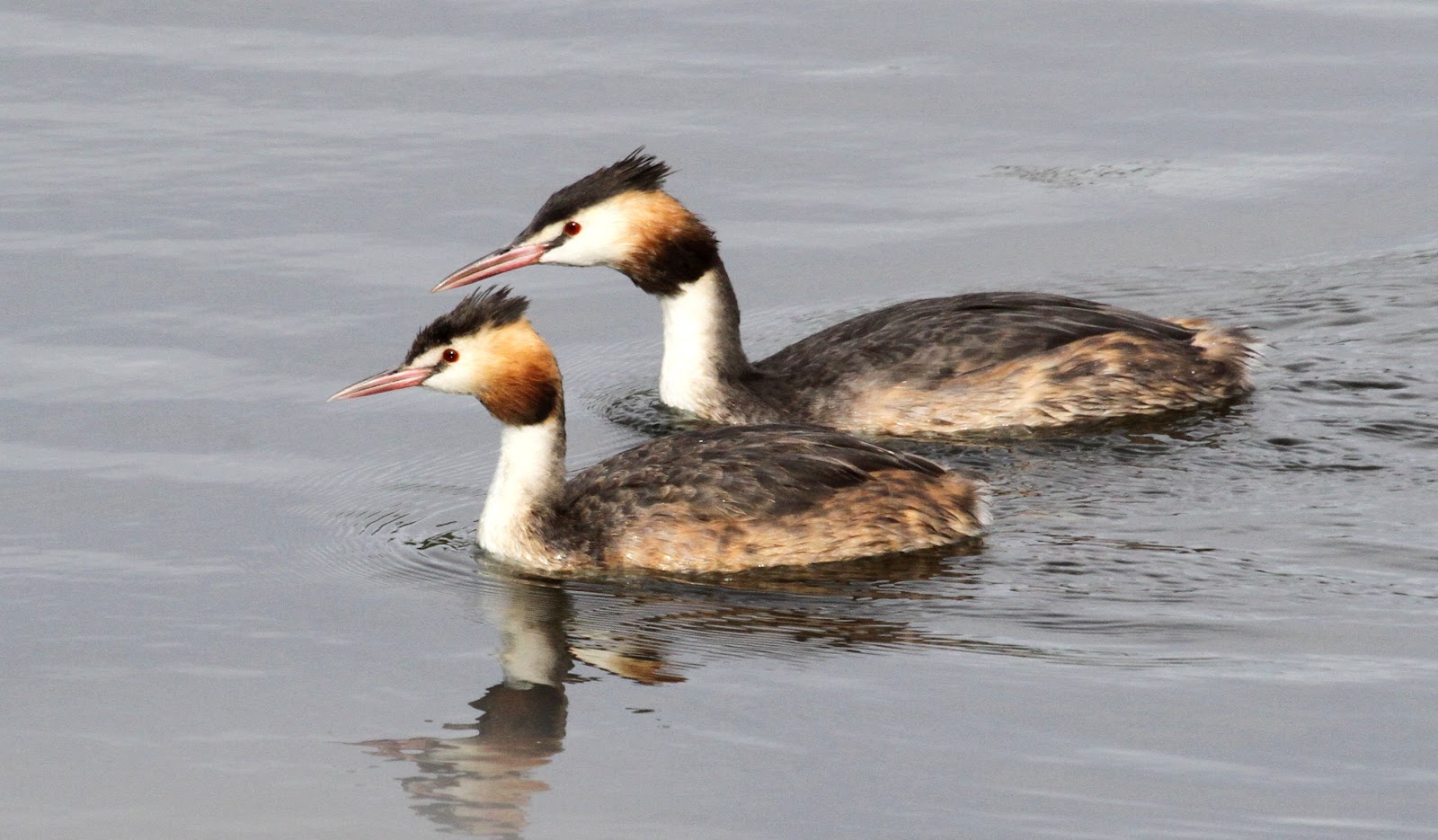
From the 1st hide we were told we had just missed a Bittern, but there were plenty of Coots and a very distant Little Grebe. A Gadwall flew in, but there wasn't much else to see until a pair of Great Crested Grebes made their stately way from the back of a reedbed and swam directly under the hide.


Great Crested Grebes (c) 2012 Richard Whateley

 Great Crested Grebe (c) 2012 Richard Whateley
 Great Crested Grebes
 House Sparrow (c) 2012 Richard Whateley


We left the hide and walked along the green tunnel, but this was also devoid of birds. We eventually heard some tits but even these remained out of sight. We bumped into a volunteer cutting back greenery, and he informed us that this path would be closed next week due to heavy machinery moving in to create a new scrape & install a new hide. As he was talking some migrating Pink-footed Geese could be heard, but they were hidden by the thick hedgerow. We climbed up the river bank and immediately located a pair of Redshank feeding on the mud. A closer inspection led us to find 4 Black-tailed Godwit probing the hinterland between river and mud. They are a lot larger an Redshank, but they had lost their breeding colours so blended into the background much better.

Black-tailed Godwit
 Black-tailed Godwit & Redshank (c) 2012 Richard Whateley
 Sparrowhawk (c) 2012 Richard Whateley
 We carried on to the next hide. Again it was very quiet from here, but Richard spotted a Sparrowhawk flying low over the water before it landed in a tree opposite to us. It stayed in the area for 20 minutes from where we were able to see its bright pinkish undersides. While we were observing the male Sparrowhawk another tiny raptor raptor swept over the area. On closer inspection it turned out to be a juvenile Hobby. Unfortunately, only a brief glimpse was permitted before it flew over the receded & then over the hedgerow which obscured it from our sight.


A walk round the perimeter of the site brought the contact calls of Willow Warblers to our ears, but the most constant sounds were the melancholy songs of several Robins. At the final hide there was very little to see beyond a Migrant Hawker, some concealed Moorhens and some fighting Coots. 

There were even fewer birds to see in the afternoon, but we did see one of our earliest juvenile Goldeneyes ever, and a soaring Buzzard over the Lincolnshire Wolds. I'll have to see if this venue improves during the next few weeks, as otherwise it may be worth dropping this venue completely from the itinerary. 
Common Blue Damselfly
 Record shot of Cormorant (c) 2012 Richard Whateley
 Record shot of Juvenile Goldeneye
 Ruddy Darter
 Migrant Hawker eating a fly


Tuesday, 11 September 2012

A Beached Grebe

Today we ventured into North Yorkshire to a site we've only visited as a one off special in the dim & distant past. There was the call of a Bullfinch near the car park, but it remained hidden. Everyone arrived on time & we shared cars to the ultimate destination about a mile or so further up the road. After lunch the 3 at the front had a brief glimpse of a Kingfisher, as it took off on sight of us and headed away along the stream. This was quite well screened from the strong winds, so we could hear juv Willow Warblers & the alarm calls of Blackcaps, Robins & Wrens, and a Great Spotted Woodpecker called as it flew behind the hedge. Even the frog-like croak of a Gadwall carried against the wind to where we were standing. In the afternoon there was a massive flock of Long-tailed Tits with a few Willow Warblers, Blue Tits and Great Tits also part of the gang.

Little Grebes
 Willow Tit
 Commas
 Comma
 Looking through the gaps in the hedge we could see Mute Swans, Greylag Geese, with plenty of Lapwings accompanied by a few Starlings. Ducks included: Mallard, Teal, Shoveler and Gadwall. There were large numbers of House Martins flying high after insects with just a few Swallows in tow. 

From the hide we had great views of a family of four Little Grebes, plus Herons, Cormorants, Lapwings & a single Redshank. John or Steve spotted a flock of Canada Geese coming in to land across the road onto some far pools. Then John spotted a very distant Great Crested Grebe, which remained long enough for everyone to find it. The only bird of prey was a distant hovering Kestrel. 

Migrant Hawker
 Migrant Hawkers
 Ditto
 Red Admiral
 Ruddy Darter
 Common Darter? [female]
 Common Darter [male]
We carried along the path until the railway bridge, at which point we saw at least 3 Willow Tits, plus a few skulking Blackcaps and Whitethroats. On the way back a female Bullfinch was spotted, but she disappeared into the hedge pushed on by the strong winds. On the pool behind the path I spotted a tiny distant bird struggling against the wind - this was a Kingfisher. Luckily, it first landed on a stout, short post then flew high into a Hawthorn bush where it sat long enough for everyone to see it. This was a new location for Len & he was especially pleased as it was his first Kingfisher for 20 years.
Speckled Wood
 Green-Veined White
 Meadow Brown
 Chickory
 Amphibious Bistort
 A return to the Visitor Centre saw plenty of Tree Sparrows on the feeders, plus Greenfinches & Goldfinches, but the visit to a screen was less productive with nothing new to add apart from a pair of scruffy moulting old Pheasants. A Marsh Harrier drifted west of the car park at lunch time, but not everyone managed to get on to it before it disappeared. The day went quite well, and would have been even better without the awful wind!

In the afternoon we had a look at the Kingfisher Screen, but there wasn't a single bird of any description. However, it was a bit better for butterflies and dragonflies. We found a pair of Migrant Hawkers resting on a bare twig, and back at the dog muck walk we saw a pair of Commas. These didn't interact at all, so it was impossible to say if they were 2 males, 2 females, or one of each!