Friday, 22 November 2013

The Crock of Gold

On Thursday we were able to make the long-planned trip to Tophill Low. Many of the others passed through a heavy rain shower, but I had a clear run. We started a little early as everyone had arrived in good time. Before both sessions started a Great Spotted Woodpecker called from the car park area. We used the screen to view the millpond which was 'O' reservoir. Apart from a few scattered Tufted Ducks and Black-headed Gulls the highlight was a female Goldeneye, but the light was tricky.

Whooper Swans
 Rainbow
We carried on until we reached the back-to-back hides. On the way a call of a Dunlin could be heard, but we couldn't actually see the bird. From the SME hide we could see a pair of Curlews on South Marsh East, and a few Tufted Ducks, but very little else. A pair of Reed Buntings were fighting to the left of the hide, and a pair of Wren were exhibiting strange courtship behaviour, which included fanning the tail and drooping the wings.
As we left the hide a Bullfinch could be heard, and later he made 2 attempts to fly over us, but he gave up and went south instead. From the dog leg hide all the birds on the marsh had departed, but we had a better view of the female Goldeneye. 
Barn Owl
We went on to Watton Borrow Pits, and although there weren't as many birds here as there were a fortnight ago, there were a couple of new species, including 2 Little Egrets and a Barn Owl. Later the sun came out, which seemed to light up the owl really well. Also present were: Wigeon, Teal, Gadwall, Cormorants and Friday unmentionables. While we were in the hide a confiding flock of Long-tailed Tits flew right past, and some landed on the hedge underneath the hide. 
Cormorant
 Ditto

Little Egrets
 Long-tailed Tit
On the return journey there was relatively little to see, but 2 swans flying over were discovered to be Whoopers, and 2 Mistle Thrushes were in the works compound. On to the D Reservoir hide those who didn't pop into the toilet were lucky enough to see the 2 Whooper Swans, but they soon flew off in a North easterly direction. There were more Goldeneye here, including 1 drake, and at last we found some Pochard. A large flock of Lapwing appeared from the far north and with them were a decent sized flock of a Golden Plovers. 
Reed Bunting
Sparkly Wren
 Ditto
In the afternoon we went north and when we reached the first hide near D Woods, and immediately saw 4 Whooper Swans. They were present for 5 minutes before taking off and eventually flying off in a SW Direction. We carried on to North Marsh, but there was very little there, apart from a flock of Long-tailed Tits. We carried on to the Northern hide, and this was where the majority of birds were sheltering against the northerly wind. Unfortunately the strong light from the south meant that most birds were only silhouettes. It didn't really matter as those closest to the hide were only Coots anyway.
Whooper Swans
 Whooper Swans

We carried on to the Angus MacBean hide. There was a Canada Goose here, and a Pheasant, and that was it. We did see a couple of large Lapwing flocks above the Yorkshire Water building. On the return journey we walked on the road along the D reservoir in the hope there would be interesting geese species grazing on the field, but they were completely empty. Only a few Blue Tits inhabited the numerous hawthorn bushes. The return to the D Reservoir hide in the car park just showed a lot of choppy waves.

Thursday, 21 November 2013

Little & Large

On Wednesday we met in one of the few decent-sized car parks in the Yorkshire Wolds. We met half an hour later than usual to avoid a wet weather system, which passed through the region early in the morning. We shared cars along a winding rural road, successfully dodging all the kamikaze Pheasants, as we headed to a high point with a great outlook. Last week on a very still day there were at least 5 Red Kites perched in trees, but on this much blustery day there were none. A Green Woodpecker called twice as it flew across the valley, and was the first bird of interest.

We walked back down the hill and soon reached the shelter of some surprisingly leafy trees. Here there were plenty of Blue and Great Tits, a Robin, Wren, then an elusive female Brambling. In the afternoon there was a Treecreeper, but it was impossible to photograph. The biggest surprise was a male Blackcap, presumably this is an continental bird, which has recently arrived. However, it should relocate to the lowlands as soon as possible. The area of Yorkshire it was found it, is often the very coldest parts of our locality at is time of the year.
Goldcrest
 Red Kite (c) 2013 Tony Robinson

 Record Shot of Red Kite
 Sparrowhawk (c) 2013 Tony Robinson
 Sparrowhawk

Unfortunately we couldn't find last weeks big Brambling flock, but this may have been because of the presence of Sparrowhawks in the area. First there was one, then a second joined it and they continued to spiral on a thermal for much of the morning. At one stage they were even in the sky at the same time as a Red Kite and a Buzzard, which was quite a spectacle. 

Blackcap
 Ditto
 Blackcap (c) 2013 Tony Robinson
 Ditto
Record Shot of Red Kites
 Record Shot of Red Kites

On the return journey the sightings of small passerines had declined, but we were rewarded with a close view of a Goldcrest. This came just after my sighting of a Jay, but unfortunately, I think I was the only one quick enough to see the latter...In the afternoon we saw at least 10 Red Kites all in the sky at the same time. A very loud jet flew low through the area, scattering hundreds of Fieldfare, several Redwings and thousands of Woodpigeons. In the end we saw at least 10 Red Kites settle in one tree, near enough for us to observe. 

Raining near Drax
 Fungi
 Black-throated Diver (c) 2013 David Tasker
In the meantime a Tuesday stalwart was at North Cave Wetlands was photographing a bird we've never seen during the classes - an elusive Black-throated Diver. This is the first record of this species at North Cave Wetlands.

Wednesday, 20 November 2013

Without a Paddle

On Tuesday we met at the Fisherman's car park at Paull & shared cars into the flatlands of Holderness.  There were plenty of Curlews either side of the road as we drove.  5 miles later we arrived at the banks of a creek and had a look round.  There were plenty of Redshank, and in the afternoon some Dunlin and a Black-tailed Godwit.  There was a massive flock of Golden Plover on the river.  One of the highlights in the morning was a Marsh Harrier, which flew fairly close to us as it made its way to the river.
Redwing (c) 2013 Maggie Bruce
 Fieldfare (c) 2013 Maggie Bruce
 Ditto
 Ditto
 Fieldfare (c) 2013 Chris Cox
 Blackbird (c) 2013 Maggie Bruce
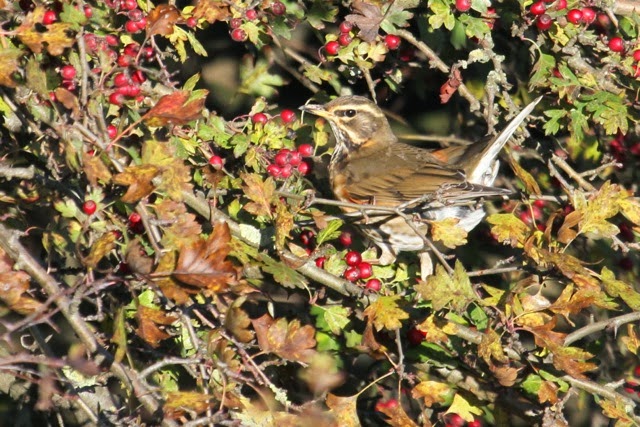
Throughout our stay plenty of winter thrushes continued to arrive, these were mainly Fieldfare with a few Redwing and plenty of continental Blackbirds.  There was also a Little Egret flying around back and forth.  Both groups had fleeting views of a Kingfisher, although some in the afternoon swear it was a black and white bird - but the light was fading.
Little Egret (c) 2013 Maggie Bruce
 Ditto
 Redshank
 Black-tailed Godwit
 Little Grebes (c) 2013 Maggie Bruce
 Lapwings (c) 2013 Maggie Bruce
 Pied Wagtail (c) 2013 Maggie Bruce
On the way back we encountered a pair of Buzzards very close to the road.  later in the day Maggie saw them behaving curiously being mobbed by crows.  It seemed they were landing on piles of filthy straw, picking up lumps of it in their talons, and then sifting it out in mid-air & then pulling out and munching worms.  Buzzards are fairly new in the area, but these are sights we are likely to encounter more frequently in the coming years, if the Buzzards remain unharmed.  
Buzzard (c) 2013 Maggie Bruce
 Ditto

Monday, 18 November 2013

Old Red Eyes is Back

On Friday we revisited one of the most popular and successful spring time locations. This time rather than meeting in the village we met at the railway line and crossed it in between the roaring trains and began the long walk to the Humber bank. In the spring the bushes and fields are teeming with Warblers, Yellowhammers and Linnets, but at this time of year there is much less to see. However, when we reached Yellowhammer Lane in the afternoon we did manage to spot a single Lesser Redpoll.
Old Red Eyes

Lesser Redpoll
When we reached the ponds then the wildlife became more noticeable. In the morning the whole area was awash with dog walkers, but the advantage with the afternoon was that these were completely absent. As we looked in the first area of water, only to be rewarded with Mute Swans and Moorhens, I did hear a Bullfinch, which Bob managed to locate for most people to view. The anglers had been increasing the height of their banks, so it was quite difficult to see the waterfowl on them. We did manage to see some Wigeon. 
Heron on the Humber


There was absolutely nothing to see on the Skiing Lake in the morning, but in the afternoon there was a female Goldeneye and a mysterious very distant brown duck. Unfortunately, the previously resident Kingfisher or the other week's Grey Wagtail were absent. On the river bank we could hear Reed Buntings, but they remained concealed in the reedbeds. From the bank we had a better view into the main angling lake, which was replete with wildfowl including more Wigeon, plus Tufted Duck, Cormorants, etc.
Strange "Birds of Prey"

In the morning on the exposed mud were several Bar-tailed Godwits, plus Lapwings, various gulls, and a single Heron. In the afternoon the tide had come in, and there wasn't so much to see here. In the morning we tried to peer into the distant marsh, but there was no wind, so the reeds were at their full height, and it wasn't possible to see large areas of water. Consequently we didn't see a single bird there. There were a few Curlews in front of the marsh in the afternoon as a result of the high tide. 
Wigeon
When we returned along the Boating Lake towards our cars, a few water skiers had taken to the water and the odd brown duck had moved near to our position. We walked along the lane concealed by the trees and when we emerged it was possible to see it was a Common Scoter. As soon as it spotted us it flew to a halfway position between us and the water skiers, initially taking refuge with a pair of Friday Unmentionables. 
Common Scoter
 Common Scoter
 Common Scoter
 Long-tailed Tit
 Goldcrest
 Lesser Redpoll
 Lesser Redpoll

When we reached Yellowhammer Lane a Redpoll was still present, but this one seemed to have a much deeper red head than the one we had seen earlier - again it was alone. Was the apparent change just a trick of the light?