Saturday, 5 May 2012

Splashes of Colour Amid the Gloom

Yesterday was another day struggling with this unappealing spring weather.  We walked along a flood-bank in strong northerly winds, and in the afternoon some horrible mizzle.  Despite the conditions we saw some quite good stuff.  Before we started there were plenty of Swallows flying around our heads, plus a few House Martins, and at least 2 inseparable Sand Martins.  Along the river bank we saw some stonking Yellow Wagtails, a Sedge Warbler, and on a pile of dung in the afternoon a Wheatear. Also in the afternoon there was a Common Sandpiper along the river bank, not far from insect-eating Yellow Wagtails & seed-chomping Linnets.  
There was no sign of the Kingfishers, which used to frequent the site before these last 3 chilly winters.  On the return journey you get a bit closer to waders & we saw 7+ Whimbrel, a gorgeous white Ruff, Lapwings, Redshank and in the afternoon despite the drizzle a single Snipe indulged in his impressive display flight.  At times the sickle-shaped wings of the Swifts sawed through the air very close to the group and at one moment came between a married couple!  We heard songbirds as this side too, with Yellowhammers, Lesser Whitethroats and common resident birds.
We’ve seen cows at this location in the past, but this time there were dozens of ponies, some of which had just given birth to foals...


We were about to wrap up for the day when Jim spotted a pair of Pintail - a great end to the afternoon!
Just hoping that next time the weather will be a lot kinder to us...

Wheatear on Dung (like yesterday pm)
 Yellow Wagtail on Reeds (a bit whacky)
 Ruff [male]
 Mute Swan
 Some Whimbrel here
 Swallows
 Foal
 Rounding them Up

Friday, 4 May 2012

Ground-Nesting Site Getting Overrun with Dogs

Today we followed the same route as Saturday's Dawn Chorus.  We didn't have any Tawny Owls, but we did have 3 singing Garden Warblers.  The weather was very cloudy & there was a strong wind, so the bird song was kept down a little.  The usual suspects were present, but only 1 Whitethroat, but luckily this was seen by both am & pm sessions.  The biggest surprise was a Wheatear which stopped for a few seconds on a gorse bush on the heath before heading off north.  

Both sessions examined an interesting egg.  It was fairly fresh going by the remains of the liquid inside, but it was impossible to say if this had been predated by a crow, or whether the egg had hatched successfully.  It was about twice the size of a Blackbird's egg, and was a lot rounder possibly indicating a game bird, but it certainly isn't a Pheasant's egg.  

The afternoon session was overrun with 7 dogs which weren't kept on leads.  1st there were 3 women who were going to take their dog out for a walk no matter what the signs said, and completely ignored the fact that this is a very important site, or used to be, for ground-nesting birds.  The worst culprit was a local woman who brings her 5 smaller dogs along the road every afternoon, and as soon as she gets to the wood, she lets them off & only tries to get 2 of them back on leads when she comes across people.

This site should have Woodcock trying to nest on the ground, and we witnessed either a Willow Warbler or a Chiffchaff making its dome shaped nest made of woven grass on the ground.  Blackcaps & other Warblers also nest very close to the ground.  This is supposed to be a nature reserve not a pleasure garden for dogwalkers.  A firmer stance needs to be taken with these selfish people during the breeding season who are either completely ignorant of the danger to ground nesting birds, or who wilfully put the needs of their pampered dogs above the survival of our indigenous wildlife.   These photos and more, including registration number of the car containing the 3 women will be passed on to the authorities.

This used to be the richest local woodland for the concentration of bird species.  Numbers have declined in recent years, and the pressure put on these birds by these thoughtless dog-walkers may be exacerbating the situation - it certainly isn't helping!

First 5 pictures (c) 2012 Richard Whateley
Great Spotted Woodpecker
 Wheatear - stopped off for a few minutes
 Treecreeper
 Treecreeper
 Wren
 Carpet of Blue
 St Mark's Fly
Female Minotaur Beetle?
 Egg of a Red-legged Partridge?
 Fungi
 Hoof Fungus
 The Sign - How Clear can it be?
Large Dog - not even on a lead
 The ever so posh "Ladies" Who refuse to read signs which aren't for them!
 A local who brings her 5 mutts every afternoon & tries to put 2 on a lead when she sees anyone

Wednesday, 2 May 2012

Stop Press!

Three of the Wednesday morning group went on to Holderness after today's class.  They saw Whitethroats, Lesser Whitethroats, a Speckled Wood butterfly, but their big find was a Wryneck on the old Hedon to Patrington Railway line.  It was a 'lifer' for Miles & Anthony, and will make many of the others on the course green with envy.
All photos (c) 2012 Tony Robinson
Wryneck
 ditto
ditto
 ditto
 Lesser Whitethroat
 Speckled Wood

New Reserve Gets Nod of Approval

Today we were able to visit a brand new nature reserve, and the morning group encountered 45 species.  The sighting highlight was a Kingfisher, probably only seen by 2 (incl the tutor); whilst the best bird heard was a Grasshopper Warbler – again only heard by 2 (incl the tutor & a different participant).  In the afternoon the Kingfisher was almost in the same place, and was seen by all but one participant.
In the morning I made the mistake of walking round the edge of the reserve, and although this yielded Willow Warbler, Whitethroat and Sedge Warbler, it would have been better to have plunged straight into the bushes by the way-marked paths.  In the afternoon we tried this method, but by that time the small passerine birds had largely vanished.  The strong winds prevented many birds from being tempted to sing high from exposed song-posts.  One notable exception were the Linnets, which on today’s showing seemed to be the most ubiquitous species, as we came across them everywhere throughout the northern section of the site. 
The Kingfisher was in the area of the pumping station, and near here were breeding Tree Sparrows and Swallows collecting mud.  A Lesser Whitethroat was heard singing and was even observed by the afternoon group.  The Sedge warblers were much quieter after lunch, and the Grasshopper and Reed Warblers remained completely silent.
Les spotted a large female Sparrowhawk which gave good views before disappearing towards North Bransholme.  The only other raptor species seen was a Kestrel in the morning & a pair near the parking area during the last part of the lunch hour.
The morning group, especially, were much impressed with the site, and are keen to visit again without a biting north-easterly wind.

Sedge Warbler
ditto 
 Linnet [male]
 Linnet [female] (c) 2012 Tony Robinson
 Whitethroat
 Reed Bunting
 Skylark
 The Duck which Cannot be Named
 Small Tortoiseshell [very worn]
Immature Gull Trying to Devour a Fish 

Bad Weather Alternative

Yesterday we should have been walking along a slow, gentle canal, but the previous day a flood warning was given out for the area by the Environment Agency & more rain was forecast for today, so we switched to North Cave Wetlands.  
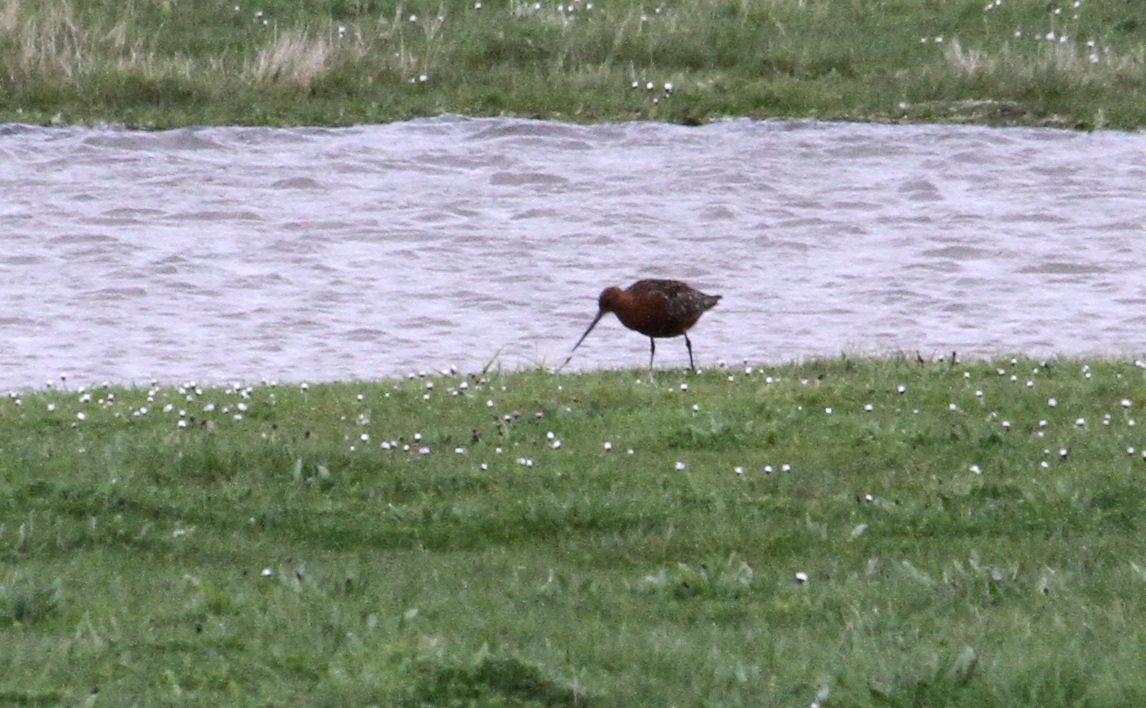
Those who didn’t arrive really early were kept waiting as cement was added to the foundations of the new gates, which are to be SE & SW corners of the reserve.  The place is blighted on a night by lowlifes who do hand- rake turns, write graffiti in the hides & have even caused damage in them in the past.  A traffic jam started on the approach road, but the early birds were able to watch the many low-flying hirundines & a Bar-tailed Godwit which flew over the road at about 9.30.  One of the few birds seen was a Red-legged Partridge, which ran away from the approaching group.
In South Hide the northerly wind was blowing straight in & there weren’t that many wildfowl on the water apart from Tufted Ducks, a single Pochard, and a snoozing Great Crested Grebe. We were buffeted by the strong winds, but a few Willow Warblers and Blackcaps were still gamely singing.  The crop of Groundsel was wondered at & admired.  A couple of Lapwings were seen in a field & some participants believe they spotted some young Lapwing chicks.  A flock of 6 Shelducks flew fairly low over our heads on an unknown mission, whilst a few Skylarks flew up briefly before disappearing in the grass.
From Turret Hide the best birds were the Bar-tailed Godwit which had taken up residence on Top Scrape, and a singing Reed Warbler which was visible perched halfway up a reed.  There were Avocets of course, but they seemed rather overwhelmed by the many Black-headed Gulls.  A pair of Great Crested Grebes were espied building a nest, and a pair of Little Grebes were heard chittering, but most of the other birds seemed to be struggling against the wind.  Passerine birds were relatively few in number because they were almost certainly sheltering in hedges.
In the afternoon the weather took a turn for the worse, so instead of making a complete circuit of the reserve we went hide hopping instead.  We saw most of the birds that the am crowd did, but one addition was a very smart male Ruff, and better views of the Bar-tailed Godwit through a state-of-the-art-telescope.

Bar-tailed Godwit [an ideal view from Spurn]
 Bar-tailed Godwit [as we saw it yesterday]
 Great Crested Grebe
 Avocet
 Lapwing
 Swallow
 Swallow
 House Martin
 Sand Martin
 Sand Martin
 Black-headed Gull