Wednesday, 22 July 2015

Sketch of Tolkien Re-discovered after 70 Years

Professor J.R.R. Tolkien by Fred A. Farrell, published in 1934
In The Advocate of 9 August 1934 a head and shoulder portrait of an academic (above) was published with the accompanying text: “Professor John Tolkien has been Rawlinson and Bosworth Professor of Anglo-Saxon in Oxford University since 1925.  He served with the Lancashire Fusiliers from 1915-18.  Born of a South African family in 1892, he was educated at the King Edward VI. School, Birmingham, and Exeter College, Oxford.  He was Professor of English Language in Leeds University in 1924-5.”   This sketch does not appear to have been published for over seventy years until it resurfaced earlier this week.   The use of John rather than Ronald suggests that Tolkien was probably not actually consulted about the text.
‘New’ drawings of Tolkien are not unearthed every day, especially from the period before the publication of The Hobbit in 1937, so this image of the author dating from 1934 is particularly interesting.  What was Tolkien doing in 1934?  He had probably fairly recently completed the first version of The Hobbit.  He was a busy academic, lecturing and teaching on a daily basis, and was also working on several academic publishing projects.  The poems ‘The Adventures of Tom Bombadil’ and ‘Looney’ had also been published for the first time earlier that year.  It is interesting that although he had not published any fiction at this point, he was considered of sufficient international significance as a Catholic to be featured in an antipodean religious publication. 
In 1934 The Advocate was a six-penny weekly newspaper specialising in supplying newsworthy items to Catholics in Melbourne, Australia.  The Advocate still appears today, but is now a monthly magazine and a web page.  The feature itself appeared in the regular column, “A Letter from London”, but the only clue as to authorship was that it was supplied by “The Advocate’s Special Correspondent.”  In 1930 and earlier the column was supplied by a named author, Denis Gwynn.
'Intelligence Officer's Shelter, Prisoner Awaiting Re-examination' by Fred A. Farrell
The portrait is signed by F.A. Farrell, and accompanied by the single word Oxford.  It is possible that the likeness may have been obtained from a photograph.  However, Charles Noad, a leading bibliographer and scholar of Tolkien, believes that the drawing is more likely to have been taken from life.  He contends that it would almost certainly be neater if it had been copied from a photograph.  Hopefully, further research may answer this question definitively.
'Daylight Raid by the 6th Gordons at Roclincourt' by Fred A. Farrell
The enigmatic initials of F.A. Farrell reveal the interesting fact that the artist was Frederick A. Farrell – who was Glasgow’s official war artist in the First World War.  This was the only known instance of a city sponsoring a war artist!  As his career and talent have suffered from a great deal of neglect I’m taking this opportunity to flesh out his biography a little here in the hope that someone will be able to discover more about him.  
Only known photo of Fred A. Farrell (centre). Published in Glasgow's The Bulletin, 1 May 1920
Frederick Arthur Farrell was born on 29th November 1882, the third son of John Farrell, curator of Glasgow’s Trades House, and Margaret Farrell, so he was precisely a decade older than Tolkien.  He originally trained as a civil engineer, but at the time of his attesting in 11 December 1915 he gave his occupation as “Artist (Etcher)”.    He was called up on 13 June 1916, but was discharged on 26 November because a gastric ulcer he’d suffered from since 1906 became inflamed.  Then, the following month he went to the western front for 3 weeks as an artist with the 15th, 16th and 17th Highland Light Infantry in Flanders.  On the home front he drew Glasgow women at work in munitions factories, shipyards and engineering works.  He returned to France in November 1917 for two months attached to the 51st (Highland) Division.  It was this latter attachment which resulted in his 1920 book: The 51st (Highland) Division War Sketches.
'Banding 6-inch Chemical Shells, Cardonald' by Fred A. Farrell
In the immediate aftermath of the war Glasgow Corporation selected 50 out of 99 of Farnell’s paintings for a substantial exhibition in the Banqueting Hall of their City Chambers.  Since that time Farrell’s work was not seen in public until Glasgow Museums organised another exhibition to commemorate the centenary of the outbreak of World War One in 2014.  This exhibition closed last November.  However, an accompanying book: Fred A. Farrell: Glasgow’s War Artist was published last year, and is still in print. 
The new book displaing Farell's War Art with essays by Joanna Meacock, Fiona Hayes, Alan Greenlees & Mark Roberts
Unfortunately, the recent book does not include a postscript to briefly describe Farrell’s post-war career.  What follows are my attempts to pull something together after spending two days searching the internet, so there must be gaps that could be filled in by more dedicated research.  After the war Farrell is known to have continued to produce etchings of London landmarks, continental scenes, and Scottish topography.  His portraits are less widespread, but some of his war work included studies of men in combat situations, as well as commanding officers in repose.  In the early 1930s Farrell’s “line portraits of eminent Catholics in the Old World” were appearing fairly regularly in the Advocate magazine, and his 1935 Advocate obituary stated that his work appeared frequently in London’s Universe, which was another Catholic periodical.  The suggestion is that Farrell too was a Catholic, which seems likely, but so far I have been unable to prove this.  It is possible that his portraits appeared first in an English journal, such as the Universe, before publication in Australia. 
John O'Malley by Fred A. Farrell
Fr. Francis Woodlock, S.J.
At least another four portraits appeared in the Advocate in the months preceding Tolkien’s: John Francis O’Malley (Aug 1933), Fr. Francis Woodlock (Sep 1933) [above], W.R. Titterton (Feb 1934) and Dr J.M. Villasante (Jun 1934) [below].  None of these have the apparent sketchiness, almost unfinished quality, of the portrait of Tolkien, and Tolkien is the only figure in which the head is looking down.  For this reason Tolkien’s portrait fails to exude some of the self-confidence and directness which the others exhibit.  If anything Tolkien’s slightly pursed mouth and frown give the sitter a pensive look.  Perhaps Tolkien was extremely busy when the portrait was executed, and was simply concentrating on a book, or working on a difficult passage of translation?  Whatever the reason it is evident that the tone of this portrait is quite different from the others.  Tolkien also differs in that no date is attached to Farrell’s signature, whilst most of the others are dated, and this dating betrays that the sketch of Villasante was drawn two years before the illustration appeared in print.  Therefore, it is possible that Tolkien’s portrait may also have been drawn as much as two years earlier than August 1934.
R.W. Titterton - journalist
 Dr J.M. Villasante - Lecturer in Spanish at UCL
Apparently, an obituary was published in the Glasgow Herald of 23rd April 1935, but at the time of writing I have not managed to track down a copy.  However, the Advocate reveals that Farrell died after a short illness while he was touring Scotland.  Meanwhile the obituary in The Times on 25th April 1935 is a little more forthcoming on the cause of death, but more reticent on his career.  The full notice reads: "Mr. Frederick Farrell, who died at Mares(?), Scotland on Monday from pneumonia, was an etcher of topographical subjects, a water-colourist, and a member of the Fine Art Trade Guild.  He did many illustrations for newspapers and his works were published by Vicars Brothers" - so his war work was completely overlooked!  From this obituary I'm able to confirm that Farrell died on 22nd April 1935.  
The picture and text from The Advocate have been kindly supplied by Brazilian solicitor and Tolkien enthusiast and collector, Eduardo Ferreira, which were sent to him by a friend, who knew of his interest in Tolkien.
I hope this post stimulates interest in Farrell and encourages someone to unearth more facts about this talented and undeservedly neglected artist.
If anyone wants to see the whole 1934 page of which Tolkien was a part, here's the link: http://trove.nla.gov.au/ndp/del/article/171898324?searchTerm=tolkien&searchLimits

Saturday, 18 July 2015

July Butterflies

On Wednesday my nephew wanted to see what all the fuss was about Yorkshire Wildlife Trust's lovely Brockadale reserve, so we travelled all the way to North Yorkshire, actually only an hour's drive away. The weather was sunny, but very breezy, so this may have affected the insects somewhat. My classes usually visit in late June, so this may be another reason why some things were absent. The Kestrel chicks we normally see had flown, and there was no sign of the Little Owls. 
Marbled Whites
 Dark Green Fritilliary
 Male Banded Demoiselle
 Ditto
 Male Banded Demoiselle
 In Flight
 Male Banded Demoiselle
 ditto
 2 males in flight
 Female Banded Demoiselle
 2 males in flight
The first section seemed a bit past its best with the Clustered Bellflower much taller than in previous years, and some flowers already dead and gone. However, a few Marbled Whites were still flying about. We walked through the woodland and when we reached the river at the other side of the grassland the stream was chocked with male Banded Demoiselles with a few females present too. A large orange butterfly was getting chased by a paler version, and the latter settled near us, and proved to be a Dark Green Fritillary. At the sheltered woodland edge there were plenty of Meadow Browns, Ringlets a few Large and Small Skippers, and a Comma.
 Large Skipper
 Small Skipper
 Ditto
 Mating Beetles
 Marbled White
 Marbled Whites
 Ditto
 Ditto
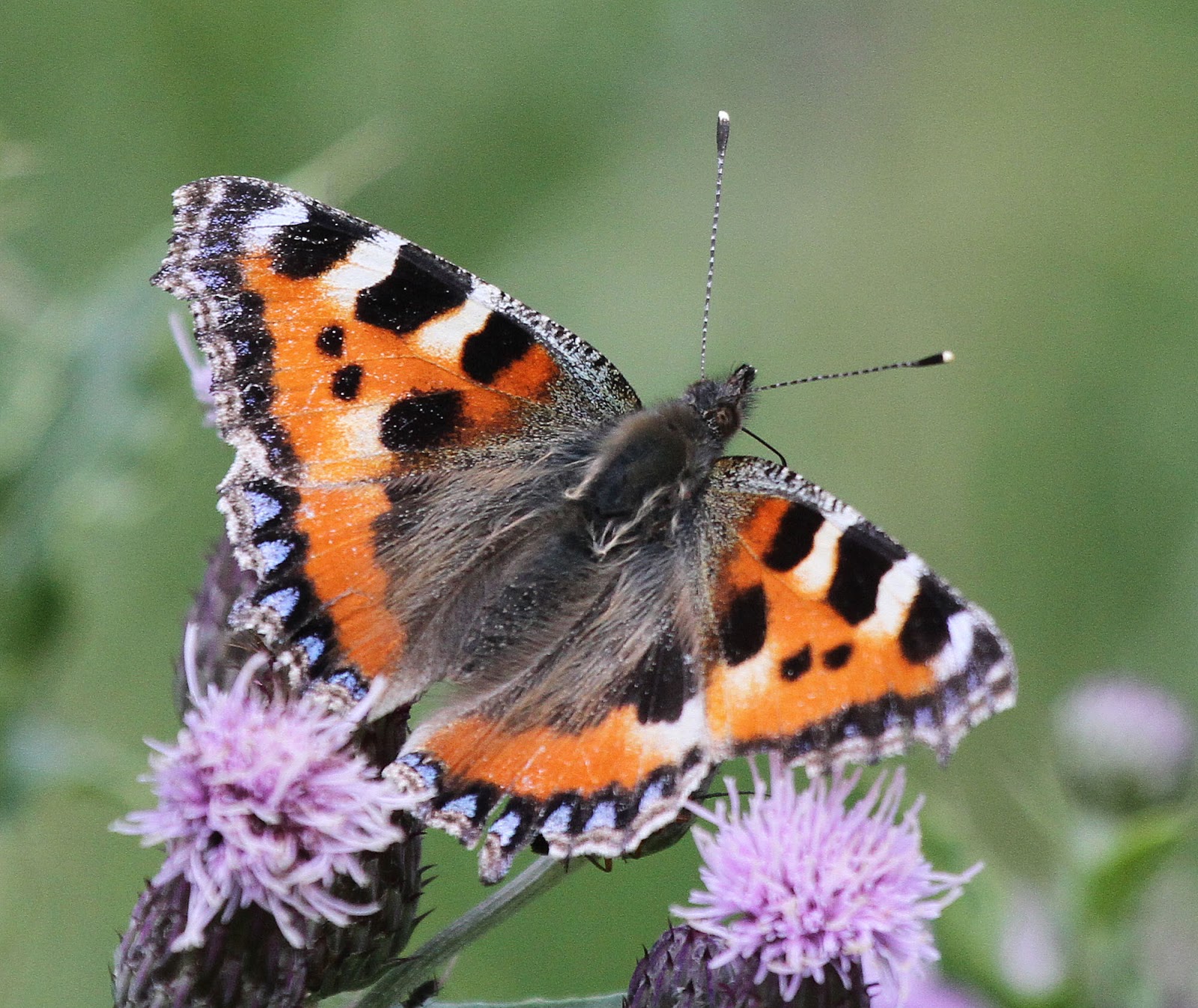
 Small Tortoiseshell
 6-Spot Burnet-Moth
 Centaury
 Cornflowers
 Bloody Cranesbill
We went on to Rifle Butts Quarry, where there were a few Bloody Cranesbills, and most of the same butterflies, minus the fritillaries. On to Kiplingcotes Chalk Pit. However, here the Greater Knapweed wasn't out in profusion yet, so most of the hundreds of Marbled Whites were concentrated on an expanse of thistles off the main path on top of the escarpment. It was a fine sight

Monday, 13 July 2015

Enrolling Now for Autumn

Pair of Bearded Tits
Wryneck

Bookings have now started for the 10-week Autumn migration term, which begins on 23rd of September.  At the time of writing there are a couple of vacancies on Tuesday mornings, and both Friday mornings & afternoons. There are fewer vacancies on Wednesdays and Thursdays. If you are interested in another session, please ask.  For at least 2 hours a week encounter the natural world as a completely new sensual experience.  You'll be amazed what you'll find just by listening, and not only be looking!  In the Autumn we'll be paying special attention to trying to see birds on migration including Whinchats, Red-backed Shrikes, Wrynecks, Ring Ouzels and Redstarts. We'll also be spending some time looking for waders and reedbed birds on the Humber Estuary.  Waders we will be trying to find include Greenshank, Black-tailed Godwits and Spotted Redshank.  Last year the Bearded Tits were very popular, so we'll be making a special event to have close encounters with those again.  So, if you are interested in learning more about your local wildlife in beautiful and secluded venues for less than £10 a week, then this is the course for you! We visit a different local hotspot each week and identify all the birds and as much other wildlife as we can. This will include mammals, butterflies, dragonflies and wild flowers. The course runs twice daily Tuesday to Friday.  If you are interested in more details of the course, or wish to be placed on a waiting list, please leave a comment next to one of my posts or email me 
Whinchat
Redstart
 Ring Ouzel
 Greenshank
 Black-tailed Godwit
Spotted Redshank
 Male Bearded Tits
 Male Bearded Tits
 Juvenile Bearded Tits

Friday, 10 July 2015

Tolkien's Hemlock Glade, Part 5

A Hemlock Glade, The Houses of Healing, Two Towers and a Beacon: Tolkien in East Yorkshire, Part 5: Easington & Spurn Point


Please note the text explaining the latest findings about Tolkien and Easington and Spurn Point may be read in my essay ‘Tolkien in East Yorkshire’ published in Something Has Gone Crack edited by Janet Brennan Croft & Annika Röttinger.


Barbed wire on Easington cliffs (2013). This must be a similar scene to that witnessed by Tolkien in WW1
Easington

The Tower, Easington


Very distinctive building in the main street, Easington

Spurn
So far this week the blog has concentrated on factual matters relating to Tolkien in East Yorkshire.  However, no proof has so far been forthcoming that Tolkien ever actually visited Spurn Point.  Nevertheless, if the opportunity came to visit such a unique geographical feature, I'm sure he would have taken that chance.  Some of the features present at Spurn would seem to indicate that he did visit Spurn, but it must be emphasised that what follows is completely conjectural.

Map of Spurn from Jan Crowther's highly recommended book: The People Along the Sand: The Spurn Peninsula & Kilnsea, A History, 1800-2000.  This illustration clearly depicts the unusual, if not unique, aspects of Spurn's topography

Two old lighthouses at Spurn Point before Tolkien's time.  The stump of the lower light (right) still exists, but has no current function, although it has been used as a water tank and an ammunition store
From Kilnsea Tolkien would have been able to see Spurn Lighthouse three miles to the south.  Spurn is such a unique geographical feature that if Tolkien was as close as Kilnsea, it would be very surprising if he had not visited the peninsula if he was given the opportunity.  As a signalling officer his duties may have caused him to take the special military train from Kilnsea to Spurn, as it is pretty certain that in a time of war purely sight-seeing trips were prohibited.  At the present time there is no documentary evidence that Tolkien actually travelled any further south than Kilnsea, but there are some similarities between Holderness’ darkest lighthouse and aspects of two dark towers in Tolkien’s fiction, which could indicate that Tolkien may have either visited Spurn lighthouse, or read about its operation.  
The current Spurn Lighthouse (before restoration in 2015).  This is the lighthouse which existed in Tolkien's time
The present Spurn lighthouse, which is the one Tolkien could see from Kilnsea was constructed in 1895.  It is 128 feet high, so is just one foot higher than Withernsea’s, but its light had an identical range of 17 miles (65).  However, as with Withernsea it is extremely likely that in wartime Spurn’s light would have been doused apart from specific occasions for guiding out particularly important vessels.  Unlike Withernsea’s completely white appearance, it is believed that Spurn Lighthouse was always painted black around the base, and again directly under the light, with a contrasting, and therefore distinctive broad white middle section.  Some 'coloured' postcards of Spurn exist which depict the lighthouse as red and white, but it is believed that the colourist wasn’t actually familiar with the location.  In addition to the standard white light from the top of the building, Spurn, rather unusually, also had the ability of showing other lights. 

Sketch showing where the different-coloured lights of Spurn Lighthouse shone out over the estuary and the sea.  A detail taken from A History of the Spurn Lighthouses by G. de Boer, p.67.  
One of these lights, which was red, shone at a height of 60 feet and with a range of 13 miles over some dangerous shoals to the south-east (66).  This light would only have been visible to those out at sea, and possibly by people directly under the lighthouse on the few feet of shore to the south-east of the lighthouse.  A contemporary local newspaper report makes it clear that for his Watchman’s Badge a Boy Scout among many other attributes “must know: the beacons, storm signals, coastguard stations, steam tugs, lifeboats, and rocket apparatus, the nearest telegraph offices, telephones, and addresses...and the mercantile code of signals” (67).  So, although it is not stipulated in the Imperial Army’s Official Signalling book, Tolkien, as a signaller in the only too real arena of a country on a war footing may have witnessed, or at least been aware of, the various lights emanating from a dark tower on the edge of the German Ocean!
A photo taken from the current lighthouse of the old lighthouse compound.  The 'ghost' of the old Smeaton Lighthouse may be seen in the very centre of the flagstones. Unfortunately, none of these buildings or the compound survives
If one ascended the lighthouse in 1917 or 1918 one could see through one of the windows to the south  the foundations of the former Smeaton lighthouse, which was painted completely black and its surrounding surviving outbuildings bounded in by a circular wall.  This photograph illustrates this scene perfectly, and the circular structure and outbuildings survived Smeaton’s black lighthouse until at least 1957, although the ‘ghost’ of the dark tower of the lighthouse may still be discerned in the above photo (68).  This is reminiscent of the situation of another dark tower of Tolkien’s imagination: 
             One who passed in...beheld a plain, a great circle somewhat hollowed out like 
             a vast shallow bowl: a mile it measured from rim to rim.  Once it had been
             green and filled with avenues, and groves of fruitful trees...But no green thing
             grew there in the latter days of Saruman.  The roads were paved with stone-
            flags, dark and hard...Many houses there were, chambers, halls, and passages,
            cut and tunnelled back into the walls upon their inner side, so that all the open
            circle was overlooked by countless windows and dark doors...Shafts were
            delved deep into the ground...the shafts by many slopes and spiral stairs
            to caverns far under; there Saruman had treasuries, store-houses, armouries,
            smithies, and great furnaces” (69).  
Barbara Strachey's representation of Orthanc from Journeys of Frodo
Spurn Point had never been filled with green avenues of trees, but  before the lighthouses were built the area would have held the prickly green shrubs of sea buckthorn, which in the Autumn are covered in their bright orange acidic fruits.  However when Tolkien was nearby photographs show very little scrub, with the only real vegetation being marram grass.  The circular wall is common to Spurn and Tolkien, and both circular interiors were paved with stone flags, and as you can see the windows and doors did open out towards the site of the tower, but the scale was enormously transfigured in Tolkien’s fiction.  Until this spring I was unaware of yet another similarity: the subterranean passages.  On a guided walk in April I learnt that a few metres to the north of the present lighthouse there are a series of underground tunnels and rooms.
Smeatons very black lighthouse, which was present before Tolkien's time.  Note the attempts to prevent its collapse.  The compound is visible as are the chimneys of the compound buildings
One thing worth mentioning is that whenever a claim has been made for towers which may have influenced Tolkien they always stop at two: the childhood Edgbaston ones and the recent claim on Channel 5 about Colchester castle and the White Tower of the Tower of London are examples which immediately spring to mind (70).  However, as Tolkien’s letters show even he was initially unsure just which two towers the title of his second volume of The Lord of the Rings referred to and there are many more than two mentioned during the course of the novel: Orthanc, Barad-dur, Minas Tirith, Minas Morgul, Cirith Ungol, the Two Towers of the Teeth at the Black Gate, and of course the white Elven Towers to the west of the Shire.  Similarly, there are more than two towers Tolkien will have seen during the course of his period in the relatively open landscape of East Yorkshire.  We know he had to pass the Black Mill at Waxholme, and he couldn’t ignore the white spire of Withernsea Lighthouse, and he must have seen Spurn Lighthouse and Rimswell’s Water Tower, and even the hospital at Godwin Battery had two observation towers on either side of it, but there is another so close to Roos, that it would be very surprising if he didn’t see it on his walks in the area: Admiral Storr’s 64 feet high brick Tower at Hilston. It should be remembered that Tolkien wrote about towers long before The Lord of the Rings, and as he worked on projects like The Book of Lost Tales in the immediate aftermath of his time in Holderness, it is just as likely that some of them may be inspired by towers he saw in wartime in East Yorkshire.
Admiral Storr's tower in Hilston, very close to Roos
Spurn Point is the southernmost extremity of East Yorkshire, and arriving there marks the end of this journey following Tolkien’s physical associations with the area. Although Tolkien ‘endured’ two holidays from the University of Leeds in the 1920s at the more northerly resort of Filey, they are the only known further visits to the Yorkshire coast.  I hope I have shown that the 18 months Tolkien spent in Holderness in the latter stages of WW1 and the early period of his marriage continued to reverberate in his imaginative fiction in the ensuing decades.  If not, I trust I have made this neglected corner of Yorkshire a little better known to Tolkien enthusiasts than it was before, and that its importance as an inspiration to Tolkien may be more significant than has hitherto been supposed.

There are some areas of East Yorkshire with Tolkien associations, or apparent Tolkien connections, I've left out of this account so far, such as Tunstall Hall, Turmar Farm, and the actual outpost he commanded.  Hopefully, I'll have time to fill in these oversights at some future date.


Howard Frost's diagrammatic representation of some of the features from Easington to Spurn Point.  Note: not all of these were present at the same time, or in Tolkien's period in the area. Taken from his book: Sailing the Rails: A New History of Spurn and its Military Railway, (2001).
My thanks for this whole week of blog posts goes to Marcel Aubron-Bülles, Jerry Aurand, Jan Crowther, Chris Delworth-Kerr, Barbara English, Linda Flowers, John Garth, Andy Gibson, Andy Mason, Irina Metzler, Dave Mitchell, Phil Mathison, Harm Schelhaas and Tony Simpson with whom I was able to consult on various aspects of my research while I was writing this piece.

Part 1 (Introduction and Hornsea) may be read here
Part 2 (Roos & Halsham) may be read here
Part 3 (Thirtle Bridge & Withernsea) may be read here
Part 4 (Brooklands Officers' Hospital) may be read here

Footnotes
61. Mathison, p.91
62. Ibid.
63. Ibid, p.88
64. English, Barbara, The Lords of Holderness, 1086-1260: A Study in Feudal Society, (Hull University Press, 1991), p.7.
65. De Boers, G.,  A History of the Spurn Lighthouses, (East Yorkshire Local History Society, 1968), pp.66-7. 
66. Ibid, p.66.
67. Hull Daily Mail, 13 Oct 1917, p.2.
68. Crowther, p.141.
69. J.R.R. Tolkien, The Lord of the Rings, 60th Anniversary Edition, ‘The Road to Isengard, p.554.
70. Jones, Dan, Secrets of Great British Castles, Channel 5, 10 Apr 2015.