Thursday, 9 July 2015

Tolkien's Hemlock Glade, Part 4

A Hemlock Glade, The Houses of Healing, Two Towers and a Beacon: Tolkien in East Yorkshire, Part 4: Brooklands Officers' Hospital and the Godwin Battery


Please note the text explaining the latest findings about Tolkien and Brooklands and Kilnsea may be read in my essay ‘Tolkien in East Yorkshire’ published in Something Has Gone Crack edited by Janet Brennan Croft & Annika Röttinger.


Note: Tolkien was hospitalised many times during the period of the First World War.  This article is purely concerned with the two hospitals, or Houses of Healing in the East Riding.
The Dennison Centre, University of Hull in 1914.  In late July 1917 it became Brooklands Officers' Hospital
The Houses of Healing

Margaret Strickland Constable (1873-1961).  She was the commandant in charge of Brooklands, during Tolkien's  recuperation.  This photo was taken several years before World War One


The rear of Brooklands showing the extensive lawn

Detail from the 1910 Ordnance Survey showing Brooklands and the neighbouring property the Cedars

1910 OS map showing open fields on the opposite side of Cottingham Road to Brooklands


The west side of Brooklands.  It is believed that the hospital beds of officers were at this side of the building

There are two short descriptive passages of the environs of the Houses of Healing in The Lord of the Rings. In the first Gandalf escorts the bier of Faramir to them for treatment, where we are informed: 

            about them was a garden and greensward with trees, the only such place in the
                  City.  There dwelt the few women that had been permitted to remain in Minas
                  Tirith, since they were skilled in healing or in the service of the healers. (48.5)

In Brooklands hopefully there were also nursing staff who were skilled in the service of the healers!  Yes, Brooklands also had a greensward, or a lawn, as we would call it, and trees.  In the second extract Merry, Pippin, Legolas and Gimli are discussing their adventures after the Battle of the Pelennor:
               For a while they walked and talked, rejoicing for a brief space in peace and rest
               under the morning high up in the windy circles of the City. Then when Merry
               became weary, they went and sat upon the greensward of the Houses of Healing
               behind them; and away southward before them was the Anduin glittering in
               the sun, as it flowed away, out of the sight even of Legolas, into the wide flats and
               green haze of Lebennin and South Ithilien. (49)
Hull is renowned by its students as a windy city, but not because of its altitude.  When the wind is from the east it blows straight from the cold continent and seems to penetrate every corner.  In relation to Brooklands the Humber does flow to the southward, and it does widen as it reaches the wide flats of Sunk Island and South Holderness, but because Hull is so flat the Humber cannot be glimpsed from Brooklands, and its alluvial nature means it does not often glitter unless the light is just right in relation to the viewer!  The Anduin flows west to the sea, but the Humber flows eastwards.


Godwin Battery, Kilnsea
Plan of Godwin Battery from the book Guardians of the Humber.  The hospital is at the top, marked with an arrow & H


An aerial photograph of Godwin Battery, taken on 15 August 1918

Plaques on the side of the Blue Bell, Kilnsea - illustrating the destructive power of the sea

Kilnsea Old Church shortly before being lost to the sea
The old medieval cross before removal from the coast

1906 - after severe flooding - a view across the fields.  Kilnsea Beacon is visible on the horizon

Godwin Battery in 1964.  The observation towers and gun emplacements are still readily visible.  It seems bizarre that many of the original battery features are present at the same time as holiday caravans
2015 - the gun emplacements now lie on the beach - only visible at low tide
 This was the sea wall in Tolkien's time - now it is only fully visible at the lowest of low tides

The Kilnsea Beacon from the 1830s
 Kilnsea Beacon - this was present in Tolkien's time
Photo kindly supplied by Jan Crowther

Kilnsea Acoustic Sound Mirror
 Kilnsea Acoustic Sound Mirror.  Note metal post in front of the dish, which would have held the microphone.  Cracks seem to have been filled with cement
After I gave this piece as a talk in Leeds on 4th July 2015, Irina Metzler, one of the delegates, explained that correspondences could be drawn between the Beacon, and Acoustic Mirror at Kilnsea and Tolkien’s Amon Hen and Amon Lhaw. She pointed out that the Acoustic Mirror is very ear-like and was obviously designed to hear approaching aircraft, whilst the beacon was originally placed on a high point and was meant to be seen from afar.  Of course in The Lord of the Rings Amon Hen is the Hill of Listening and Amon Lhaw is the nearby Hill of Seeing. As with so many things in Tolkien if indeed he did have these two nearby structures as an inspiration they were utterly transformed in his fiction.  This is another matter I am going to have to give further consideration.

You may read Part 1 (Introduction & Hornsea) here
You may read Part 2 (Roos and Halsham) here
You may read Part 3 (Thirtle Bridge & Withernsea) here
You may read part 5 (Easington & Spurn Point) here

My thanks to  Jan Crowther, John Garth, Irina Metzler, and Phil Mathison with whom I was able to consult on various aspects of my research while I was writing this paper.

Footnotes
45. Hull Daily Mail, 1 Aug 1917, p.2.
46. Ibid.
47. Garth, p.239. 
48. Margaret Chichester-Constable, Diaries, The Treasure House
48.5. J.R.R. Tolkien, The Lord of the Rings, 60th Anniversary Edition, ‘The Pyre of Denethor’, p.855.
49. Ibid, ‘The Last Debate’, p.873.
50. Chichester-Constable, Diaries,
51. Hull Daily Mail, 12 Oct 1918, p.2.
52. Mathison, p.90.
53. Letters, 5 Jun 1955 to W.H. Auden, p.213. 
54 Crowther, Jan, The People Along the Sand: The Spurn Peninsula & Kilnsea, A History, 1800-2000, Andover: Phillimore, p.176, plate 3.
55. Ibid, plate 1. 
56. Ibid, plate 12.
57. Letters, 5 Jun 1955 to W.H. Auden, p.213.
58. Hammond & Scull, The Lord of the Rings: A Reader’s Companion, p.509.
59. Crowther, p.136.
60. Crowther, p.88..

Wednesday, 8 July 2015

Tolkien's Hemlock Glade Part 3

A Hemlock Glade, The Houses of Healing, Two Towers and a Beacon: Tolkien in East Yorkshire, Part 3: Thirtle Bridge and Withernsea 


Please note the text explaining the latest findings about Tolkien and Thirtle Bridge and Withernsea may be read in my essay ‘Tolkien in East Yorkshire’ published in Something Has Gone Crack edited by Janet Brennan Croft & Annika Röttinger.


Map showing the road from Roos passing Thirtle Bridge and heading towards Waxholme
 The actual Thirtle Bridge today crossing Tunstall Drain.  Note the new brick work looks 1950s or later
The site of the former Officers' Mess can be seen on the far right of the photo
 Detail of the original foundation stone of the bridge, dated 1832

Thirtle Bridge

The current Mona House, the section on the far left incorporates the former Officers' Mess
 The footprint of the former Cookhouse is preserved by this corrugated barn
Dave Mitchell's reconstruction model of Thirtle Bridge, kept at Withernsea Lighthouse Museum
The Officers' Mess is on the far left (front) and the Cookhouse is the reddish building at the rear, slightly left of centre. 
To examine a larger image of the photo, simply click on the image 
Despite the relatively meagre evidence Dave Mitchell, a model maker has examined the ground, looked at surviving family photographs and reconstructed as far as is possible what the camp may have looked like.  Mitchell has informed me that this model represents about a quarter of the camp, there would have been many more barrack huts.  I have examined the model from close-range, and the amount of work which has gone into the reconstruction is amazing.  
(You may view the Thirtle Bridge model for yourself at Withernsea Lighthouse Museum during normal opening times: here)
Dave Mitchell's reconstruction of the view of Thirtle Bridge as approached on the road from Roos 
 A Zeppelin's eye-view of Thirtle Bridge Army Camp
Key to the numbered areas:
1. Sentry Post & entrance barrier  (front, left of centre)
2. Guardroom (right of sentry post)
3. Sports pitch/Physical training area (front right)
4. Accommodation Huts (centre right)
5. Shower block (right of accommodation)
6. HQ and weapons store  (longest building slightly left of centre)
7. Generator room  (centre left)
8. Ammunition compound  (rear left)
9. Cookhouse  (rear to left of ammunition compound)
10. Laundry  (left of cookhouse)
11. Officers' Mess and shower block (behind officer's mess, front left).


Edith's Lodgings at 76 Queen Street, Withernsea - 2nd bay window on the left.
Photo from Phil Mathison's book Tolkien in East Yorkshire
 The same address in 2014 - the open doorway marks the entrance to Edith's lodgings
 Withernsea Lighthouse

Withernsea

Plan of Withernsea showing the position of the lighthouse at 21, and Edith's lodgings at the larger cross to the right.  Detail from a plan in Victoria County History, which includes Withernsea
 The more open aspect of Withernsea Lighthouse in the early twentieth-century

View taken from B1242 looking east (2015).  Withernsea Lighthouse is clearly visible beyond the buildings currently on the Thirtle Bridge Army Camp site.

The view of the lighthouse from Arthur Street, which Tolkien would have used when travelling from Thirtle Bridge to Edith, or the railway station

Map showing the only direct route from Thirtle Bridge to Edith's lodgings in Withernsea.  Thirtle Bridge camp was just above the road junction to the right in the top left-hand corner of this map.  Edith's lodgings were in the bottom right-hand corner of the map, just where the road marked in red bends towards the right.  Just to the left of this Withernsea Lighthouse may also be seen.  Note that roughly halfway along the whole route is a junction at a kink in the road.  This junction is the site of the Black Mill of Waxholme.

From a postcard of the Black Mill at Waxholme dating from 1904 or later
 Another image of the Black Mill taken after the removal of the sails.  
Photo kindly supplied by Phil Mathison (July 2015)

The ruined Black Mill as it looks in 2015.  Traces of the black paint may still be observed.  Note Withernsea Lighthouse in the distance at the right-hand side of the image.

Rimswell Water Tower taken in 2015 through a 400mm lens from the Black Mill
 Rimswell Water Tower.  Note the clear date of construction inscribed on a pillar - 1916


Withernsea Lighthouse in an aerial photo (centre right)
In some of the early pictorial representations of the towers, Tolkien’s sketches can look remarkably like lighthouses.  One example is the rejected cover illustration for The Two Towers (44).
Tolkien's original rejected design for the dustjacket of the Two Towers.
As the above design depicts Minas Morgul (formerly called Minas ithil), which was originally the sister city of Minas Tirith, and it was originally constructed by the same regime, it may well have had some design similarities to the white tower of Minas Tirith.  So, does Withernsea lighthouse have a sister lighthouse which Tolkien also saw?  The nearest candidate is Spurn lighthouse, which is visible from Kilnsea, which we know he visited when undergoing hospital treatment.  However, the possible ramifications of Spurn lighthouse will be featured in the final blog in this sequence!
A distant view of Spurn Lighthouse (2014), similar to the view seen from Kilnsea
Next time: the Houses of Healing
Part 1 (Introduction & Hornsea) may be read Here
Part 2 (Roos & Halsham) may be read Here
Part 4 (Brooklands Officers' Hospital & Godwin Battery) may be read here
Part 5 (Easington & Spurn Point) may be read Here

My thanks to John Garth, Dave Mitchell, Phil Mathison and Tony Simpson with whom I was able to consult on various aspects of my research while I was writing this paper.

Footnotes
28. Garth, p.234.
29. Yorkshire Post, 2 Aug 1915, p.3.
30. email from Tolkien Estate, dated 10 Apr 2015.
31. Garth, pp..190, 235, 239.
32. Mathison, p.71.
33. www.withernsealighthouse.co.uk/about-the-lighthouse/
34. Hull Daily Mail, 19 Sep 1914, p.3.
35. Pers comm, Email, date: 24 Feb 2015.
36.  www.bbc.co.uk/programmes/p021jx7j, Interview between Denys Gueroult & J.R.R. Tolkien, 1964, released 24 Jun 2014.
37. Chapman, Maeve & Ben (eds.), The Archive Photographs Series: Withernsea, (Stroud: Chalford, 1996), p.30. 
38. Mathison, Phil (pers comm.).
39. Hull Daily Mail, 29 Apr 1916, p.2.
40. Ibid, 6 Dec 1917, p.4.
41. Ibid.
42. J.R.R. Tolkien, The Lord of the Rings, 60th Anniversary Edition, p.751.
43. Ibid, p.821.
44. Hammond, Wayne & Scull, Christina, J.R.R. Tolkien: Artist and Illustrator, (HarperCollins, 1995), p.181.

Tuesday, 7 July 2015

Tolkien's Hemlock Glade, Part 2


A Hemlock Glade, The Houses of Healing, Two Towers and a Beacon: Tolkien in East Yorkshire, Part 2: Roos (& Halsham)


Please note the text explaining the latest findings about Tolkien and Roos may be read in my essay ‘Tolkien in East Yorkshire’ published in Something Has Gone Crack edited by Janet Brennan Croft & Annika Röttinger.


Cow Parsley in Roos Churchyard - May 2014
 Cow Parsley & fresh Beech leaves in Roos Churchyard - May 2015
Modern map of Roos with Dents Garth marked to the upper right (north-east) of the church

Roos


Railings surrounding the crypt stairs at the north-east corner of Roos Church (2015)

Ivy & ferns covering subterranean stairs to a crypt before undergrowth was cleared (c) 2006 Paul Glazzard
Heraldic Device of the Sykes family
Detail of the hand from the Sykes' family Heraldic Shield 


Tolkien's sketch of Beren's heraldic device


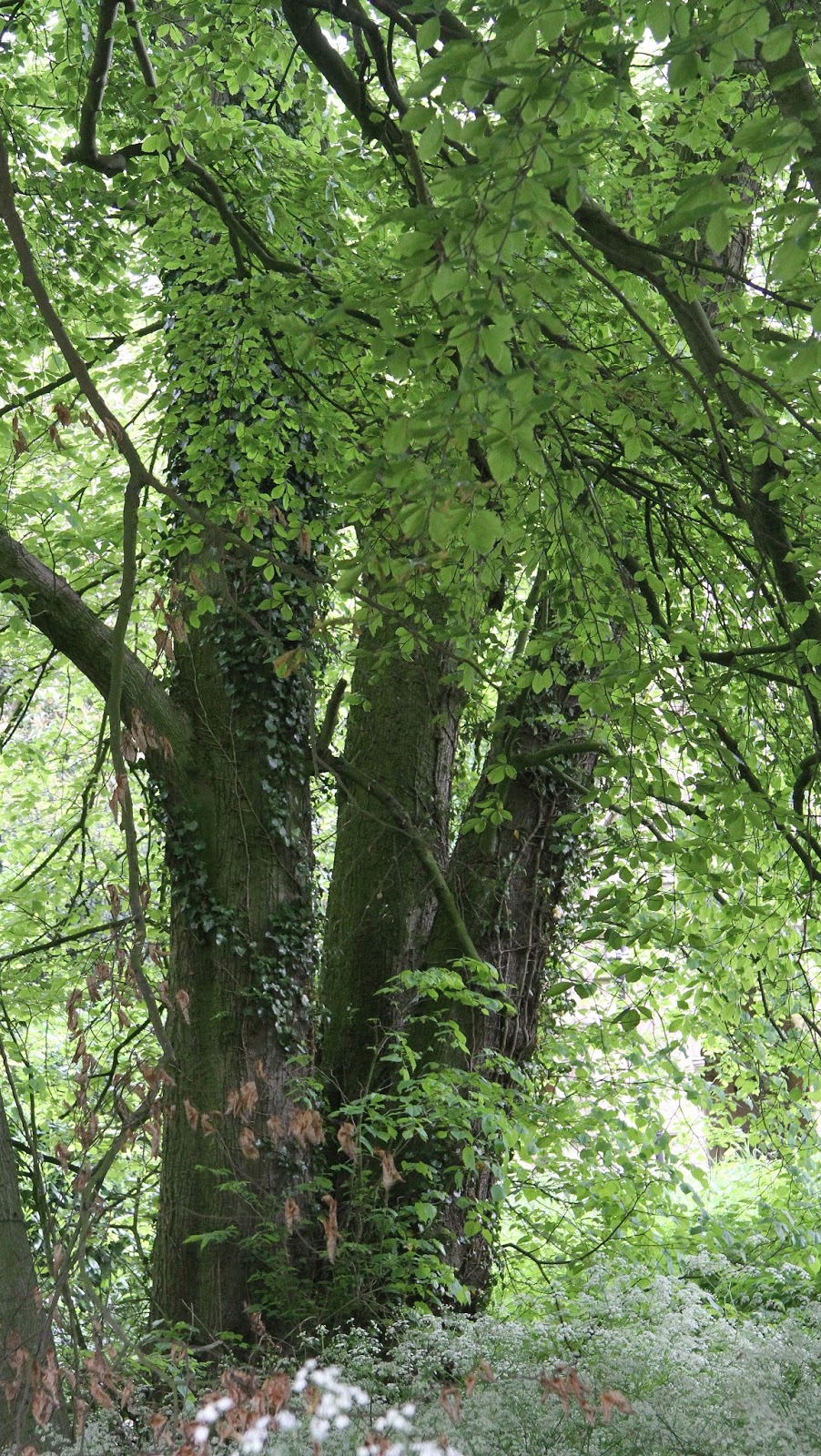
Three-trunked Lime Tree in Roos churchyard

Three-trunked Lime Tree surrounded by Cow Parsley

The almost dry course of Roos Beck - 25th May 2015
Halsham

Victorian Map showing relative densities of Roos & Halsam

Halsham Mausoleum
Halsham Mausoleum


Halsham House
North-facing alcove on Halsham Hoiuse containing a statue of the Virgin Mary.  Some of the cement work looks modern, so is the alcove a relatively modern feature, or has it just been recently repaired?

Part 1 (Introduction & Hornsea) may be read here
Part 3 (Thirtle Bridge & Withernsea) may be read here
Part 4 (Brooklands Officers' Hospital & Godwin Battery) may be read here
Part 5 (Easington & Spurn Point) may be read here  

My thanks to Marcel Aubron-Bülles, Jerry Aurand, Chris Delworth-Kerr, Linda Flowers, John Garth, Phil Mathison with whom I was able to consult on various aspects of my research while I was writing this paper.   

Footnotes

11. Mathison, p.34.
12. Carpenter, Humphrey (ed.) with Christopher Tolkien, The Letters of J.R.R. Tolkien, (George Allen & Unwin, 1981), p.221.
13. Ibid, p.345.
14. Ibid, p.420.
15. J.R.R. Tolkien, The Book of Lost Tales, Part Two, (ed.) Christopher Tolkien (George Allen & Unwin, 1984) p.11.
16. Ibid, p.18.
17. Tolkien Society Facebook page, 29 May 2015.
18. Rooster, 147, 148, 150 [July, Aug, Oct 2007].
19. J.R.R. Tolkien, Silmarillion, (ed.) Christopher Tolkien (George Allen & Unwin, 1977) p.358 & p.329.
20. Garth, p.237.
21. Kent, p.93.
22. Allison, p.39.
23. Ibid, p.32.
24.  J.R.R. Tolkien, Sauron Defeated, (ed.) Christopher Tolkien (George Allen & Unwin, 1992), p.367.
25. Ibid, p.384.
26. Mathison, p.12.
27. Ibid, p.56.

Monday, 6 July 2015

Tolkien's Hemlock Glade, Part 1

A Hemlock Glade, The Houses of Healing, Two Towers and a Beacon: Tolkien in East Yorkshire, Part 1
 

Please note the text explaining the latest findings about Tolkien and East Yorkshire may be read in my essay ‘Tolkien in East Yorkshire’ published in Something Has Gone Crack edited by Janet Brennan Croft & Annika Röttinger.


The Holderness Coastline - showing the Lost Towns of Holderness
from a book by T. Sheppard


Nineteenth-Century Map of some villages near Roos, showing Danthorpe (N of Burton Pidsea), Hilston (top right) & South Frodingham (bottom right) 


1 Bank Terrace, Hornsea
Blue Plaque on 1 Bank Terrace.  Note Jennie is the correct spelling, and she was Edith's cousin, not Tolkien's

Hornsea
An aerial photo of Hornsea looking north towards Bridlington Bay.  Note the flat surrounding countryside.  Photo (c) 2015 Tony Kirwan


Margaret Strickland-Constable (nee Pakenham) several years before 1917


A British De Havilland DH6 plane on the beach at Hornsea taken in c.1918

(to be continued)
Part 2 (Roos and Halsham) may be read here:
Part 3 (Thirtle Bridge & Withernsea) may be read here
Part 4 (Brooklands Officers' Hospital & Godwin Battery) may be read here
Part 5 (Easington & Spurn Point) may be read here

My thanks to John Garth and Phil Mathison with whom I was able to consult on various aspects of my research while I was writing this paper.

Footnotes
1. Carpenter, Humphrey, J.R.R. Tolkien: A Biography (George Allen & Unwin, 1977), pp. 95-8.
2. Website: www.surnamedb.com/Surname/Thirtle
3. Kent, G.H.R. (ed.), A History of the County of York, East Riding, Vol. Vii. Holderness: Middle & North Divisions, (Oxford: OUP), p.57.
4. Ibid, p.50.
5. Allison, K.J. (ed.), A History of the County of York, East Riding, Vol. V. Holderness: Southern Part, (Oxford: OUP), p.85. 
6. Scull, Christina & Hammond, Wayne, The J.R.R. Tolkien Companion & Guide: Chronology, (HarperCollins, 2006), p.95.
7. Garth, John, Tolkien and the Great War: The Threshold of Middle-earth, (HarperCollins, 2003), p.234.
8. Mathison, Phil, Tolkien in East Yorkshire, 1917-1918: An Illustrated Tour, (Newport: Dead Good, 2015), p.34.
9. Chichester-Constable, Margaret, Diaries, The Treasure House, Beverley.
10. Mathison, p.53.
11. Mathison, p.34.