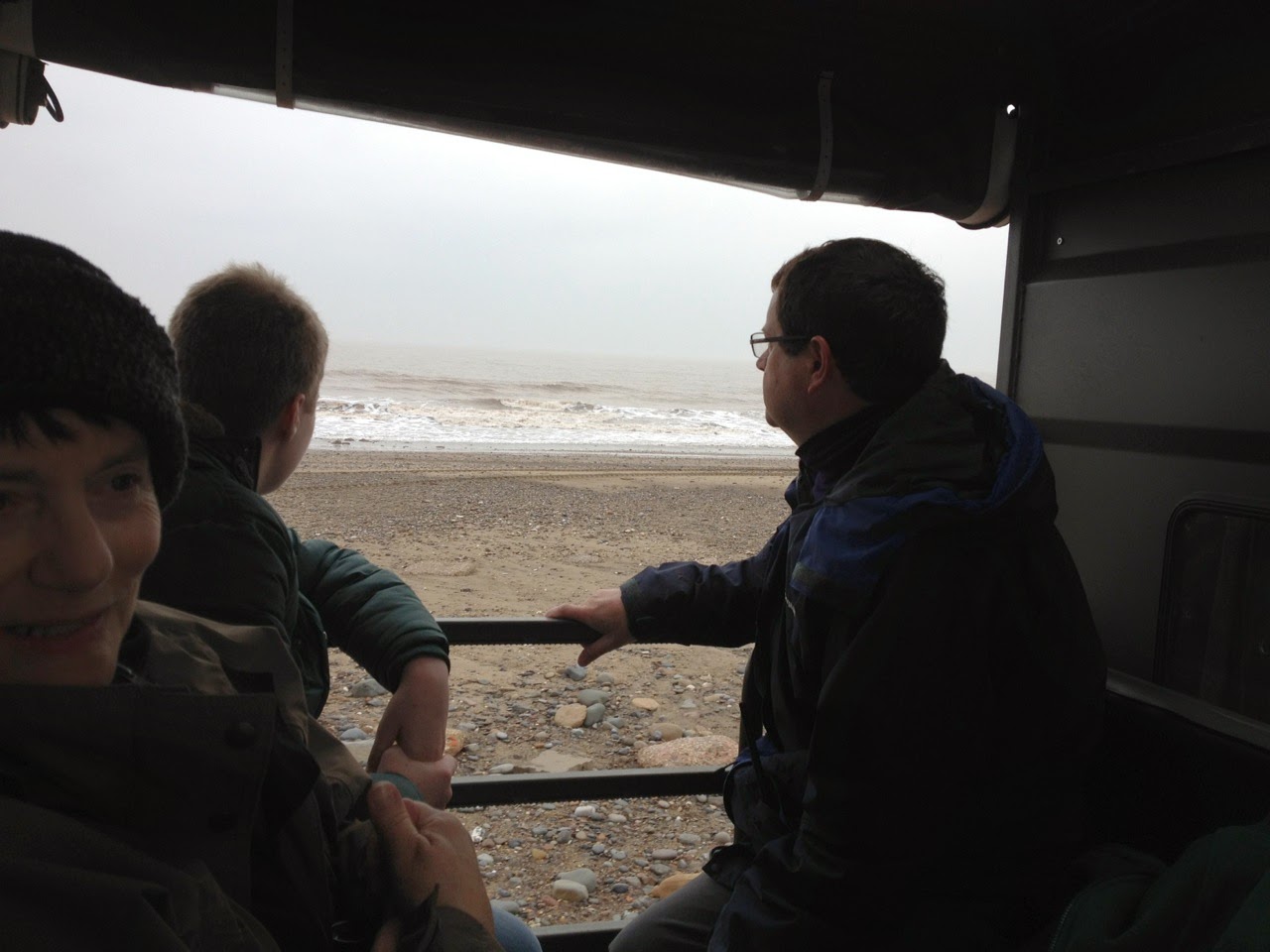
Last Thursday some of us were involved in migration event at Spurn Point involving the new Unimog. For those not in the know Unimog is a range of multi-purpose auto four-wheel drive medium trucks produced by Mercedes-Benz. 'Unimog' as a word itself is an acronym for the German "UNIversal-MOtor-Gerät", Gerät being the German word for machine or device. 20 people bought tickets for the day, but 2 had to pull out at the last minute as they felt ill. In the event this was probably a sensible thing, as the trip wasn't for anyone with an upset stomach!
Black Redstart (c) 2014 Maggie Bruce
Unimog
Ditto (c) 2014 Maggie Bruce
Ditto
Looking out at the Breach (c) 2014 Maggie Bruce
We gathered in the Blue Bell car park, and set off along the shore line towards Spurn point. It was clear right from the start it was a day of a major influx of thrushes with mainly Redwings, but also Fieldfare, Song Thrushes and Blackbirds. Ring Ouzels were reported, but we didn't manage to see either of those. Brian R spotted a Wheatear, which actually flew nearer towards us, permitting itself to be photographed before we moved on. We strode out, and as the group became strung out the 2 at the back spotted a pair of Snow Buntings on the beach.
Wheatear (c) 2014 Maggie Bruce
Wheatear
When we arrived at the Warren we noticed Redwings were being removed from the mist nets to be ringed, measured and weighed. There was a Black Redstart on the roof, but this didn't really allow very close views. We waited while the unimog was being test driven after the high tide, and before we embarked on it.
Brent Geese (c) 2014 Maggie Bruce
Same View Different processing
The affable and enthusiastic guide and chauffeur gave us a few brief facts of the background of the YWT's involvement with the unimog, let us know what we would probably experience, some future uses planned for it, and some basic health and safety information. After a sturdy stepladder was put in place we were all able to embark.
Record Shot of a Redwing
Record Shot of a Fieldfare
Everything ran very smoothly until we reached the breach. Once the unimog had travelled a stretch on the sand we had to swing round at just the right angle to regain the road. After several attempts watched by the open-mouthed consternation of the few sightseers, this was achieved, accompanied by the loud cheers of all those on board! Someone commented that this section was more fun than Hull Fair!
Goldcrest
One of the best things we saw in the area of the Narrows was a female Merlin, which on our approach took to the air with her kill. We saw her ahead of us for several minutes. Meanwhile on the river side the highlight was a large flock of Brent Geese, plus Little Egrets, Redshank & Curlew.
Ditto (c) 2014 Maggie Bruce
On reaching the point we saw some of the substantial changes put in place after the breach, and did our traditional walk of years past. On the way to the Green Beacon we were continually being overtaken by thrushes heading south, some of which stopped over to refuel on berries, before heading off once more over the open sea or river. Skylarks were heard flying over, as was a single Brambling. Other birds we encountered in the bushes were a few Goldcrests and at least 2 Chiffchaffs. On our return to the unimog we saw first one, then two and finally three Black Redstarts, one of which was much paler than the other two.
Black Redstart (c) 2014 Ben Coneyworth
Ditto
Ditto
Black Redstart & Starling
Starling
Roe Deer Buck
On the way back we saw a grounded Skylark just north of the lighthouse, and plenty of thrushes still streaming south. The experience near the breach was almost a carbon copy with the cheering possibly even louder than the first time!
Immature Skylark
Everyone seemed very impressed with the trip, which was especially good in respect of the very mild weather and the great chance to witness visible migration on a vast scale. Someone commented that he'd heard about migration many times, but this was a rare chance to witness it from first hand. There were many other positive comments about the enthusiastic YWT guide, and basically the whole experience. Many of them are looking forward to taking part in future events, which may include trips to see spring migrants, breeding plumaged waders at summer high tides, and possibly autumn migration.