Sunday, 8 June 2014

Larks Shouldn't Try to be Owls!

Clicking Woodcock
On Friday evening my mother and I collected my nephew and we drove for 45 minutes to a prospective evening site.  We parked in a tiny car park and put on our wellies, sprayed ourselves with insect repellent, put on our sun hats and basically covered up as much flesh as possible.  
Woodcock
Ben was surprised at how much birdsong seasoned the evening air as he opened the car door.  This included Blackcap, Song Thrush, Willow Warbler and Chiffchaff.  We made our way through the paths I'd used in March and April, but this time the bracken had obscured the smaller paths.  we didn't see much first, but as we walked on the main central path Ben spotted a buck Roe Deer staring in our direction.  Not long after this we saw several Linnets, which had been coming down to drink from the many flooded area.  I've never seen so much standing water at this location on previous visits.  Luckily, we were forewarned.  
Roe Deer Buck
We headed in a southerly direction, and then came across a confiding male Yellowhammer giving us a cool look over his shoulder.  We reached the heath, which again was flooded.  Here we found a female Adder hiding under some corrugated iron.  Her eye had a faint milky look, which probably means she will soon be sloughing her skin.  Not too far away we located a Woodlark perched high above us in a Scots Pine.  Finally, it was time to tramp towards our final destination. 
Male Yellowhammer
 Female Adder
 Female Adder
 Underside of a Woodlark
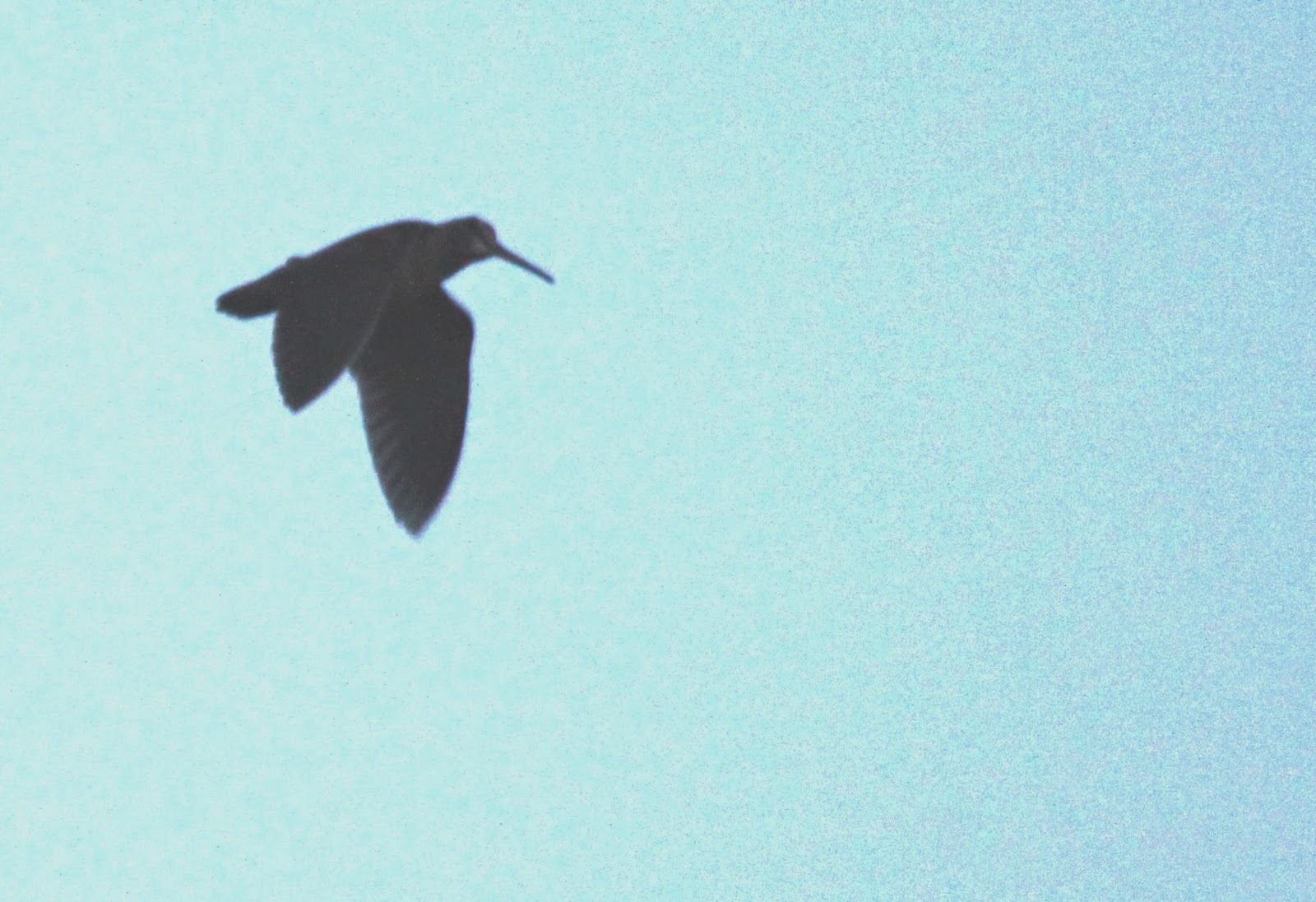
We hadn't been waiting long before we saw a medium slow-moving bird heading towards us just over the height of all the pines - the first of more than 20 fly-pasts of a Woodcock.  We waited here for well over an hour.  As it got darker the Robins and Song Thrushes continued, until only the repetitive song of the Thrush remained.  Before it died out completely some distant Tawny Owls hooted.  Initially, all the Woodcock had been silent, but as the crepuscular twilight deepened then they began to make both their clicking and croaking sounds.  Because this open area was so large these were the best and most prolonged views of Woodcock I've ever seen.   However, their visits began to diminish as the twilight changed to dark.  It was almost pitch black when I noticed something pale and ghostly to our left, which as it got nearer it became clear was a Barn Owl - the first I'd seen at this particular location.  When it became too dark it was time to head back to the car, when the torches were essential to avoid the rampant dog mess which pollutes this particular location.  It seems we were successful in this regard, as the only unpleasant scent which met us at the car were the Stinkhorns concealed amongst the trees.
Roding Woodcock
 Sunset through the Conifers
 Moon
On Friday morning I had woken up at 4.30, and after the Woodcock trip I didn't arrive back until nearly midnight.  The following morning there was no chance to sleep in, so I felt hung over all that morning.  Natural larks really shouldn't try & be owls, it's not good for you!

Saturday, 7 June 2014

(A Different) Ken's Bugs

On Friday as the weather was gorgeous we went to a hidden location in the wilds of Holderness.  We didn't really get close enough to photograph any birds, but there were some nice insects on show including our first ever Mother Shipton moth, this year's first Large Skipper, and Small Heath, plus Red Admirals and plenty of caterpillars in cocoons.  In the afternoon Ken discovered some unusual dark red bugs, which seemed brighter red on their underside.  Barry Warrington has kindly identified them as Spiked Shieldbugs (Picromerus bidens).  They are carnivorous, being especially fond of sawfly larvae, and they are unusual in that they reach adulthood rather late in the year.
Mother Shipton
 Caterpillars
 Speckled Wood
 Not Even a Record Shot of a Yellow Wagtail
 Ken's Bugs

Friday, 6 June 2014

A Bee on Ken's Bonnet

On Thursday we had our only visit to Eastrington Ponds this year. At the main lake we saw a single Great Crested Grebe chick, but it's parents were already brooding the second clutch. There was a Common Tern on a nest with its partner quartering the lake for food. Blackcaps and Willow Warblers were singing, whilst a Bullfinch called mournfully nearby. A male Kestrel was mobbed by the Common Tern. 
Great Crested Grebe

 Great Crested Grebe with Chick
 Common Tern
 Common Tern
 Wren
 Trapped Roe Deer
It was a very windy overcast morning so we tended to hear birds rather than see them. We were watching a distant Yellowhammer when Claire spotted the bird of the day. There was a Chiffchaff singing near the embankment hide, and a few Blackcaps singing throughout the woodland & scattered Reed Warblers in the reedbeds. A female Roe a Deer spent the whole day trapped in a field with some rather strange sheep. There was at least one husk of a Giant Puffball, some emergent Shaggy Parasols, and in a new area there was the stench of hidden Stinkhorns. It was quite a day for fungi with a gigantic tree stump covered with fairy caps - only normally seen in Autumn. A pair of Mistle Thrushes and an immature Pied Wagtail were on the mown Meadow, plus a feeding Song Thrush, but the area was flooded and the summer flowers had yet to emerge here. The only disappointment was the apparent lack of Green Woodpeckers, Jays and the once resident Barn Owl.  However, it was many people's first visit to the area, and they were mightily impressed with the place. 
Common Spotted Orchid
 Twayblade
 A Bee on Ken's Bonnet

Thursday, 5 June 2014

Floral Flourish

Yesterday the planned trip to Hempholme had to be cancelled because of the heavy rain.  We went round the southern half of Tophill Low instead.  There were a lot of bee orchids - we located 22 plants - not all of who had started to flow yet.  There were plenty of other flowers on display, and the afternoon group and the morning stayers were lucky enough to observe a Garganey!  Overall we saw just over 40 species, despite the pretty miserable weather confitions.
Garganey
 Reed Bunting
 Reed warbler (c) 2014 Aileen Urquhart
 Ditto
 Canada Geese (c) 2014 Tony Robinson
 Canada Geese
 Gosling
 Cormorant
 Pochard
 Pochard Ducklings - c.2% of UK breeding population
 Pochard
 Bee Orchid
 Bee Orchid (c) 2014 Aileen Urquhart
 Ditto
 Common Spotted Orchid
 Marsh Orchid
 Hybrid? Orchid Species
 Copulating Little Grebes
 Garganey (c) 2014 Tony Robinson
 Ditto

Wednesday, 4 June 2014

Resuming Classes

Classes resumed yesterday at Welton Waters after the half-term break.  The clouds were very oppressive, but luckily in the end only a few drops fell.  Maggie was on fire & spotted the Roe Deer and Yellowhammers & possibly another species.  Meanwhile June and Pat were the first to spot a distant Marsh Harrier.  The police were scrutinising the river bank at high tide.  Has someone gone missing? 
Roe Deer Buck
 Female Roe Deer
Yellowhammer
 Ditto
 Bullfinch
 Reed Bunting
 Ditto
 Police Search Team - who is watching who?