Saturday, 8 February 2014

Never Seen Before

On Friday we met at East Park for our final visit of 2014. Before the morning session started there was a Common Gull in pristine breeding plumage, but of course it had gone before everyone was ready to proceed.  I can't remember seeing such a smart Common Gull in the park before.  This week there was no Great Spotted Woodpecker in the poplar in the entrance, and not much else after a spaniel ran amok through the feeding gulls. So, we started off to slim pickings at first. The afternoon group had a brief view of a Sparrowhawk in a sycamore which then took off with its typical flap-flap-glide action before plunging down and making an attack on the Sparrows chattering in the bushes. Plenty of Blackbirds flew out of the area, and Jeff last spotted the hawk heading north along the line of gardens. Just a little further on we saw a male Great Spotted Woodpecker. Lynda hadn't seen one before her first session at Hornsea the other week, and now at East Park she enjoyed her best view so far. 
Pair of Sparrowhawks
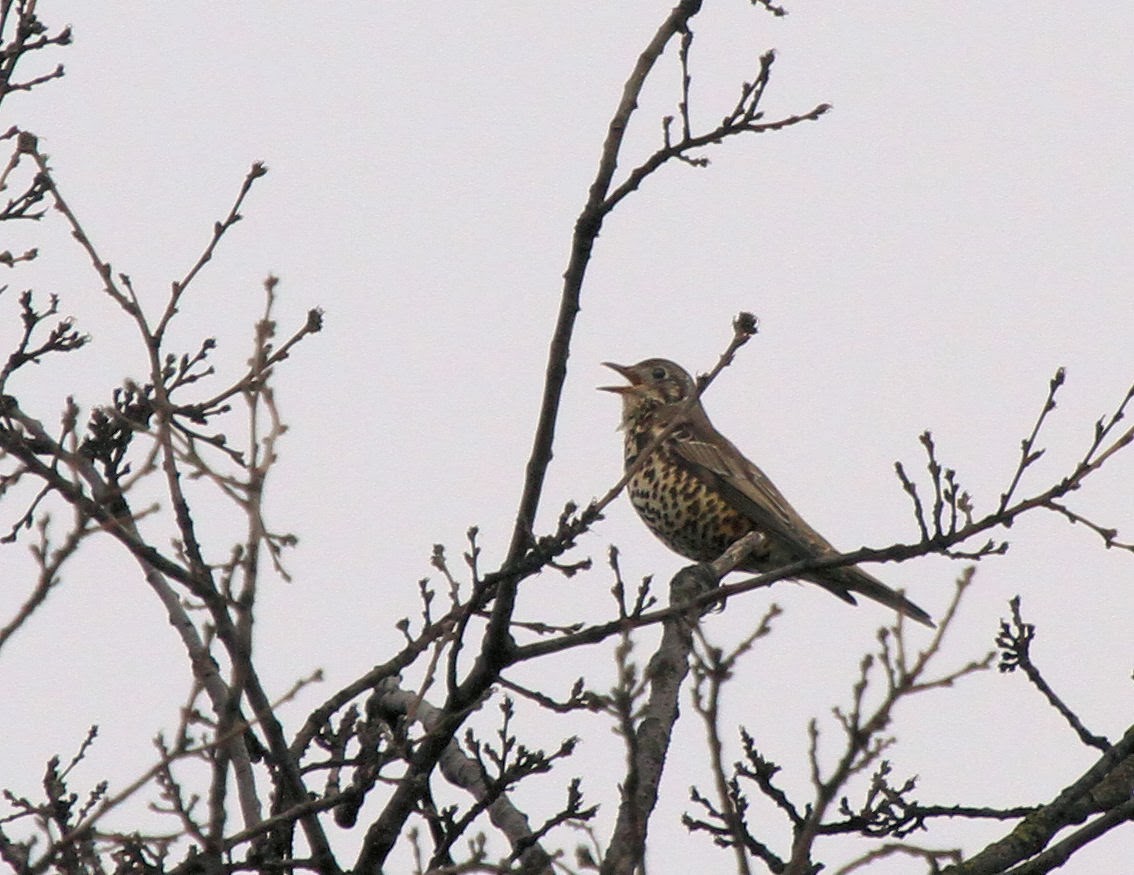
In the morning we enjoyed fairly good views of a singing Mistle Thrush just a little north from this area. Normally Mistle Thrushes give a fairly relaxed delivery, but this one seemed be singing with particular urgency. The is the first time we've heard one singing this year, so perhaps he is desperate to find a mate. 
Mistle Thrush
 Ditto
 We were keeping an eye on the small alder trees and bushes when I was gobsmacked to spot a Jay. It was low down among the bare canes of the vegetation, and was quite tricky to see at first, but it was eventually flushed by a dog walker, so everyone managed to get decent views of it before it later flew to a more central area of the park. Although I heard a Jay in East Park last year, and had been told by the rangers that at least one was still there, I hadn't really believed it until we stumbled across it.  This is a special bird you don't see in the Hull area every day of the week.
Jay
 Jay
 Lynda's Great Spotted Woodpecker
On to the model boating lake, but this was almost empty on both Friday visits, with just a few Friday Unmentionables and a couple of Black-headed Gulls and a single Common Gull in residence during the morning visit. We reached the first part of the 'serpentine' lake where we saw a pair of Tufted Ducks some mongrel unmentionables, and both adult and first winter Black-headed Gulls. From here in the morning we had our first glimpse of Goosanders, but they were swimming away from us.  
Tufted Duck
We kept going until we reached the grassy mound. From here we could see some sleepy Pochard under the sweeping bare twigs on the island, and a large group of Goosanders sailing away from the far bank. We heard the squawking of the Ring-necked Parakeet from here and Jenny spotted it in a tree in front of a two-tone building, and although it was difficult among all the tangled twigs she was able to point it out to some of her classmates. As we reached the eastern edge of the grassy mound, some geese were hauling themselves into the water, and one of these was the lone Pink-footed Goose. It was here that there was a high-pitched song, and sure enough we enjoyed good views of a male Treecreeper. In the afternoon it had shifted to one of the trees along the main road nearer the Khyber Pass.  
Treecreeper
 Ditto
 Lesser Redpoll
 As the morning group reached the splashboat car park some tiny finches were spotted in a silver birch tree at just above head level. There were at least 6 Lesser Redpolls, but not the full 13 seen last week. In the afternoon the redpolls had moved on, just leaving 3 Goldfinches behind. Such excellent views of Redpolls  hadn't been enjoyed before by some members of the class. On the lake next to the splashboat people were feeding the birds on both occasions. There was a single Mute Swan, plenty of mongrel unmentionables and quite a few Tufted Ducks of both genders. There was one confiding drake Pochard here in the morning, and 2 in the afternoon, and tucked away in a corner near the toilets block an unassuming female Pochard. The only one we saw in the whole visit. Why are there so many drake Pochard, and very few females? In the afternoon the rogue Pink-footed Goose flew in, and it was obviously a lot smaller, darker-headed and less big billed than the Greylags.
 Lesser Redpoll
 Pochard
 Pochard
 Coot
 Coot
When we reached the main lake again the sightings of the Goosanders increased again with another large grouping, and a single Great Crested a Grebe was seen by both groups.  That was the first sighting we'd had of this species in the park this year.
Great Crested Grebe
 Goosander
 Goosanders
 Ditto
 Drake Goosander
 Goosanders
 Goosanders
In the morning I spotted a male Sparrowhawk sunbathing on one of the islands. We moved around a little attempting to get an uninterrupted view from the many twigs of the tree it was sitting in. 10 minutes later a larger bird flew towards it, fluffed itself up, before settling down next to the male - it was the female. Unpaired males are said to have a lot of trouble finding suitable females. The size difference means that several males when approaching potential mates are killed and then eaten by the larger females. However, there was no antagonism between these 2 birds, so they were obviously a well-established pair.  I've never seen a pair of Sparrowhawks sit side-by-side before, and I suspect few other birdwatchers have, but East Park is obviously the place to see it.   
Sunbathing Male Sparrowhawk
 Pair of Sparrowhawks
 Larger Female Sparrowhawk [left] & smaller more colourful Male [right]
 That Glare!
We circumnavigated the lake without a great deal of extra sightings, and the wind was rather fierce in our faces on the opposite bank, so we hurried through this part of the walk. As the morning group approached the cafe again the Pink-footed Goose was grazing on a mound behind the Greylags. Finally, we walked through a little conifer section south of the cafe, and here both groups had excellent views of a confiding Goldcrest, and a large group of foraging Long-tailed Tits. Such a view of a Goldcrest was new for John in the morning and only the second for at least one afternoon participant. It was an intimate experience, and a fitting conclusion to this visit of such a public venue. 
Pink-footed Goose
 Ditto
 Black-headed Gull
 Male Goldcrest
 ...And Finally...

Friday, 7 February 2014

Visiting Brideshead

On Thursday we went to Brideshead for the first time as a birding location. We entered through a gate and began walking down a very muddy slippery path. Eventually we made it through to a less muddy area. There was a Skylark over the car parking area, and a Reed Bunting in the reeds as we went through the gate. On the lake there were Wigeon, Gadwall and Friday Unmentionables. Not long afterwards we saw our first drake Goldeneye with a female on either side. There were more and more wildfowl ahead, although the light was rather tricky at first. 
All wildlife pictures apart from the Treecreeper (c) 2014 Richard Whateley
Brideshead
 A Friday Unmentionable
 Gadwall
 Wigeon
 Goldeneye

We carried on until we arrived opposite an island, which was absolutely festooned with Cormorants. Some of these were perched on the edge of nests and at least one bird was seen carrying in nesting material. While we were standing here we were told about some Pintail, and I managed to locate 2 drakes in the telescope for everyone to look at. I thought I'd spotted a female Scaup when suddenly a Kingfisher flew past at the back of the lake. It landed in some twigs and I managed to get the scope on it, but only Jan managed to see it before it was off again. I wasn't able to pick out the ghostly Scaup again. While the rest were observing and identifying duck species, Maggie spotted a Treecreeper. Unfortunately, myself & Chris were only quick enough to see it flying off. 

Cormorant Colony
 Cormorant carrying nesting material
 Mute Swans
 Treecreeper
 About to Swallow a Morsel
Other birds seen included: Canada & Greylag Geese, a few Teal, but the Pochard and the Shoveler were noticeable by their absence. On the walk back we saw a distant Mistle Thrush, and a Wren in the reeds at our feet, and a pair of noisy Great Tits. There were relatively few small passerines in the area. The afternoon bucked the normal trend with first a Great Spotted Woodpecker, a pair of Treecreepers, a flock of Chaffinches, 3 Fieldfare, and a pair of Greenfinches flew out of the caravan park and twittered in the trees along the path.  We also enjoyed a better view of a flying male Goosander in the afternoon who settled in the western edge of the car.  It tried to avoid us by skirting the far edge of the lake.

Thursday, 6 February 2014

Otter Plays with Us

Because of the terrible forecast on Wednesday we transferred to Tophill Low.  We headed north to try and encounter the Otter.  We were watching the feverish activity at  the bird feeders when we met someone who had had close, but brief views of the Otter at 9.30.   There were both Marsh Tits and a Willow Tit visiting the feeders as well as all the usual suspects.
All photos (c) 2014 Tony Robinson
Little Egrets
We carried on through D Woods were 3 Roe Deer ran ahead of us and burst into North Scrub.  Here, there was a concealed Barn Owl, which after much peering through the thick vegetation everyone was able to see.
Heron
There were 2 Little Egrets hunched up at Hempholme Meadows, but they flew off after a time leaving nothing at all.  In the afternoon a substantial number of Friday Unmentionables were in residence, plus a single drake Teal.  The only other birds there were some Black-headed Gulls. 
Great Tit
 Record Shot of Willow Tit
We popped into a couple of the hides overlooking the reservoir on the return joinery where we enjoyed some good views of Goldeneyes, plus Pochard Wigeon, Gadwall, Great Crested Grebes, and in the afternoon the impressive gull roost had started.  We managed nearly 40 species despite the ever increasing gloom and growing wind.

Later I found out that there had been another Otter sighting at South Marsh West, just as we were leaving at 15.30 - just our luck!

Wednesday, 5 February 2014

Once more unto the Beach

On Friday & Tuesday we went to Seweby. On Tuesday the tide was just going out, so we walked round the hall grounds first. The first bird we really tracked down was a Treecreeper. Unfortunately, it chose a yew tree to climb up, so was quite difficult to see especially for prolonged views, although I think everyone managed to see it eventually. Rather surprisingly the Mistle Thrush was nowhere to be seen, nor were the Great Spotted woodpeckers. However, one bird which didn't let us down was a very confiding male Goldcrest. He flitted about, singing from one tree or another before we moved on and left him in peace. There was very little on the golf course, but Rose spotted an immature Herring Gull paddling. This is when a gull seems to run on the spot. It is thought that this action simulated the falling of heavy rain & the worms leave their burrows to escape the possible flooding only to end up in the bill of the waiting gull.

Male Goldcrest (c) 2014 Chris Cox
 Goldcrest (c) 2014 Maggie Bruce
On the way to the beach we noticed a "Pied Crow" flying around the animal enclosures.  This is a bird that relied on artificial food sources when it was moulting, resulting in this leucistic appearance.  It almost looks like a different species.  If only he'd followed some his cousins down on the beach.  Their more varied diet of molluscs ensured that their feathers were full of melanin and were completely normal. 

"Pied" Carrion Crow (c) 2014 Maggie Bruce
 Record Shot of Flying "Pied" Crow (c) 2014 Maggie Bruce
 Bog Standard Carrion Crow (c) 2014 Chris Cox
 Oystercatcher in winter plumage (c) 2014 Maggie Bruce
 Ditto
By 11 o'clock the tide was starting to recede so we went down onto the beach. Unlike Friday there were dozens of birds on the beach. There were noisy Oystercatchers as always, but also bathing Turnstones, and plenty of nearby Redshank. Then David, who had been scanning the foot of the cliff, reported a Rock Pipit, and sure enough ear eventually located it on the top of one of the seaweed heaps at the bottom of the cliff. There was also a very pale Pied Wagtail in the area.  
Turnstones (c) 2014 Chris Cox
 Turnstone (c) 2014 Maggie Bruce
 Turnstone with a stump (c) 2014 Maggie Bruce
 Redshank (c) 2014 Chris Cox
 Oystercatcher in Breeding Plumage (c) 2014 Chris Cox
 Rock Pipit (c) 2014 Chris Cox
 Rock Pipit (c) 2014 Maggie Bruce
 Pied Wagtail (c) 2014 Maggie Bruce
Although we kept scanning the skies, this was one day when there was no sign of any birds of prey. 
Dunlin (c) 2014 Chris Cox
 Flying Oystercatchers (c) 2014 Chris Cox
 Rock pipit (c) 2014 Maggie Bruce

Sunday, 2 February 2014

Bird of the Week 1: Little Owl

Bright sunny afternoons in February can be a good time of the year to see sunbathing Little Owls. The winter months can be productive for good views of Little Owls because later in the year the sprouting leaves of their favourite tree can make the birds harder to spot, or obscure their plumage details from photographers. Little Owls are sedentary birds, generally not moving far from their summer breeding sites, and as this charismatic bird continues to decline, this tends to be in old gnarled trees or dilapidated buildings often close to livestock. Little Owls are attracted to the beetles, moths and other invertebrates, which feed on the droppings of sheep or cattle. However, worms are also a very popular prey item, and they have often been observed suddenly toppling over backwards when the force of their efforts to pull up a worm is unexpectedly successful.

Little Owl (c) 2014 Maggie Bruce
According to Birds Britannica, Little Owls can take prey far larger than themselves including Lapwing, Woodpigeon, Cuckoo, Magpie and Moorhens, and mammals as big as Rabbits or rats. If you are lucky enough to see one chasing a prey item, you will be amazed that such an apparent aerodynamic impossibility seems to be able to fly after its victim with great ease. Only a flying brick seems less able to fly through the air. 
Near Pocklington taken February 2013
 2/2/14 (c) Margaret Richardson
 2/2/14 (c) Margaret Richardson
 A Less Expected Angle (c) 2014 Margaret Richardson
Little Owls were released onto a few aristocratic estates from the mid 18th-century, which weren't thought to be successful, but renewed attempts in the early 20th-century were far more rewarding, and the birds quickly spread, reaching as far north as the borders of Scotland. Fossil evidence shows that the Little Owl used to be a native of the UK, but they died out some time in antiquity. So, the Little Owls found a ready-made niche, where the birds didn't compete with any known native species, unlike the introduction of many non-native birds, which have gone on to cause severe problems with the ecosystem. 
Holderness (c) 2014 Chris Cox
As the name implies, the Little Owl is considerably smaller than the Barn, the Tawny, the Long-eared and Short-eared Owls. It is also much more darkly-plumaged than any of the other species. Although a Little Owl hunts largely during the hours of darkness, as well as at dawn and dusk, it isn't as nocturnal as the Long-eared or Tawny Owls, but it is seen during daylight even more than Barn Owls. Only the Short-eared Owl is seen during the daytime more than a Little Owl, and is therefore the most diurnal of the UK owls. 
Lying Low (c) 2014 Maggie Bruce
The feathering on the heads of Little Owls have a curious aspect appearing almost like a pair of white eyebrows, which either make it look as though the birds are always frowning, or instead that they are perpetually surprised. So, this 'cross' expression, and the birds' habit of bobbing its head furiously up and down if you approach too closely lend them a rather comic air, which endears them to bird watchers and members of the public alike.  
Lying Low 2 (c) 2014 Maggie Bruce
In East Yorkshire many rural villages hold at least one Little Owl, and some lucky ones have one at each exit! So, if you know a location which contains this charming and attractive species, now should be a good time to enjoy decent views as they pose in full afternoon sunlight before a cold February night takes over. Sometimes early morning sunshine can be productive too, as the owl warms itself after a freezing night searching for food.  
Lying Low 3 (c) 2014 Maggie Bruice
Will any of you be as lucky as Maggie who managed to photograph her local owl indulging in extremely bizarre behaviour. She posted her pictures on a forum asking what people thought was happening, answers ranged from suggestions that it was anting, sunbathing, playing dead, or even dying. However, one expert believes that the bird was simply having a snooze in a warm and relatively safe location. Happy Little Owl Hunting!  Please send the results of your experiences to me.

Saturday, 1 February 2014

Marsh or Willow

In today's Yorkshire Post my photographs of Marsh and Willow Tit are used to help illustrate an article about how to differentiate these species.  However, their calls are the most sure-fire way of telling them apart if you can't see the birds extremely clearly. 

Marsh Tit
Listen for the "pitchoo" sneezing call of this species 
Willow Tit
The nasal "chay-chay-chay" call of this species is very distnictive