Monday, 11 November 2013

The Shorts are Out in the Afternoons Again

The forecast for Friday was excellent, although it was due to cloud over in the afternoon and rain was predicted for later in the day, so we were able to visit one of the bleakest locations in East Yorkshire. Sure enough it was a lovely sunny morning with only a light breeze. There wasn't a great deal to see at first with just a few Skylarks, Meadow Pipits and Reed Buntings calling as we walked along the drain. Then we reached the floodbank, and climbed it to see that the tide was extremely high and had inundated most of the designated area. Because of the depth of the water there weren't many waders here, but the Shelduck were still dabbling in the water. Great flocks of Golden Plovers swept over our heads, and looked especially fine in the sun - their flapping wings seemed to make them wink in the sunlight. In the afternoon the water had drained away, and some Redshanks had dropped in. Also in the afternoon we looked 90 degrees towards the west, where we spotted a bird flying around the rough grass near a telegraph post. It was a Short-eared Owl. It continued hunting for several minutes, but there was an opportunistic Kestrel a little nearer to us in the hedge, so the final outcome was unknown.
Short-eared Owl

 Golden Plover
 Knot
 Mainly Knot
 Mute Swan
 We carried on towards the pumping station and here there were literally hundreds of birds on the small portion of available mud, but many more swirling around in the air. There were Oystercatchers, Curlew, Dunlin, Knot, Ringed Plover, Wigeon, and Friday Unmentionables. The air was rent with the very distinctive 'Cooo-eee' of Grey Plovers, and we eventually saw some of those too. As we stood on the floodbank a couple of Little Egrets were noticed flying from one area to another.
Reed Bunting
 Record Shot of Short-eared Owl
 Ditto
Looking towards the Saltmarsh there were Roe Deer and Carrion Crows, but no raptors of interest. This changed after lunch when a Short-eared Owl was observed hunting up and down for virtually the whole of our visit. It was later joined by a second bird, which may have been the one we had seen earlier. It was so mild in the afternoon we were able to return along the top of the floodbank - it is usually far too windy and cold to even attempt this is in the winter months. As we walked back the shrill cry of a Kingfisher came from the drain. It appeared to be flying towards the pumping station, but it was obscured from our sight by the vegetation along the bank. The first drops of the approaching weather system could be felt on our faces, but we managed to get back dry shod and just before the rain began in earnest. The gamble had paid off. 

Friday, 8 November 2013

A Splash of Gold

We had our first visit to the year to a particular estuarine location. At first it was beautiful: a Marsh Harrier hunting as seen from the car park, and a smattering of ducks and gulls. Linnets, Skylarks and Meadow Pipits flew over, but they must have been fairly high, as they couldn't be seen against the very bright sky. However, the wind soon picked up and made the day less bearable. The reedbeds were sparkling in the sunlight, but Wrens seemed the most numerous birds in there. I did hear the single "ping" of a Bearded Tit a little later, but it was never repeated, and we certainly didn't see the bird.

Grey Wagtail
 Marsh Harrier
 ditto
 Golden Plover
Once we left the factory buildings behind we could obtain a better all round view, and son several Skylark took the air, and a few of them were singing. Once we caught sight of the marsh, which has been hidden behind a massive floodbank, we could see Lapwings, and Golden Plovers, which were hunkered down in the long grass. Greylag Geese and Starlings were also present, but last year's Herons were absent.
We arrived at the Fishing Lake and this had a diverse population of Wigeon, Tufted Duck, Mallard, Gadwall, Mute Swans and Coot. The skiing lake was much quieter, and at first there didn't appear to be a single bird, but Claire first spotted a Grey Wagtail, followed by a pair of Little Grebe. The only other bird on the water was a Moorhen, while a male Reed Bunting and a charm of a Goldfinches were flying around.
Grey Plover
 Long-tailed Tit
 Roe Deer
 ditto

This was the extent of our walk, and the remainder of the morning consisted of a March back to the car park. On the return journey, not a single new species was added to the tally.
In the afternoon the tide had begun to leave some exposed mud, and on here there were some Black-tailed Godwits and a new species for me at this site: 4 Grey Plovers. Of course there were Redshank and Lapwings, but the Golden Plovers were under the radar. 2 Snipe flew up from the marsh area, and a male Marsh Harrier brightened the afternoon, as did a female Sparrowhawk. Three Roe Deer grazed in the open during our return journey. 

Thursday, 7 November 2013

Hitting a Purple Patch

We went to Bimble Bay again today.
I looked in the bushes for any ringing going on, but I couldn't see any. We therefore shared cars to Bimble Bay Dams. We tried the big hide first, but it was relatively quite, with not a single wader to be seen. Bird seen included: Heron, Teal, Herring Gull, and a Sparrowhawk being chased by Magpies or Crows.

Purple Sandpiper
 Heron (with a gull we totally ignored at the time!)
Trying the smaller hide we came across Tree Sparrows on the way & plenty of Blackbirds. From the hide itself we saw absolutely hordes of Moorhens, plenty of Friday Unmentionables, but a pair of Wigeon flew in later. 
Teal
 Oystercatcher
We tried birdwatching from Carr Naze. A Redshank was the only bird any way near the grotty pond just through the gate. We could see plenty of Oystercatchers from here, and a single Curlew, and Cormorants flying low over the sea. Reaching the end Lynn spotted a seal pup, and Eric identified a female Eider bobbing off the end of the Brigg. As we made our way back a flock of tiny waders were seen, which turned out to be Dunlin. Later I saw three Turnstones fly in & myself and Anthony could make out a Purple Sandpiper scurrying along the water's edge. 
Knot & Dunlin (left)
 Turnstone (& rear of Purple Sandpiper)
 Ringed Plover, Dunlin, Knot & Purple Sandpiper - you decide
 ditto
 ditto
 ditto
 Cormorant
 Record shot of Rock Pipit
All Action Pictures (c) 2013 Tony Robinson 
Mock Air Sea rescue
 Daredevil

In the afternoon we went down onto the beach first, and saw a select sprinkle of wader species, but they were continually being frightened off by rampant dogs. Despite the canine invasion, I think it was the first decent views some had obtained of a single Purple Sandpiper. It was certainly the first the Weds pm group had seen for some time. Hardly noticeable among the seaweed were a few Rock Pipits, with Meadow Pipits somewhere around too. The subsequent visit to the Dams was as disappointing as in the morning. A single Curlew & a sole Redshank dropped in briefly.  The most interesting sighting came in the afternoon.  I went to inspect the site of the mist nets in the Carr Naze bushes, when a Woodcock launched itself into the air - I didn't have my camera with me at the time.   That's the most convoluted use of a euphemism I've made it quite some time!

Tuesday, 5 November 2013

The Way Old Friends Do


Another terrible weather day, another day at North Cave Wetlands. 
The day started well with a Curlew over the car park, swiftly followed by the flight call of a Green Woodpecker. We hadn't been walking long along Dryham Lane when Chris Cox spotted the Green Woodpecker right on the edge of the road and the grassy verge. It allowed us to approach fairly close, but we had good views of it flying across the road and hopping about on the verge. A single Meadow Pipit flew over, and a large charm of Goldfinches.

Kingfisher (c) 2013 Maggie Bruce
 Green Woodpecker (c) 2013 Chris Cox
 Green Woodpecker (c) 2013 Maggie Bruce
 ditto
 Goldfinches (c) 2013 Maggie Bruce
 Little Grebes (c) 2013 Maggie Bruce

There seemed to have been a clear out of birds on the Main Lake, but we did see 5 Great Crested Grebes and 4 Little Grebes including one of the latter, which ran on the water. 2 Snipe spent a short period on the edge of the lake before disappearing into the the vegetation.

Kingfisher (c) 2013 Chris Cox
 Ditto

We were just entering the gate to make a circuit of the reserve, when I spotted a Kingfisher flying low over the water towards South Hide. Maggie & Chris crept back there and were rewarded with excellent views in the semi-gloom, including a period when it landed on the ground in front of the hide!  We hadn't seen either Green Woodpeckers for months at this location, years in the case of the Kingfisher, so it was like meeting old friends.  Lets hope they'll be still there on future visits.
There were Fieldfare, Redwings & Siskins in the bushes around the perimeter. Gadwall and Wigeon were on Carp Lake and Far Lake respectively. 
 Whooper Swans (c) 2013 Chris Cox
Whooper Swans (c) 2013 Maggie Bruce
 ditto
 Skylark (c) 2013 Maggie Bruce
 Greylag v Pink-Footed Geese (c) 2013 Maggie Bruce
 ditto, but (c) 2013 Chris Cox
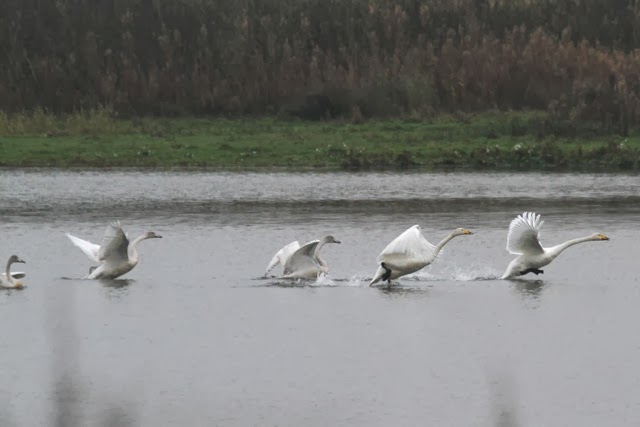
There was a family of 5 Whooper Swans on Reedbed Lake, but they took fright at the massed ranks of the large Tuesday am group & flew to the new flooded area in front of Crosslands hide. When we were watching them there in the afternoon another pair of adults flew in, making 8 Whooper Swans in total. During our morning walk a male Marsh Harrier flushed all the Teal from Village Lake. As we emerged from the big hedge we had good views of many individuals making up an exaltation of Skylarks. In the same fields was a large flock of Greylag Geese  
 Redshank (c) 2013 Maggie Bruce
Teal were the main birds seen from Turret Hide, but we failed to find a single Snipe. On the way back to East hide a female Sparrowhawk dived out of deep cover with small prey in her talons, plus the remains of the tree the bird had been sat in! We flushed her 3 more times, after she'd dropped half the tree she was carrying - the last time after we'd been in the East hide, and it still hadn't plucked its prey. She eventually flew to an area of the reserve from where she was unlikely to be disturbed. In the afternoon Linda spotted a Snipe, and after that we managed to find 4 more. 
Cormorant (c) 2013 Maggie Bruce
 Rook (c) 2013 Maggie Bruce
 House Sparrow (c) 2013 Maggie Bruce