Saturday, 15 May 2010

Kelsey Gardens, Burstwick


Blogger seems to be misbehaving at the moment, so the top 2 pics are of a Whitethroat, followed by 2 of the Blackcap, and one of the Meadow Pipit. The back end of a Cuckoo is next and the final photo is of a Willow Warbler

Today’s session was not one of my standard classes, but was one organised by the landowner to allow visitors to observe the spring birds around Kelsey Gardens. 8 people arrived for the start time of 10am. 4 people were Kelsey Garden regulars, whilst the remaining 4 were either my ‘students’ or accompanied my ‘students’ for their first visit to this venue.

We commenced by peering through what at first glance was the unprepossessing barbed wire of the adjacent Sangwins yard. Here, we had amazing views of a Whitethroat, briefer views of a Linnet, and an even shorter view of a Stock Dove. We walked down to the first lake where we were serenaded by a Blackcap. The lake was ringed with anglers, but we saw Mallard, and Coot here. In a bush in the grassy field to our left we had good views of a Meadow Pipit, which later delighted the crowd with its parachuting song flight. After passing the lake we reached an area of reeds where we heard the monotonous rhythmic song of a Reed Warbler, and Kelsey Garden regular, Mike, was able to get his first glimpse of one. Climbing the adjacent slope we heard a Willow Warbler, but the Turtle Doves were silent. The birds were fairly quiet at the top of the hill, but we could hear another Blackcap & a Goldfinch tinkled as it flew overhead. Unsurprisingly, last year’s passing Osprey failed to appear!

Retracing our steps we arrived at ‘The Path of Brian’ where everyone got good views of 3 male Reed Buntings, and heard the songs of a couple more Reed Warblers, but the Sedge Warblers and the Lesser Whitethroat seemed to be absent this year. However, the highlight here, and the star bird of the morning, was a bubbling female Cuckoo, which flew quite close to us a couple of times before it was joined by a male. Later, they flew right over our heads as we climbed the hill between the 2 lakes. We were able to see the nest-hole of the Kingfisher, but it remained out of sight as canoeing was taking place on South Lake. Similarly, we glimpsed a Great Crested Grebe, but it hid itself among the reeds as soon as the first canoe set out. However, one participant was able to see her first Tufted Duck at the back of this lake. Along this hill we continued to hear a Cuckoo, and then saw our first Willow Warbler of the morning. The nearby drain yielded a concealed Sedge Warbler and a flagrant yellowhammer on the wires, but along the old railway line we failed to hear the usual Lesser Whitethroat or Turtle Dove. However, I was relieved to hear that Mike had heard the ever-decreasing Turtle Dove much earlier that same morning. In all we saw or heard 37 species, which isn’t bad going, but several expected birds were missing during our trip, so on a weekday when there should be less activity on the lakes one may expect to encounter around 40 different species. We headed back to the refreshment tent for a welcome drink & a snack. Overall, everyone was very pleased with their trip around Kelsey Gardens.

One out of 3 Ain't Bad...

2 old pictures out of the archive.


Yesterday, we popped to a venue which should have had guaranteed Little Owl, Peregrines & Redstart. In the morning only the Peregrines obliged as one was observed flying round a quarry, and the other was seen feeding one of its 3 chicks. We were unable to find the Redstart, but as we were climbing a steep hill after giving up, its song rang out behind us - too late! However, we did see Willow Warblers, Yellowhammers and Linnets, and heard a Garden Warbler in atypical habitat. The Little Owl let us down on the way back to the car park. The afternoon started similarly with Betty being the first to spot a flying Peregrine - she went on to say she thought the site was better for watching Peregrines than the much more famous Malham Cove. Through the telescope we could see one was with the chicks and another perched on the cliff edge nearby. We tried for the Redstart again near last year's nest-site without luck, and then walked along a level track. At the furthest extent of the walk we heard a Redstart and caught fleeting glimpses, but he was nervous of the crowd of 12 & refused to pose in the open. However, in the same location a Goldcrest with its beak full of food for its youngsters posed well before disappearing into some ivy. On walking back another Redstart was singing in a very prominent, if fairly distant place, and even those least proficient with binoculars managed to get a decent view. The Little Owl lived up to its truculent reputation, and refused to appear at all. The Peregrines really made the day for everyone.

Thursday, 13 May 2010

Third Time Lucky


Most of the above pics (c) 2010 Vince Cowell
Pics above, are from the top: Willow Warbler, Heron, Yellow Wagtail, Lesser Whitethroat x2
Whitethroat, Willow Warbler, Yellowhammer, Blackcap & Wren
Below: Wren

Apple Blossom Local View Mallard nest with eggs

Well, I suppose it had to happen, we didn’t see or even hear a Cuckoo today! Every successive visit to the organic farm sees the spring taking a stronger hold, and this was our 3rd tour. It was even warm at times today, although the day ended with a strengthening and still chilly South-westerly wind. Many of the young Herons seem to have fledged, and we found a Mallard nest containing 8 eggs. New birds included: our first Lesser Whitethroat at this site, and at least 2 Yellow Wagtails were confirmed in the afternoon, after their presence was suspected in the morning. The normally shy and skulking Lesser Whitethroat gave good, if extremely brief views near the top of a hedge; whilst the Yellow Wagtail began to walk towards us on the path we were travelling. A cream crown Marsh Harrier was seen heading north up the stream, we discovered the remains of a Pheasant probably snaffled by a Fox on the edge of the woodland; whilst among the trees we found a Sparrowhawk’s plucking post. A Kestrel was heard calling, possibly near a nest site & a Barn Owl was glimpsed before disappearing near a derelict garden shed. The Sedge Warbler showed well in the morning, but was harder to locate after the very satisfying organic lunch. Reed Buntings showed well for both sessions, but its cousin, the Yellowhammer, was only seen in the morning. Linnets flirted round us on the edge of our vision, if not exactly coming into proper focus. The Hares were not as noticeable this time, and we failed to see any Roe Deer. Again, this site proved hugely popular, but I’m still not sure if it’s really the organic produce which ticks all the boxes!

Wednesday, 12 May 2010

Cloud Cuckoo-Land

Male Cuckoo in flight (c) 2010 Maurice Gordon
Cuckoo (c) 2010 Tony Robinson
Male Cuckoo at rest
Reed Warbler
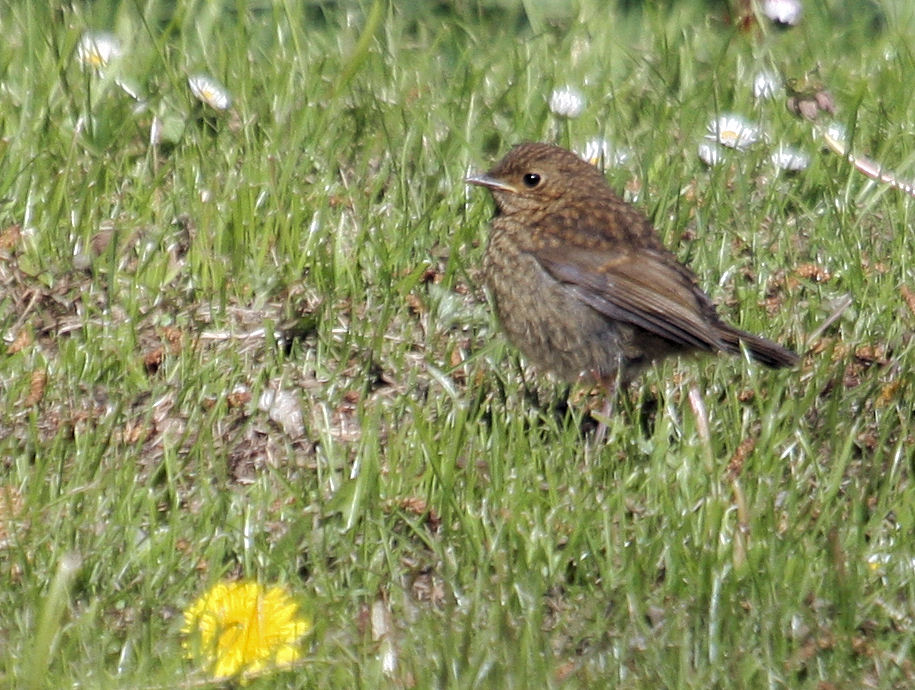
Robin Fledgling
Male Blackbird
Drake Mallard (c) 2010 Maurice Gordon
Blue-tailed Damselfly
For the second day running a close encounter with a Cuckoo was a major highlight of both sessions. Last week at this location the Cuckoo called fairly briefly in the morning, and then appeared to be completely absent in the afternoon, but today he performed well all day, and even indulged in some ‘gowking’. He seemed to be patrolling the canal in a vain search for an available female, but as far as it was possible to tell in this regard, he didn’t have any luck. The Cuckoo was a ‘lifer’ for some present, but for most of the rest of today’s participants it was the best view of a Cuckoo they had ever enjoyed. We were able to observe it at rest, waggling its tail from side to side with drooping wings, and calling for minutes on end, but also it flew past several times – its long tail, drooping pointed wings, and grey colouration giving the impression of a bird of prey. Between the squally showers there was some warm sheltered moments, and in these we managed to see a few Blue-tailed Damselflies, Green-veined Whites, Speckled Woods, dozens of St Mark’s Flies, and at least 5 Orange-Tips. Today was our 2nd visit to our local quiet canal. The birds were pretty similar as last week, but the Reed & Sedge Warblers were less prominent as they presumably kept out of the worst of the cutting Northerly winds. However, we did manage to obtain good views of both of these species. In the morning we saw 38 species, and a couple were added in the afternoon bringing the tally to 40. Carol marked the pm session 10 out of 10 as soon as the Cuckoo appeared, so goodness knows what the close views of Sedge Warbler, reed Warbler and Linnets did to the final score!

Tuesday, 11 May 2010

Pulling Rabbits Out of Hats

Barn Owl (with thanks to V Cowell)
Barn Owl (with thanks to M Gordon)
Talons with clunky ring - one for Ben!
Cuckoo (c) 2010 Phil Hargreaves

Cuckoo (c) 2010 Phil Hargreaves
Yellow Wagtail
Yellow Wagtail
Yellow Wagtail
Record shot of Yellow Wagtail (female)
Whitethroat (c) 2010 Phil Hargreaves
Chaffinch - Only using one leg
Moorhen Nest
Record shot of Whimbrel
This morning’s session was probably one of the most productive classes this term, but the afternoon started very overcast with pouring rain & looked like a wash-out. Could anything be salvaged? The morning class saw plenty of Linnets and a few Meadow Pipits, but we enjoyed really good views of several Yellow Wagtails, mainly males, but a female was also on one of the muck heaps. A melanistic or escaped black rabbit was a bit of a surprise, but the weasel was more satisfying. We had a solo Whimbrel at Stone Creek, where we able to discern its head markings and its relatively short bill. 4 Redshank were also present, and a few Swallows flew past. On the return journey a Barn Owl allowed us to approach very near, and we were rewarded with amazing views, and then we saw a Cuckoo being chased by a Meadow Pipit!. Unfortunately, the pm session commenced badly with a heavy, squally shower full of sleet. I’m sure most participants thought the afternoon session would be hopeless, and they’d be better off starting for home straight away! We drove to all the am sites, with virtually no results, so went further north to another venue. On the way those in the 2nd car spotted a small group of Roe Deer, which soon made their getaway. At the final destination we stood entranced while a pair of Marsh Harriers participated in a food pass, plus an amazing fly past of a Cuckoo, a Heron, and every common member of the hirundine family. We also saw breeding plumaged Silver Plovers (OK, called grey in the books), some Bar-tailed Godwits, Curlew, Shelduck and flocks of Dunlin & c.50 Brent Geese. We also eventually had good views of the target species: Yellow Wagtail, especially of one individual struggling with a large larvae. On the way back we saw more of the same, but nothing different. What looked like a complete disaster, ended far more than satisfactorily by the end of the extended session – only the Barn Owl refused to play ball in the afternoon!

Monday, 10 May 2010

Blinking Hoodie

Hooded Crow
Hooded Crow
Hooded Crow
Blinking Hooded Crow
Wheatear - shame about the dung!
Whitethroat
Whimbrel
Reed Bunting
I went down to Spurn today to pick up my copy of the recently published 2009 report - the best one so far, and that's saying a lot. The most unusual bird present was a Hooded Crow at the tip of Spurn. Most Spurn Hooded Crows fly straight through, but this one was perching for long periods. This is the best view of a Hooded Crow I've ever managed to see in Yorkshire. When I managed to catch up with the bird it was obvious that the bird was blinking continually, and it may have been persecuted by other crows, or suffering from some sort of illness. It will be interesting to see if it survives. There were plenty of Wheatears, and a single Whinchat, and some Willow Warblers and Chiffchaffs but few unusual migrants. On to Sammy's Point which also had several Wheatears, a Willow Warbler, and 3 singing Whitethroats, but the the most unusual birds were the 4 Whimbrels which attempted to roost on the bank. Other Whimbrels called pleasantly from the estuary mud. I checked on tomorrow's venue on the way back home, and was relieved to see Yellow Wagtails, a persistent Cuckoo, Linnets and a Meadow Pipit all lined up to be seen - if they remain one more day!